Strategic foresight is not about guessing the future. It is about understanding the forces that shape it. Organizations that navigate the next five years successfully rely on structured frameworks to interpret macro-environmental shifts. One such framework is the PEST Analysis. This tool provides a clear lens through which to view Political, Economic, Social, and Technological factors.
When applied to a five-year horizon, PEST Analysis moves beyond simple observation. It becomes a predictive instrument. It helps leaders anticipate changes in regulation, market volatility, consumer behavior, and technological disruption. This guide details how to deploy this methodology effectively to forecast trends with precision and authority.
Understanding the PEST Framework 🧩
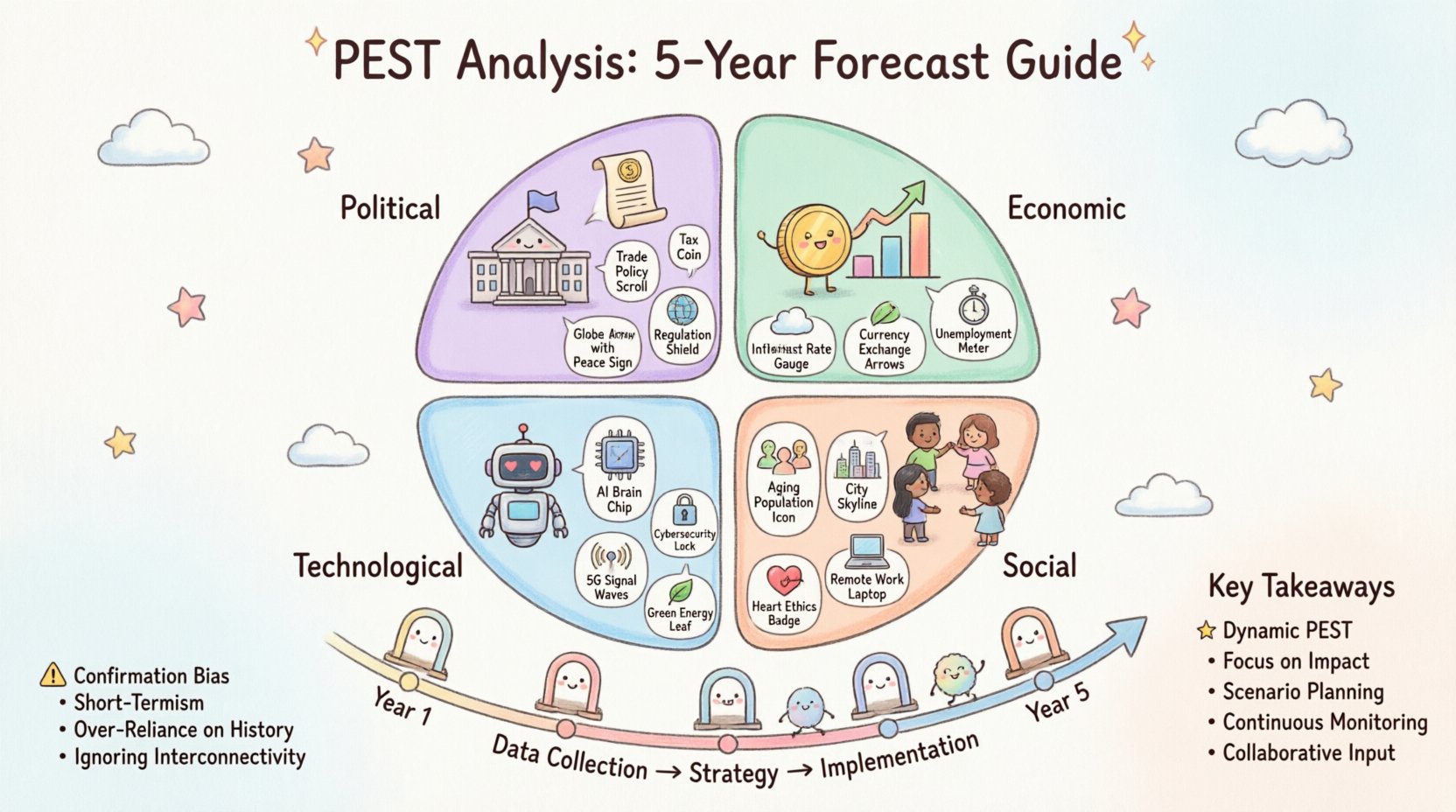
The PEST acronym stands for Political, Economic, Social, and Technological. Each letter represents a category of external factors that influence an organization. These factors are generally outside the control of the business but must be accounted for in strategic planning.
- Political: Government policies, trade restrictions, tax laws, and political stability.
- Economic: Inflation rates, interest rates, economic growth, and exchange rates.
- Social: Demographics, cultural trends, lifestyle changes, and population health.
- Technological: Innovation rates, automation, research and development activity, and technology incentives.
For a five-year forecast, static analysis is insufficient. The framework must be dynamic. It requires a continuous review cycle. Trends do not appear overnight. They build momentum over time. By examining the trajectory of each factor, organizations can identify inflection points.
Political Factors: Navigating Policy Shifts 🏛️
Political stability and government intervention play a critical role in shaping the business landscape over a five-year period. Changes in administration or regulatory bodies can alter the cost of doing business significantly.
Key Political Variables to Monitor
- Trade Policies: Tariffs, trade agreements, and sanctions affect supply chains. A shift toward protectionism can increase costs, while free trade agreements can open new markets.
- Taxation: Corporate tax rates and incentives for specific industries (like green energy) dictate profitability and investment decisions.
- Regulatory Compliance: Data privacy laws, environmental regulations, and labor standards evolve. Non-compliance risks fines and reputational damage.
- Geopolitical Stability: Regional conflicts can disrupt markets. Stability is a prerequisite for long-term capital investment.
Forecasting political trends involves monitoring legislative agendas. It is not enough to look at current laws. One must analyze the political rhetoric of key stakeholders. If a government emphasizes national security, expect stricter controls on foreign investment. If they emphasize sustainability, expect carbon pricing mechanisms.
| Factor | Impact on Business | Forecasting Indicator |
|---|---|---|
| Trade Barriers | Supply chain costs, market access | Legislative proposals, diplomatic tensions |
| Tax Incentives | Investment ROI, location strategy | Budget speeches, policy white papers |
| Labor Laws | Hiring costs, operational flexibility | Union negotiations, court rulings |
Economic Indicators: Financial Forecasting 📊
Economic conditions determine the purchasing power of consumers and the cost of capital for businesses. Over a five-year span, cycles of growth and recession are common. Understanding where the economy sits within the cycle is vital.
Critical Economic Drivers
- Inflation Rates: High inflation erodes purchasing power and increases input costs. It forces pricing adjustments and can lead to wage spirals.
- Interest Rates: Set by central banks, these rates influence borrowing costs. High rates slow expansion; low rates encourage it.
- Exchange Rates: For businesses operating internationally, currency fluctuation affects revenue and margins. Hedging strategies become necessary.
- Unemployment Levels: Labor availability impacts hiring strategies and wage expectations. Low unemployment drives up labor costs.
Economic forecasting requires looking at leading indicators. Consumer confidence indices, manufacturing PMI, and GDP growth projections provide signals before the actual data is released. Organizations must build flexibility into their financial models. Scenario planning allows for adjustments if the economic outlook deteriorates.
Socio-Cultural Dynamics: Demographic Shifts 👥
Social factors reflect the human element of the market. Culture, demographics, and lifestyle choices drive demand for products and services. These shifts are often slow-moving but deeply impactful.
Major Social Trends to Track
- Demographic Aging: Many developed nations face an aging population. This creates demand for healthcare, retirement services, and age-friendly products.
- Urbanization: Migration to cities changes housing needs, transportation infrastructure, and retail locations.
- Values and Ethics: Consumers increasingly prefer brands that align with their values. Sustainability, diversity, and ethical sourcing influence purchasing decisions.
- Work-Life Balance: The definition of work is changing. Remote work, flexible hours, and gig economy participation are reshaping labor markets.
Understanding social shifts requires qualitative research. Surveys, focus groups, and social listening tools help gauge public sentiment. Quantitative data from census bureaus provides the hard numbers on population density and age distribution.
Technological Disruption: Innovation Cycles 🤖
Technology is the most volatile component of the PEST framework. It changes rapidly and can render business models obsolete. A five-year forecast must account for the adoption curve of emerging technologies.
Technological Categories to Analyze
- Artificial Intelligence: Automation of decision-making and content creation. AI impacts productivity and workforce requirements.
- Data Security: As digital reliance grows, cybersecurity threats increase. Investment in security infrastructure is non-negotiable.
- Connectivity: 5G and future network standards enable new applications in IoT, autonomous vehicles, and smart cities.
- Green Technology: Renewable energy solutions and carbon capture technologies are becoming central to industrial operations.
Forecasting technology involves watching R&D spend and patent filings. It also means monitoring venture capital flows. Where is the money going? That indicates where the market is heading. Adopting technology early can provide a competitive advantage, but timing is critical to avoid investing in unproven standards.
Integrating PEST into Strategic Roadmaps 🗺️
Gathering data is only the first step. The value lies in integration. How does this information translate into action? Strategic planning teams must weave PEST findings into the core business strategy.
Steps for Effective Integration
- Identify Critical Success Factors: Determine which PEST factors have the highest impact on your specific industry. Not all factors are equal.
- Assess Risk and Opportunity: Categorize trends as threats or opportunities. A new regulation might be a threat to one business model and an opportunity to another.
- Develop Scenarios: Create best-case, worst-case, and most-likely scenarios based on the PEST analysis. This prepares the organization for various futures.
- Set Review Cycles: A five-year plan is not static. Review the PEST analysis annually or biannually. Update assumptions as new data emerges.
| Phase | Action | Output |
|---|---|---|
| Year 1 | Data Collection & Analysis | Baseline PEST Report |
| Year 2-3 | Strategy Formulation | Updated Strategic Plan |
| Year 4-5 | Implementation & Monitoring | Performance Metrics & Adjustments |
Common Pitfalls and How to Avoid Them ⚠️
Even with a robust framework, errors occur. Recognizing common mistakes helps ensure the accuracy of the forecast.
- Confirmation Bias: Looking only for data that supports pre-existing beliefs. Challenge assumptions actively.
- Short-Termism: Focusing on quarterly results instead of long-term trends. The five-year horizon requires patience.
- Over-Reliance on History: Past performance does not guarantee future results. External shocks can break historical patterns.
- Ignoring Interconnectivity: Factors do not exist in isolation. A political change can trigger an economic shift. A social trend can drive technological adoption.
Independence in analysis is crucial. Involve external consultants or diverse internal teams to challenge the narrative. This reduces the risk of blind spots.
Conclusion on Strategic Application 📝
Using PEST Analysis to forecast trends over the next five years is a disciplined process. It requires gathering data, analyzing relationships, and making tough decisions. The goal is not to predict the future with certainty, but to prepare for it with clarity.
Organizations that master this process gain a significant advantage. They adapt faster. They mitigate risks before they materialize. They position themselves to capitalize on emerging opportunities. The framework is a tool, but its power comes from the rigor of its application.
Start by mapping the current landscape. Identify the variables that matter most. Build scenarios. Test strategies against those scenarios. Then, execute with confidence. The future is uncertain, but the path to navigating it is clear.
Summary of Key Takeaways 📌
- PEST is Dynamic: Treat the analysis as a living document, not a one-time exercise.
- Focus on Impact: Prioritize factors that directly affect the bottom line.
- Scenario Planning: Prepare for multiple outcomes, not just one prediction.
- Continuous Monitoring: Stay alert to changes in the macro-environment.
- Collaborative Input: Gather insights from across the organization and external experts.
By adhering to these principles, businesses can construct a resilient strategy capable of withstanding the uncertainties of the coming half-decade.