Navigating the early stages of a business requires more than just a great product. It demands a clear understanding of the external environment in which your company operates. Market conditions shift, regulations change, and consumer behaviors evolve. To survive and thrive, founders must look beyond internal metrics and assess the broader landscape. This is where the PEST analysis framework becomes an essential tool for strategic planning.
PEST analysis stands for Political, Economic, Social, and Technological factors. It provides a structured way to evaluate these external forces. For a startup, ignoring these elements can lead to costly missteps. Conversely, leveraging this insight allows for proactive decision-making. This guide details how to conduct a comprehensive PEST analysis, interpret the findings, and apply them to your business strategy.
What Is PEST Analysis? 🧐
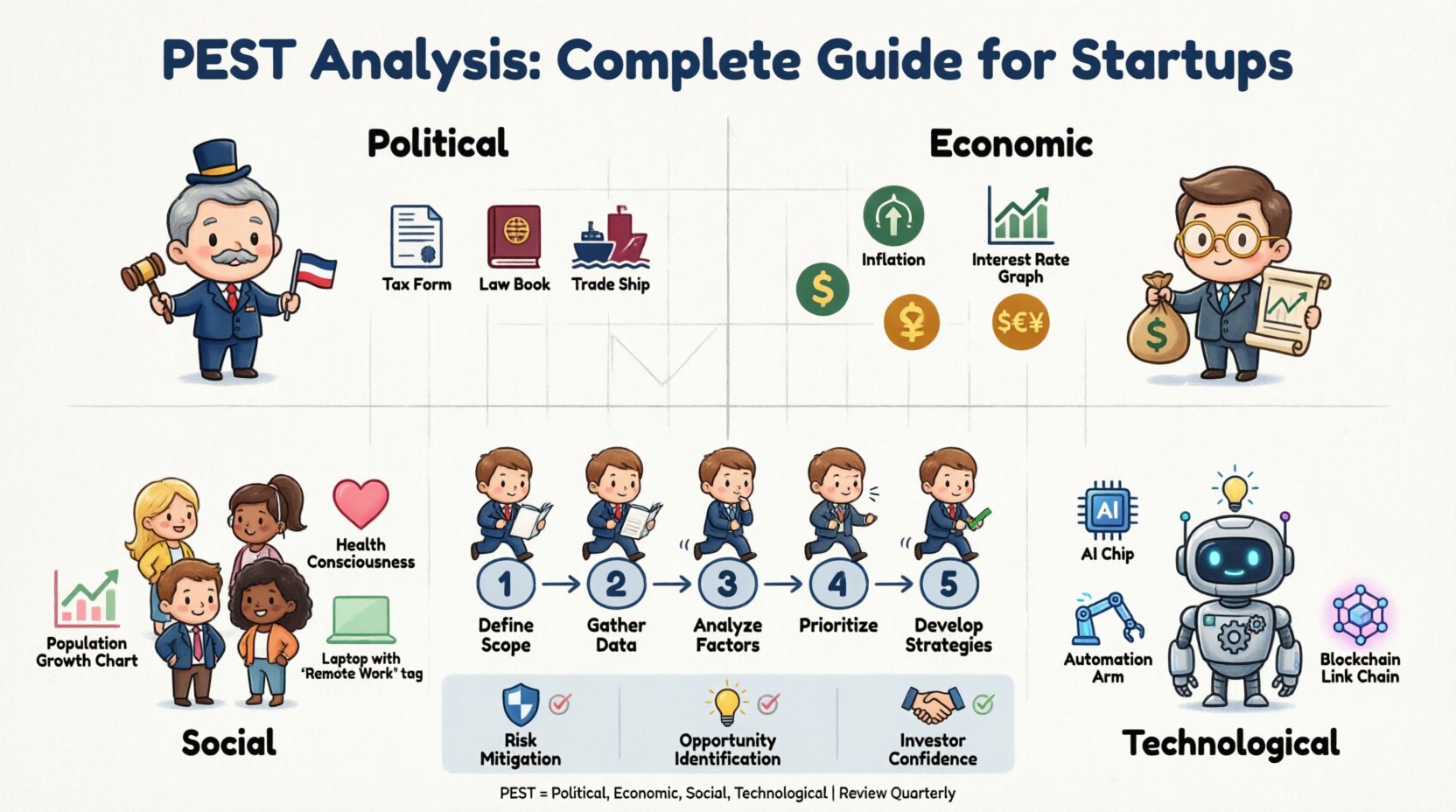
PEST analysis is a strategic framework used to identify and analyze the key external factors that impact an organization. The acronym stands for:
- Political: Government policies, regulations, and political stability.
- Economic: Economic growth, interest rates, exchange rates, and inflation.
- Social: Cultural aspects, population growth, age distribution, and health consciousness.
- Technological: Innovations, automation, research and development activity, and technological incentives.
While some variations exist, such as PESTLE which includes Legal and Environmental factors, the core PEST model remains the foundation for macro-environmental scanning. For a startup, this analysis is not about predicting the future with certainty. It is about identifying risks and opportunities before they materialize.
Why Startups Need This Framework 📈
Startups operate with limited resources. Every decision carries weight. Unlike established corporations, a startup cannot afford to pivot blindly based on internal assumptions. External factors often dictate the viability of a business model.
1. Risk Mitigation ⚠️
Regulatory changes can shut down a business overnight. Economic downturns can dry up funding. By mapping these factors, you can prepare contingency plans. This reduces the shock when market conditions change.
2. Opportunity Identification 💡
New technologies create markets. Demographic shifts create demand. Understanding these trends allows you to position your product ahead of the competition. You can align your value proposition with emerging societal needs.
3. Investor Confidence 🤝
Investors look for founders who understand the market landscape. Presenting a PEST analysis demonstrates due diligence. It shows that you have considered the macro-environment and are not just relying on a product idea.
Deep Dive: The Four Pillars 🔍
Each factor in the PEST framework requires specific attention. Here is a detailed breakdown of what to consider for each category.
Political Factors 🏛️
Government actions directly influence business operations. You must consider how laws and regulations affect your industry.
- Tax Policy: How does corporate tax affect your margins? Are there tax incentives for startups in your sector?
- Labour Laws: What are the regulations regarding hiring, firing, and employee benefits?
- Trade Restrictions: If you plan to import or export, are there tariffs or quotas?
- Political Stability: Is the region stable enough for long-term investment? Civil unrest can disrupt supply chains.
- Environmental Regulations: Even in the political category, environmental compliance often falls under government mandates.
Economic Factors 📉
Economic conditions determine whether customers have the money to spend. They also affect your cost of capital.
- Inflation Rates: High inflation increases the cost of raw materials and labor. It also reduces consumer purchasing power.
- Interest Rates: High interest rates make borrowing expensive. This impacts your ability to scale through debt financing.
- Exchange Rates: If you operate internationally, currency fluctuation can wipe out profits or increase costs.
- Economic Growth: Is the economy expanding or contracting? In a recession, consumers prioritize essentials over discretionary purchases.
- Disposable Income: What percentage of income is left after taxes and necessities? This dictates your target market’s spending power.
Social Factors 👥
Social forces shape customer demand. Understanding culture and demographics is crucial for product-market fit.
- Population Growth: A growing population increases the potential customer base. Aging populations may require different product features.
- Cultural Barriers: What are the taboos or preferences in your target market? Humor, colors, and messaging vary by region.
- Health Consciousness: Are consumers prioritizing wellness? This affects industries like food, fitness, and insurance.
- Career Attitudes: Do people prefer remote work or office environments? This impacts your operational model and hiring strategy.
- Lifestyle Changes: Are people delaying marriage or children? This shifts demand in various sectors.
Technological Factors 📱
Technology drives disruption. Ignoring it can render a business obsolete.
- R&D Activity: How much is the industry investing in innovation? Fast-moving sectors require constant adaptation.
- Automation: Can automation reduce your operational costs? It may also reduce the need for certain labor.
- Rate of Change: How quickly does technology evolve? In tech-heavy sectors, a product can become outdated in months.
- Infrastructure: Is there reliable internet access or logistics infrastructure to support your service?
- Barriers to Entry: Does technology lower the barrier to entry for competitors? Or does it create a moat for you?
Conducting a PEST Analysis: A Step-by-Step Guide 🛠️
Executing this analysis requires a systematic approach. You do not need expensive software to do this. A shared document or spreadsheet is sufficient. Follow these steps to ensure accuracy.
Step 1: Define the Scope 🎯
Start by clarifying the specific market you are analyzing. A global PEST analysis differs significantly from a local one. Define your geographic boundaries. Are you targeting a specific city, a country, or a continent? Narrowing the scope ensures the data is relevant.
Step 2: Gather Data 📊
Collect information from reliable sources. Government statistics, industry reports, and news articles are primary sources. Look for trends over the last three to five years to identify patterns. Avoid anecdotal evidence. Use data to support your assertions.
Step 3: Analyze Each Factor 🔎
Brainstorm the factors for each of the four categories. Ask critical questions. For example, under Economic, ask: “How will inflation impact our pricing strategy?” Be honest about the impact. Some factors will be minor, while others could be existential.
Step 4: Prioritize Findings 📝
Not all factors are equal. Some will have a high impact and high probability. Others will be low impact. Focus your resources on the high-priority items. Create a matrix to rank factors by their potential effect on your business.
Step 5: Develop Strategies 💼
Translate insights into action. If a political factor suggests stricter regulations, how will you comply? If a social trend indicates a shift in lifestyle, how will you adapt your marketing? This step turns analysis into strategy.
Comparison of PEST Factors
To help structure your thinking, refer to this table summarizing the key focus areas.
| Factor | Key Question | Example Data Source |
|---|---|---|
| Political | How do laws affect compliance? | Government websites, legal journals |
| Economic | Can customers afford this? | Central bank reports, economic indices |
| Social | What do people value? | Surveys, demographic census data |
| Technological | What tools are available? | Tech news, industry whitepapers |
Integrating Findings Into Strategy 🔄
Conducting the analysis is only half the work. The real value lies in integration. How do you move from a list of factors to a business plan?
- Adjust Pricing Models: If inflation is rising, consider dynamic pricing or subscription models that protect margins.
- Modify Product Features: If social trends show a demand for privacy, build security features into your core product.
- Optimize Supply Chain: If political instability is a risk, diversify your suppliers across different regions.
- Refine Marketing: Align your messaging with current cultural sentiments. Avoid campaigns that clash with social values.
- Plan for Technology: Invest in platforms that allow for scalability. Ensure your tech stack is not a bottleneck.
Common Mistakes to Avoid ⚠️
Founders often make errors when performing this analysis. Being aware of these pitfalls will save time and prevent strategic blunders.
- Ignoring Recent Data: Relying on data from five years ago is dangerous. The world changes fast. Ensure your information is current.
- Being Too Vague: “The economy is bad” is not useful. “Inflation is expected to rise by 3% next quarter” is actionable.
- Confusing Internal and External: PEST is for external factors. Do not include internal strengths or weaknesses here. Those belong in a SWOT analysis.
- Overlooking Interconnections: Factors are linked. A technological shift can change social behaviors. A political decision can impact the economy. Look for these correlations.
- Analysis Paralysis: Do not get stuck in research. Make a decision based on the best available information and iterate.
Practical Example: A Fintech Startup 💳
Consider a fictional startup building a peer-to-peer payment app. How would they apply this framework?
Political
The government is introducing stricter KYC (Know Your Customer) laws. This increases compliance costs. The startup must budget for legal teams and automated verification systems.
Economic
Interest rates are low, encouraging borrowing. However, inflation is high, reducing disposable income. The startup should focus on fee transparency to attract cost-conscious users.
Social
Younger generations prefer digital wallets over physical cards. There is a growing trust in decentralized finance. The marketing should highlight security and ease of use.
Technological
Biometric authentication is becoming standard. The app must integrate fingerprint and facial recognition to stay competitive. Blockchain technology is emerging as a settlement layer.
Updating Your Analysis 🔄
A PEST analysis is not a one-time task. It is a living document. Market conditions shift quarterly or even monthly. Schedule regular reviews of your analysis.
- Quarterly Reviews: Check for major shifts in economic indicators or political landscapes.
- Trigger Events: If a new regulation is passed, update the analysis immediately.
- Team Input: Different departments see different signals. Sales teams hear customer complaints. Engineering hears about tech shifts. Gather input from the whole team.
Frequently Asked Questions ❓
Here are answers to common questions regarding this strategic tool.
Is PEST Analysis suitable for all industries?
Yes, but the weight of each factor varies. A manufacturing firm will focus heavily on Political and Economic factors. A creative agency might prioritize Social and Technological factors more.
How does PEST differ from SWOT?
SWOT includes Internal (Strengths, Weaknesses) and External (Opportunities, Threats). PEST focuses exclusively on the macro-environment. You can use PEST to inform the Opportunities and Threats sections of a SWOT analysis.
How much time does this take?
A basic analysis can take a few days. A comprehensive one involving deep research and interviews may take weeks. Balance depth with the need for speed.
Can this analysis predict the future?
No. It cannot predict the future with certainty. It helps you prepare for potential futures. It reduces uncertainty, not eliminates it.
Final Thoughts on Strategic Planning 🧭
Successful startups are built on more than just a great idea. They are built on a deep understanding of the world they operate in. The PEST analysis provides the lens to see that world clearly.
By systematically evaluating Political, Economic, Social, and Technological factors, founders can navigate uncertainty with confidence. This process does not guarantee success, but it significantly reduces the risk of failure due to external shocks.
Commit to regular reviews. Keep your data fresh. Involve your team. Use these insights to shape your product, your pricing, and your growth strategy. In a volatile market, preparation is the only true advantage.
Start your analysis today. Map your environment. Build your strategy on facts, not assumptions.