


In the modern business landscape, sustainable growth rarely happens by accident. It requires a deliberate, data-driven approach to understanding the environment in which an organization operates. One of the most robust frameworks for this external analysis is the PEST analysis. This tool allows leaders to examine the macro-environmental factors that influence their industry. By systematically evaluating Political, Economic, Social, and Technological forces, businesses can identify hidden opportunities before competitors do.
This guide explores how to utilize PEST analysis not just as a compliance exercise, but as a strategic engine for discovery. We will break down each component, discuss how to synthesize the data, and provide a roadmap for turning insights into actionable growth strategies. 📈
Understanding the PEST Framework 🔍
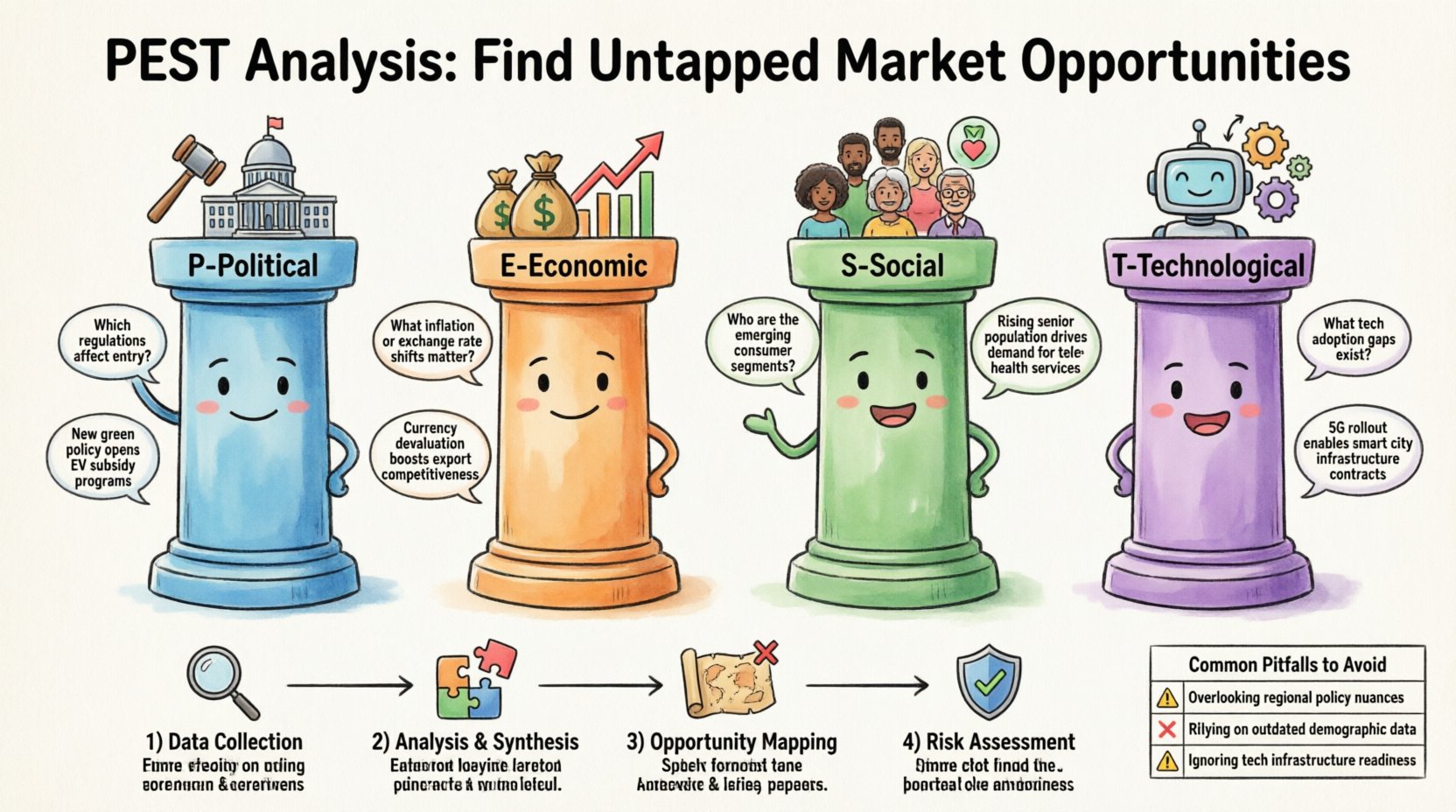
PEST analysis is a strategic tool used to evaluate the external factors that affect an organization. Unlike internal audits that focus on resources and capabilities, this framework looks outward. It helps organizations understand the “why” behind market shifts. When applied correctly, it reveals patterns that are often invisible in day-to-day operations.
The acronym stands for:
- Political
- Economic
- Social
- Technological
Each letter represents a category of influence. When these categories are analyzed together, they provide a holistic view of the market landscape. This comprehensive view is essential for long-term planning and risk management.
Deep Dive: The Four Pillars of Analysis 🏛️
To find untapped opportunities, one must understand the nuances of each pillar. A superficial glance at these factors will not yield results. Deep interrogation is required.
1. Political Factors: The Rules of the Game ⚖️
Political factors refer to government intervention in the economy. This includes tax policy, labor law, environmental law, trade restrictions, tariffs, and political stability. These elements dictate the boundaries within which a business must operate.
When analyzing political factors, consider the following questions:
- Is there a shift in government leadership that might alter trade policies?
- Are there new regulations regarding data privacy that impact operations?
- How does the current administration view foreign investment?
- Are there subsidies available for specific industries or technologies?
Opportunity Identification:
Consider a scenario where a new government introduces tax incentives for green energy. A company that ignores this trend misses a chance to pivot. However, a company that recognizes this shift can reposition its product line to align with these incentives. This alignment often results in lower operational costs and increased market appeal. Political instability, on the other hand, might signal a need to diversify supply chains into more stable regions.
2. Economic Factors: The Engine of Demand 🏦
Economic factors affect the purchasing power of potential customers and the cost of capital. This includes inflation rates, exchange rates, interest rates, GDP growth, and unemployment rates. These metrics determine whether consumers have the money to buy and whether investors have the confidence to fund expansion.
Key areas of investigation include:
- Disposable Income: Is the average consumer wealth increasing or decreasing?
- Interest Rates: How does the cost of borrowing affect expansion plans?
- Inflation: Are input costs rising faster than the ability to pass those costs to customers?
- Currency Fluctuation: How does exchange rate volatility impact import/export margins?
Opportunity Identification:
During periods of economic downturn, consumers often seek value. A brand that positions itself as offering high quality at a reasonable price can capture market share from luxury competitors. Conversely, in a booming economy, premium pricing strategies may become viable. Economic trends also dictate where capital flows. If interest rates are low, investing in research and development becomes more attractive. If rates are high, focusing on cash flow and efficiency becomes the priority.
3. Social Factors: The Human Element 👥
Social factors examine the cultural and demographic aspects of the target market. This includes population growth, age distribution, career attitudes, health consciousness, and cultural barriers. Understanding the “who” and “why” of consumer behavior is critical for product-market fit.
Questions to ask during this phase:
- Is the population aging or getting younger?
- Are there shifting attitudes toward work-life balance?
- What are the current health and wellness trends?
- How do cultural norms affect product usage or acceptance?
Opportunity Identification:
Demographic shifts are powerful indicators. For instance, an aging population creates demand for healthcare services, retirement planning, and accessible housing. If a company can adapt its offerings to serve this demographic earlier than competitors, it secures a loyal customer base. Similarly, the rise of remote work has changed social expectations regarding office culture. Companies that offer flexible work arrangements are now more attractive to top talent, which indirectly boosts growth through better human capital.
4. Technological Factors: The Disruption Driver 💻
Technological factors involve innovation, automation, and the rate of technological change. This includes R&D activity, technology incentives, and the rate of obsolescence. In the modern era, this is often the most volatile and impactful category.
Areas to scrutinize:
- What emerging technologies could disrupt the current supply chain?
- Are there new platforms changing how customers discover products?
- How is automation affecting production costs?
- What are the cybersecurity risks associated with digital transformation?
Opportunity Identification:
Technology does not just improve efficiency; it creates entirely new markets. The rise of mobile internet created the app economy. Companies that failed to adapt to mobile interfaces lost significant revenue. By monitoring technological trends, businesses can adopt new tools to reduce costs or enhance the customer experience. For example, adopting AI for customer service can reduce wait times and increase satisfaction, opening the door for higher retention rates.
Integrating PEST into Strategic Planning 🗺️
Gathering data is only the first step. The real value lies in integration. How does this information translate into a growth strategy? The process requires synthesis and prioritization.
Step 1: Data Collection
Gather relevant reports, government statistics, industry news, and market research. Ensure sources are credible and up-to-date. Avoid relying on anecdotal evidence.
Step 2: Analysis and Synthesis
Look for connections between the factors. A political change might drive an economic shift. A social trend might accelerate technological adoption. For example, a new environmental law (Political) might force a shift to electric vehicles (Technological), which aligns with health consciousness trends (Social).
Step 3: Opportunity Mapping
Identify gaps in the market based on the findings. If a competitor is ignoring a specific regulatory change, that change might represent a barrier to entry that you can leverage. If a social trend is underserved, that is a direct opportunity for product development.
Step 4: Risk Assessment
Every opportunity carries risk. Evaluate the potential downsides of acting on these insights. Is the market too small? Is the technology too immature? Ensure the risk profile aligns with the organization’s capacity.
Practical Application: The PEST Checklist 📝
To assist in the analysis process, use the following checklist. This table structures the information to ensure no critical area is overlooked.
| Factor | Key Questions | Potential Opportunity |
|---|---|---|
| Political | Are trade tariffs changing? Is labor law tightening? | Entering a region with favorable tax incentives. |
| Economic | Is inflation affecting raw material costs? Are interest rates rising? | Locking in long-term supplier contracts at current rates. |
| Social | Is the population aging? Are wellness trends growing? | Developing products tailored to health-conscious demographics. |
| Technological | Is automation becoming cheaper? Are new platforms emerging? | Adopting new software to reduce operational overhead. |
This table serves as a starting point. Fill in specific details relevant to your industry. The more granular the data, the more accurate the strategic output.
Navigating Common Analytical Pitfalls ⚠️
Even with a solid framework, errors can occur. Being aware of common mistakes helps maintain the integrity of the analysis.
- Analysis Paralysis: Collecting too much data without a clear objective can stall decision-making. Focus on factors that directly impact the business strategy.
- Static Thinking: The macro-environment changes constantly. A PEST analysis is not a one-time event. It should be reviewed regularly to remain relevant.
- Ignoring Interconnections: Treating the four factors as silos is a mistake. Political decisions often drive economic outcomes. Social shifts often require technological solutions. Look for the web of influence.
- Internal Bias: It is easy to interpret data in a way that supports preconceived notions. Ensure the analysis remains objective and evidence-based.
- Overlooking Micro-Trends: While PEST focuses on macro factors, micro-trends within those categories can be the source of the best opportunities. Look for niche movements within the broader data.
Case Scenario: Applying the Framework 🏢
To illustrate the practical application, consider a hypothetical retail company looking to expand into a new international market. They conduct a PEST analysis.
Political: The target country has stable governance but high import tariffs on electronics. Strategy: Partner with a local manufacturer to avoid tariffs.
Economic: The currency is volatile, but disposable income is rising. Strategy: Price products in local currency to absorb volatility, focusing on volume sales.
Social: Consumers in this region value sustainability heavily. Strategy: Market the product as eco-friendly and use sustainable packaging.
Technological: Mobile payment adoption is at 90%. Strategy: Integrate mobile wallets into the checkout process immediately.
By synthesizing these points, the company avoids a direct import model that would fail due to tariffs. Instead, they leverage local production, align with social values, and adapt to technological habits. This results in a market entry strategy that is resilient and tailored.
Building a Culture of Strategic Awareness 🧠
For PEST analysis to be effective, it must be part of the organizational culture. It should not be a task delegated solely to the strategy department. Front-line employees often see market shifts before executives do.
Encourage Open Dialogue:
Create channels for employees to share observations about the market. A salesperson might notice a change in customer complaints related to a new regulation. An engineer might spot a technological trend in competitor products.
Regular Reviews:
Schedule quarterly reviews of the macro-environment. This keeps the strategy agile. If a significant shift occurs, the organization should be able to pivot quickly.
Training:
Ensure key personnel understand how to interpret external data. Training on how to distinguish between noise and signal is vital for accurate analysis.
Next Steps for Implementation 🛠️
Once the analysis is complete, the focus shifts to execution. Here is a roadmap to move from insight to action.
- Validate Findings: Cross-reference the PEST data with internal performance metrics. Does the external data explain internal trends?
- Prioritize: Rank the opportunities based on impact and feasibility. Not all opportunities are worth pursuing.
- Develop KPIs: Set specific metrics to track the success of the new strategy. Define what success looks like.
- Allocate Resources: Assign budget and personnel to the prioritized initiatives.
- Monitor and Adapt: Continuously track the external environment. Adjust the strategy as new data emerges.
Conclusion 🎯
Growth in a complex environment requires clarity. The PEST analysis provides that clarity by structuring the external landscape into manageable components. It moves decision-making from intuition to evidence.
By carefully examining Political, Economic, Social, and Technological factors, organizations can uncover opportunities that others miss. This approach minimizes risk and maximizes potential. It is not about predicting the future with certainty, but about preparing for multiple possibilities.
Start the analysis today. Gather the data. Identify the patterns. And build a strategy that stands the test of time. The market is waiting for those who are prepared to listen to its signals. 🌍
Related posts:
 Definitive Overview: The Complete Guide to PEST Analysis for Startup Founders
 Component Breakdown: PEST Analysis Explained: A Beginner’s Guide to the 4 Key Forces
 Quick Start: How to Run a PEST Analysis in Under 2 Hours for Your New Business
 Comprehensive Walkthrough: Step-by-Step PEST Analysis for Small Business Owners