Strategic planning for a startup often feels like navigating a dense fog without a compass. Founders frequently face the challenge of making high-stakes decisions with incomplete information. To cut through the noise, established businesses and new ventures alike rely on structured analytical frameworks. These tools do not provide magic answers, but they organize data into actionable insights.
Among the most common methodologies are PEST, PESTLE, and SWOT. While they share similarities in their goal to assess business viability, they differ significantly in scope, focus, and application. Choosing the wrong framework can lead to blind spots in your strategy. This guide provides a deep dive into each model, offering a clear comparison to help you select the right approach for your specific stage and industry.
🌍 Understanding the Macro Environment: PEST Analysis
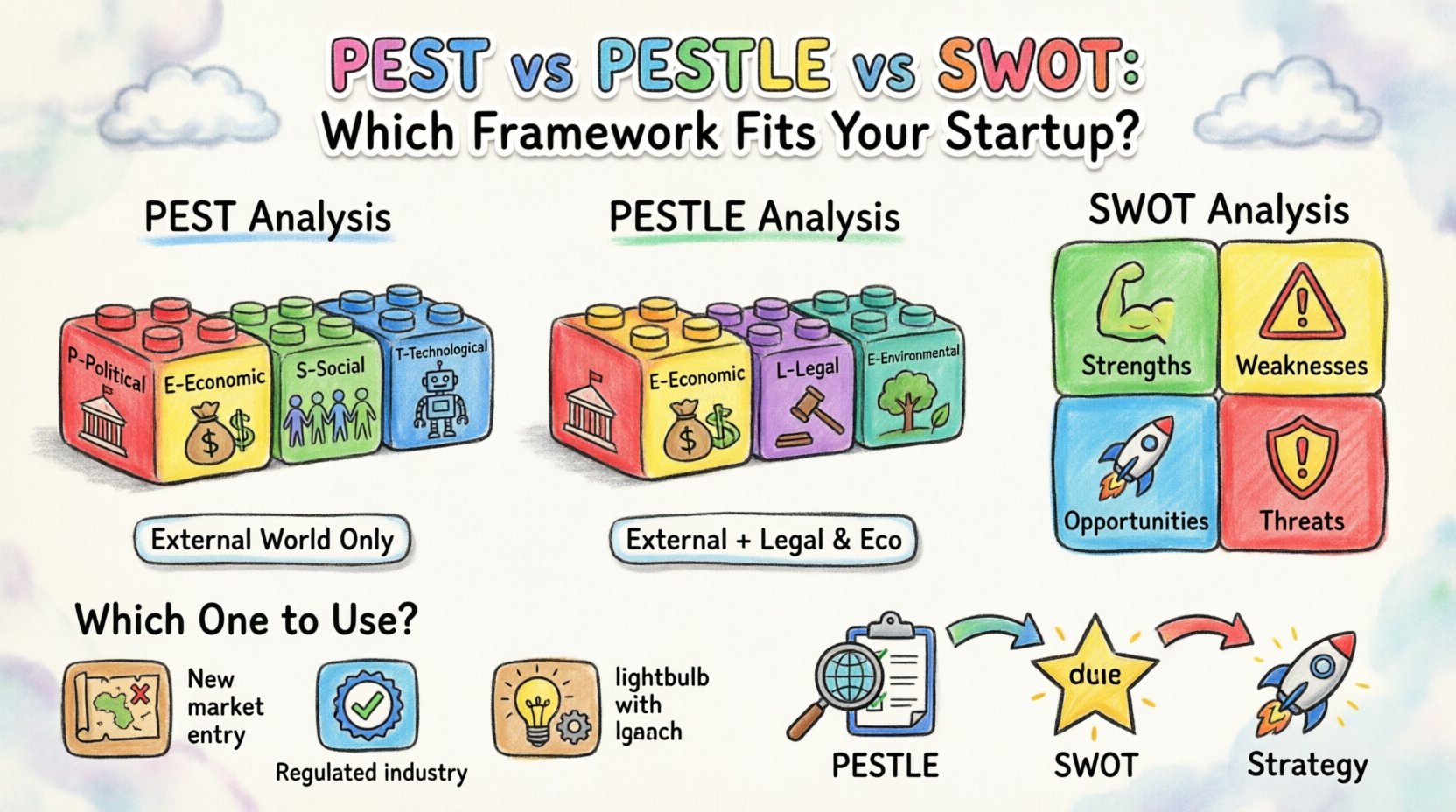
The PEST analysis is a foundational tool for scanning the macro-environment. It focuses on external factors that a company cannot control but must adapt to. For a startup, understanding these forces is critical before launching a product or entering a new market. The acronym stands for four key areas:
- Political: Government influence on the economy and business operations.
- Economic: Factors affecting purchasing power and spending patterns.
- Social: Demographic trends, cultural aspects, and lifestyle changes.
- Technological: Innovations, automation, and research and development activity.
1. Political Factors 🏛️
Political stability and government policy directly impact operational costs and market access. When conducting this analysis, consider the following:
- Tax Policy: How do corporate tax rates change? Are there incentives for specific industries?
- Trade Restrictions: Are there tariffs or quotas that affect your supply chain?
- Labour Laws: What are the regulations regarding minimum wage, benefits, and hiring practices?
- Environmental Regulations: How strict are the laws regarding waste disposal or emissions?
- Political Stability: Is the region stable, or is there a risk of civil unrest affecting operations?
2. Economic Factors 📈
Economic conditions dictate the demand for your product. A startup in a booming economy faces different challenges than one in a recession.
- Economic Growth: Is the GDP growing? Higher growth usually means more consumer spending.
- Interest Rates: High rates increase the cost of borrowing capital for expansion.
- Exchange Rates: If you import materials or export services, currency fluctuations affect margins.
- Inflation: Rising prices can increase your operational costs and reduce customer purchasing power.
- Disposable Income: How much money do potential customers have left after essential expenses?
3. Social Factors 📢
These factors help you understand the demand for your product. They are often the hardest to quantify but are crucial for product-market fit.
- Population Growth: Is the market expanding or shrinking?
- Age Distribution: Is the population aging, or is there a large youth demographic?
- Health Consciousness: Are consumers prioritizing wellness and sustainability?
- Cultural Barriers: Are there language or cultural norms that affect how you market your product?
- Lifestyle Changes: Is there a shift towards remote work, digital consumption, or urbanization?
4. Technological Factors 💻
Technology is often the biggest driver of disruption. Ignoring this section can render a business model obsolete.
- R&D Activity: What new technologies are emerging in your sector?
- Automation: Can technology reduce your labor costs or improve efficiency?
- Infrastructure: Is the internet and digital infrastructure robust enough to support your solution?
- Disruptive Innovations: Are there new ways to deliver the same value that could make your current approach redundant?
- Patent Protection: How easy is it to protect your intellectual property in this environment?
🌱 Expanding the Scope: PESTLE Analysis
As businesses grow more complex, the basic PEST model sometimes lacks sufficient depth. The PESTLE analysis expands the framework by adding two critical dimensions: Legal and Environmental. This is particularly relevant for startups in regulated industries or those with a sustainability mission.
5. Legal Factors ⚖️
While political factors touch on government policy, legal factors focus on the specific laws currently in force. This distinction is vital for compliance.
- Employment Law: Regulations regarding discrimination, harassment, and termination.
- Consumer Protection: Laws regarding warranties, refunds, and data privacy.
- Health and Safety: Standards required to ensure products are safe for users.
- Competition Law: Regulations regarding monopolies and anti-trust activities.
- Intellectual Property: Copyright, trademark, and patent laws specific to your region.
6. Environmental Factors 🌿
In the modern landscape, environmental sustainability is no longer optional. Investors and customers increasingly demand transparency regarding ecological impact.
- Climate Change: How might extreme weather events affect your supply chain?
- Carbon Footprint: What are the emissions associated with your production and logistics?
- Waste Management: How do you handle disposal, and what are the recycling laws?
- Resource Availability: Is there a scarcity of raw materials needed for your product?
- Green Initiatives: Are there government subsidies for eco-friendly practices?
🎯 Internal and External Alignment: SWOT Analysis
Unlike PEST and PESTLE, which focus almost exclusively on the external environment, SWOT analysis brings internal factors into the conversation. It is a versatile tool used to evaluate your startup’s current position relative to the market.
1. Strengths (Internal) 💪
These are the positive attributes within your organization that you can control. They are your competitive advantages.
- Proprietary Technology: Do you have a patent or unique code base?
- Brand Reputation: Is your team or founder well-regarded in the industry?
- Financial Resources: Do you have sufficient cash reserves to sustain operations?
- Talent Pool: Does your team have specialized skills that competitors lack?
- Location: Are you situated in a hub that offers networking or logistical benefits?
2. Weaknesses (Internal) ⚠️
Weaknesses are internal limitations that hinder your performance. Acknowledging these is necessary for honest planning.
- Limited Budget: Can you afford to market as aggressively as larger competitors?
- Brand Awareness: Is your name unknown in the target market?
- Infrastructure Gaps: Do you lack the software or hardware needed for scale?
- Experience: Does the founding team lack industry-specific experience?
- Customer Base: Is your current user base too small to provide meaningful feedback?
3. Opportunities (External) 🚀
Opportunities are external chances to improve your business performance. These are often identified through PEST or PESTLE analysis.
- Market Gaps: Is there a segment of customers that competitors are ignoring?
- Regulatory Changes: Are new laws opening up a new market segment?
- Technological Shifts: Can a new tech allow you to lower costs or improve features?
- Partnerships: Are there potential alliances that could expand your reach?
- Global Expansion: Are there foreign markets that are less saturated?
4. Threats (External) 🛡️
Threats are external challenges that could cause trouble for your business. These are the risks you must mitigate.
- Competitor Activity: Are established players lowering prices or launching similar products?
- Changing Consumer Tastes: Is demand for your product category declining?
- Economic Downturns: Could a recession reduce spending on your solution?
- Supply Chain Disruption: Are your suppliers vulnerable to external shocks?
- Technological Obsolescence: Could a better technology make your solution irrelevant?
⚖️ Key Differences: A Side-by-Side Comparison
Understanding the nuances between these frameworks helps prevent misapplication. The table below outlines the structural differences.
| Feature | PEST Analysis | PESTLE Analysis | SWOT Analysis |
|---|---|---|---|
| Primary Focus | External Macro Factors | External Macro Factors (Expanded) | Internal + External Factors |
| Scope | 4 Elements (Political, Economic, Social, Tech) | 6 Elements (PEST + Legal, Environmental) | 4 Elements (Strengths, Weaknesses, Opportunities, Threats) |
| Control | No Control (External) | No Control (External) | Partial Control (Internal) + External |
| Best Used For | Initial Market Entry | Regulated Industries / Sustainability | Strategic Planning / Product Launch |
| Data Type | Macro Trends | Macro Trends + Compliance | Qualitative + Quantitative |
🧭 When to Use Which Framework?
Selecting the right tool depends on your startup’s maturity, industry, and current challenges. Below are scenarios where each framework shines.
Use PEST When:
- Entering a New Market: You need a quick overview of the external landscape before investing capital.
- High-Level Strategy: You are setting a vision for the next 3 to 5 years.
- Simple Industries: Your business is not heavily regulated or dependent on environmental factors.
- Speed is Priority: You need a streamlined analysis without getting bogged down in details.
Use PESTLE When:
- Heavily Regulated Sectors: Healthcare, finance, or energy sectors require strict legal and compliance checks.
- Global Expansion: Operating in multiple countries requires understanding diverse legal and environmental landscapes.
- Sustainability Focus: Your brand identity is tied to environmental responsibility.
- Long-Term Risk Management: You need to anticipate regulatory shifts or climate risks.
Use SWOT When:
- Product Development: You need to align internal capabilities with market needs.
- Crisis Management: You are facing immediate threats and need to assess your internal resilience.
- Competitive Positioning: You need to understand why you win or lose against specific rivals.
- Team Alignment: You want to get the whole team on the same page regarding the business health.
🛠️ How to Conduct the Analysis: Step-by-Step
Regardless of the framework, the process of gathering and interpreting data remains similar. Follow these steps to ensure rigor and accuracy.
Step 1: Define the Objective 🎯
Start by clarifying the purpose of the analysis. Are you evaluating a new product line? Assessing a merger? Expanding internationally? A clear objective keeps the scope manageable.
Step 2: Gather Data 📊
Collect information from reliable sources. This may include industry reports, government publications, competitor websites, and customer feedback. Ensure the data is current; outdated information leads to flawed strategies.
Step 3: Brainstorm and Categorize 🧠
Hold a session with key stakeholders. List every relevant factor you can identify. Then, sort them into the appropriate categories of your chosen framework. For example, place tax changes under Political and interest rates under Economic in a PEST analysis.
Step 4: Prioritize Findings 🔍
You cannot act on every finding. Identify the top three to five factors that will have the most significant impact on your business. Rank them by urgency and potential impact.
Step 5: Develop Strategies 📝
Translate the insights into action. If a PESTLE analysis reveals a new environmental regulation, your strategy might involve investing in greener technology. If SWOT identifies a weakness in marketing, the strategy is to hire a specialist or partner with an agency.
Step 6: Monitor and Review 🔄
Business environments are dynamic. Schedule regular reviews of your analysis. Update the data quarterly or annually to ensure your strategy remains relevant.
⚠️ Common Pitfalls to Avoid
Even with a solid framework, execution errors can undermine the value of the exercise. Be mindful of these common mistakes.
- Generalizations: Avoid vague statements like “Economy is good.” Be specific, such as “Inflation is rising by 3%, increasing raw material costs.”
- Confirmation Bias: Do not seek only data that supports your pre-existing beliefs. Look for evidence that contradicts your assumptions.
- Ignoring Internal Factors: Using only PEST or PESTLE ignores your company’s capabilities. Combine these with internal assessments like SWOT.
- Static Analysis: Treating the analysis as a one-time document. It should be a living part of your strategic process.
- Lack of Stakeholder Input: Conducting the analysis in isolation. Input from sales, operations, and product teams provides a fuller picture.
🔗 Integrating Frameworks for Maximum Clarity
The most robust strategic plans often combine these tools. Using them in isolation can leave gaps in your understanding. Here is a suggested workflow for integration.
Phase 1: External Scanning (PESTLE)
Begin with PESTLE to map the external landscape. This ensures you are aware of all macro risks and opportunities, including legal and environmental constraints.
Phase 2: Internal Audit (SWOT)
Next, conduct a SWOT analysis. Use the Opportunities and Threats identified in the PESTLE analysis as inputs. Then, assess your internal Strengths and Weaknesses.
Phase 3: Strategic Alignment
Cross-reference the data. Does your Strength match a Market Opportunity? Does your Weakness expose you to a Threat? This cross-mapping helps identify actionable strategies.
Example Scenario:
A fintech startup uses PESTLE to discover new data privacy laws (Legal). They then use SWOT to see if their current security infrastructure is a Strength or a Weakness. If it is a Weakness, they prioritize investment in security before launch.
📉 Impact of Industry on Framework Choice
Different sectors require different levels of scrutiny. Tailoring your choice to your industry improves relevance.
- Technology Startups: Technological factors are paramount. However, the rapid pace of change means SWOT is often more useful for short-term pivots.
- Manufacturing: Environmental and Legal factors are critical due to supply chains and physical production. PESTLE is the standard choice here.
- Service Industry: Social factors and consumer trends are key. PEST or SWOT works well to gauge customer sentiment.
- Healthcare: Legal and Political factors dominate due to strict regulation. PESTLE is almost mandatory.
📈 Metrics for Success
How do you know if your analysis was useful? Look for tangible outcomes.
- Reduced Risk: Fewer unexpected regulatory hurdles or market failures.
- Clearer Roadmap: The team has a documented understanding of priorities.
- Better Resource Allocation: Capital is directed toward high-impact opportunities identified in the analysis.
- Improved Agility: The ability to react quickly when external factors change.
🌟 Final Thoughts on Strategic Rigor
Building a startup requires more than just a great idea. It demands a disciplined approach to understanding the environment in which you operate. PEST, PESTLE, and SWOT are not magic bullets, but they are essential maps for navigating uncertainty.
By selecting the right framework and applying it with rigor, you move from guessing to planning. This shift in mindset is what separates sustainable ventures from fleeting experiments. Use these tools to illuminate your path, identify risks before they materialize, and leverage opportunities before your competitors do.