Enterprise architecture is a complex discipline that demands precision, clarity, and adaptability. As organizations grow, their systems, processes, and strategies become increasingly intricate. A single monolithic model often fails to communicate effectively with diverse stakeholders. This is where ArchiMate viewpoints become essential. They act as lenses, allowing different audiences to see only what is relevant to their specific concerns.
This guide explores a practical application of ArchiMate viewpoints within a scaling enterprise context. We will move beyond theory to examine how structured modeling supports growth without losing coherence. By understanding the mechanics of viewpoint design, architects can ensure their models remain useful assets rather than becoming obsolete repositories.
🔍 Understanding ArchiMate Viewpoints
Before diving into the case study, it is necessary to clarify the core concepts. An Archimate model represents the enterprise at a specific point in time. However, a full model contains too much information for any single person to process. A viewpoint defines the rules for constructing a view. It specifies which elements and relationships are relevant for a particular set of stakeholders.
- View: The actual representation (e.g., a diagram) for a specific stakeholder.
- Viewpoint: The template or definition that dictates what goes into the view.
- Stakeholder: The individual or group consuming the information (e.g., CTO, Business Analyst, Compliance Officer).
Without distinct viewpoints, models tend to become cluttered. Everyone tries to see everything at once, resulting in confusion. By defining viewpoints early, architects can tailor the communication strategy to match the audience’s needs.
🚧 The Challenge of Scaling Enterprise Models
Scaling an enterprise model presents unique challenges. When an organization expands, the volume of data increases exponentially. The following issues often arise in large-scale environments:
- Fragmentation: Different departments create their own models without a shared standard.
- Version Drift: Stakeholders work from outdated diagrams because there is no clear governance.
- Loss of Context: Detailed technical diagrams are shown to business leaders, while high-level strategy is shown to engineers.
- Tool Dependency: Models become locked into specific tools, making collaboration difficult.
To address these issues, a structured approach to viewpoint definition is required. This ensures that as the model grows, the communication channels remain clear.
📋 Case Study Overview: Global Logistics Corporation
Consider a hypothetical organization, Global Logistics Corporation (GLC). GLC operates in the supply chain sector with operations across three continents. They recently underwent a merger, resulting in a complex landscape of legacy systems and new digital initiatives.
The Scenario:
- Business Layer: Multiple business units handling warehousing, transport, and customs.
- Application Layer: A mix of on-premise ERP systems and cloud-based tracking tools.
- Technology Layer: Hybrid infrastructure involving private clouds and physical data centers.
The architecture team needed to scale their modeling efforts to support a digital transformation program. They could not present the entire architecture to every stakeholder. Instead, they implemented a viewpoint strategy.
🛠️ Implementing Viewpoints for Scaling
The implementation of viewpoints followed a systematic process. This approach ensures consistency across the organization. The steps below outline the methodology used to scale the models effectively.
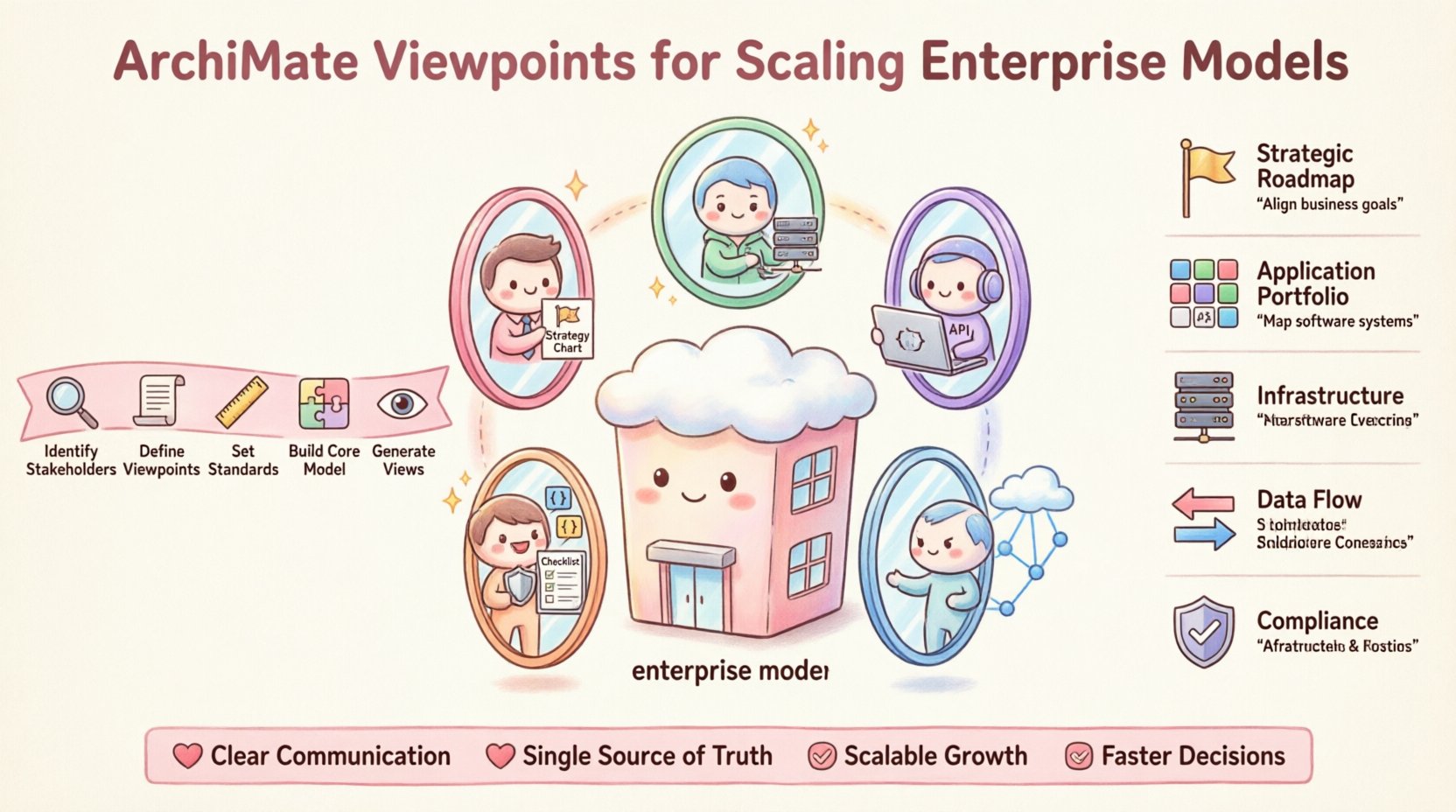
1. Identify Key Stakeholders
The first step involves mapping out who needs information. For GLC, the key groups were:
- Executive Leadership: Interested in strategic alignment and cost.
- IT Management: Focused on system integration and infrastructure.
- Development Teams: Need details on APIs and data flows.
- Compliance Officers: Require data lineage and security mapping.
2. Define Viewpoint Definitions
Once stakeholders were identified, specific viewpoints were defined. Each viewpoint restricted the elements shown to only those relevant to the group. This reduced cognitive load.
3. Establish Modeling Standards
Consistency is vital. The team established naming conventions, color coding rules, and layer separation guidelines. This ensures that a diagram created by one team looks consistent when viewed by another.
4. Build the Core Model
The underlying model was built using standard ArchiMate constructs. This included Business Functions, Applications, and Technology Nodes. Relationships were defined strictly to maintain data integrity.
5. Generate Views
Using the defined viewpoints, specific views were generated. These were not separate models but filtered representations of the core data. This allowed for a single source of truth.
📊 Viewpoint Comparison Matrix
Understanding the difference between viewpoints is crucial for scaling. The table below illustrates how different viewpoints filtered the same core data for different audiences.
| Viewpoint Name | Target Audience | Focus Area | Key Elements Included |
|---|---|---|---|
| Strategic Roadmap View | Executives | Business Capabilities & Goals | |
| Application Portfolio View | IT Managers | System Landscape | |
| Infrastructure Deployment View | Infrastructure Team | Hardware & Network | |
| Data Flow View | Developers | Data & Integration | |
| Compliance View | Auditors | Risk & Control |
🔧 Governance and Maintenance
Scaling is not just about building; it is about maintaining. A model that is not updated becomes a liability. Governance ensures the model remains accurate over time.
Regular Review Cycles
The architecture team scheduled regular reviews. These were not just technical audits but stakeholder validation sessions. Every quarter, the viewpoints were reviewed to ensure they still matched the current organizational structure.
- Quarterly Review: Check for outdated elements.
- Change Request: Any architectural change triggers a viewpoint update.
- Access Control: Only authorized architects could modify the core model.
Integration with Project Management
Architecture does not exist in a vacuum. The viewpoints were linked to project management workflows. When a new project was initiated, the relevant viewpoint was updated to reflect the new capabilities or applications. This ensured the model always reflected the current state.
⚠️ Common Pitfalls to Avoid
Even with a solid plan, errors can occur during the scaling process. The following pitfalls are common in enterprise architecture initiatives.
- Over-Engineering: Creating too many viewpoints makes the system confusing. Start with the essential ones.
- Ignoring Stakeholders: Building views without consulting the audience leads to low adoption.
- Tool-Centric Thinking: Focusing on the software features rather than the architectural intent.
- Lack of Training: Stakeholders need to understand how to read the diagrams. Provide training sessions.
📈 Measuring Success
How do we know if the scaling effort was successful? Metrics are needed to validate the investment. The following indicators were tracked by the architecture team.
- Adoption Rate: How many stakeholders actively use the viewpoints?
- Decision Speed: Did architectural decisions happen faster with clearer views?
- Relevance: Do stakeholders find the information useful for their daily tasks?
- Consistency: Is there less variation between different departmental models?
🛡️ Ensuring Long-Term Viability
For an enterprise model to remain viable, it must evolve. The organization must treat the architecture as a living asset. This involves continuous improvement of the viewpoints themselves.
- Feedback Loops: Collect feedback from users to improve the viewpoints.
- Versioning: Maintain history of changes to understand evolution.
- Documentation: Keep documentation alongside the model to explain the rationale.
💡 Key Takeaways
Scaling enterprise models requires discipline and a clear strategy. ArchiMate viewpoints provide the structure needed to manage complexity. By focusing on stakeholder needs and maintaining strict governance, organizations can ensure their architecture supports growth.
The case of Global Logistics Corporation demonstrates that a single model can serve multiple purposes if viewed through the right lenses. This approach reduces noise, improves communication, and aligns technical capabilities with business goals. Success lies not in the size of the model, but in the clarity of the views provided to the people who need them.
Architecture is a communication tool. When viewpoints are designed correctly, they bridge the gap between strategy and execution. This alignment is the foundation of a resilient enterprise capable of navigating change with confidence.