In the dynamic landscape of franchise business, success often hinges on the ability to anticipate change rather than merely react to it. External factors—ranging from government regulations to shifting consumer habits—can alter the profitability of a location overnight. This is where a structured strategic framework becomes indispensable. A PEST analysis provides a clear lens through which operators can view the macro-environmental forces affecting their operations.
This guide explores a detailed case study of a mid-sized franchise operator who utilized PEST analysis to navigate significant market shifts. By examining Political, Economic, Social, and Technological factors, the operator adjusted their expansion strategy, supply chain logistics, and marketing approach. The result was sustained growth during a period of volatility.
Understanding the PEST Framework 🧠
Before diving into the specific case, it is vital to understand the components of the PEST model. This tool categorizes external factors that influence business performance. It is not merely a checklist but a strategic diagnostic.
- Political: Government policies, tax laws, labor regulations, and trade restrictions.
- Economic: Economic growth rates, exchange rates, inflation, and interest rates.
- Social: Cultural trends, population growth, age distribution, and lifestyle changes.
- Technological: Innovation in production methods, automation, research and development, and technology incentives.
For a franchise, these factors are not abstract concepts. They dictate foot traffic, operational costs, and customer acquisition costs. When applied correctly, this framework transforms uncertainty into actionable intelligence.
The Operator: Apex Dining Group 🍽️
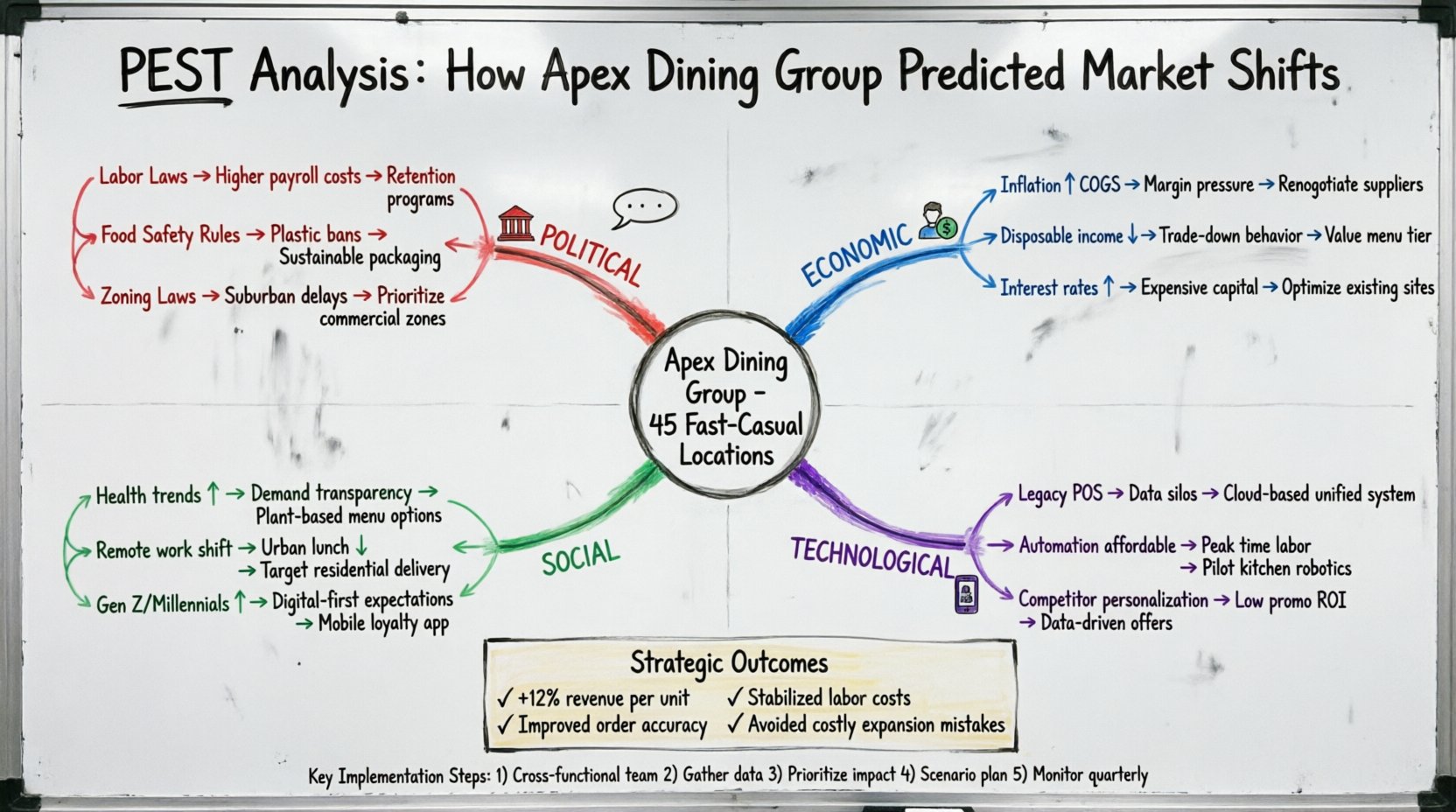
For the purpose of this case study, we examine “Apex Dining Group,” a hypothetical but representative franchise operator managing 45 locations across the United States. The brand focuses on fast-casual dining. In the early stages of the review period, the group faced stagnation. Despite opening new stores, revenue per unit was plateauing. The leadership team needed to understand why the market was behaving differently than historical trends suggested.
The goal was to identify upcoming risks and opportunities before competitors did. They commissioned a comprehensive external environment audit using the PEST methodology.
Political Factors: Navigating Regulations 🏛️
The Political analysis focused on the regulatory environment impacting food service. The team gathered data on local, state, and federal levels to understand compliance requirements.
1. Labor Laws and Minimum Wage
- Observation: Several states where Apex operated were proposing minimum wage hikes.
- Impact: Increased labor costs directly affect the bottom line in labor-intensive sectors like dining.
- Strategy: The operator adjusted their budget forecasting to account for higher payroll expenses. They also began investing in employee retention programs to reduce turnover costs associated with wage inflation.
2. Food Safety and Environmental Regulations
- Observation: New ordinances were emerging regarding single-use plastics and composting.
- Impact: Supply chains would need to shift to biodegradable packaging, potentially increasing unit costs.
- Strategy: Apex proactively sourced sustainable packaging vendors. This turned a compliance cost into a marketing advantage, appealing to eco-conscious consumers.
3. Zoning and Licensing
- Observation: Some municipalities were tightening zoning laws for new food establishments in residential areas.
- Impact: Expansion into suburban markets faced potential delays.
- Strategy: The expansion team prioritized commercial zones with established food service infrastructure to minimize licensing friction.
Economic Factors: The Inflation Challenge 💰
Economic conditions are perhaps the most volatile aspect of the PEST analysis. For Apex Dining Group, the economic review focused on consumer purchasing power and operational costs.
1. Inflation and Cost of Goods Sold (COGS)
- Observation: Inflation rates for raw ingredients like beef, dairy, and produce were rising faster than the consumer price index.
- Impact: Maintaining current menu prices while keeping margins intact became difficult.
- Strategy: The operator renegotiated contracts with major suppliers and diversified sourcing to include local farms for specific items, reducing transport costs.
2. Disposable Income Trends
- Observation: Data indicated a contraction in discretionary spending among middle-income demographics.
- Impact: Customers were trading down to cheaper meal options.
- Strategy: Apex introduced a “value menu” tier. This did not dilute the brand but captured price-sensitive customers who might otherwise switch to competitors.
3. Interest Rates and Capital Expenditure
- Observation: Rising interest rates increased the cost of borrowing for new franchise openings.
- Impact: The cost of capital for expansion projects rose significantly.
- Strategy: The group shifted focus from rapid expansion to optimizing existing locations. They closed underperforming units and invested capital into remodeling high-performing sites to increase throughput.
Social Factors: Changing Consumer Behavior 🧍
The social analysis looked at the human element. Who was eating? How were they eating? What did they value?
1. Health and Wellness Trends
- Observation: There was a marked increase in demand for transparent ingredient sourcing and healthier menu options.
- Impact: Traditional heavy, calorie-dense items were losing popularity.
- Strategy: The menu was updated to highlight plant-based proteins and fresh ingredients. Marketing campaigns shifted to emphasize nutrition rather than just taste.
2. The Remote Work Shift
- Observation: Office populations in central business districts had decreased due to hybrid work models.
- Impact: Lunchtime traffic in urban locations dropped significantly.
- Strategy: Apex reoriented their digital ordering systems to target residential areas. They partnered with third-party delivery services to ensure coverage in suburban neighborhoods where office workers were now dining.
3. Demographic Shifts
- Observation: The millennial and Gen Z cohorts were becoming the dominant spending power.
- Impact: These groups prioritize experiences and digital convenience over traditional loyalty cards.
- Strategy: The operator invested in a mobile-first loyalty program that offered instant rewards, aligning with the expectations of younger demographics.
Technological Factors: Digital Integration 📱
Technology is the accelerator of change. The technological analysis focused on tools that could improve efficiency and customer experience.
1. Point of Sale (POS) Systems
- Observation: Legacy systems were slow and lacked integration with inventory management.
- Impact: Data silos made it difficult to track waste and forecast orders accurately.
- Strategy: The group standardized on a cloud-based POS solution across all locations. This allowed for real-time data visibility from headquarters to the individual store.
2. Automation and Kitchen Efficiency
- Observation: Automation technology for food preparation was becoming more affordable.
- Impact: Potential for reduced labor hours during peak times.
- Strategy: Pilot programs were launched in high-volume locations to test automated cooking equipment. The goal was to reduce wait times and consistency issues.
3. Data Analytics
- Observation: Competitors were using data to personalize offers.
- Impact: Generic promotions were yielding lower redemption rates.
- Strategy: Apex implemented a data-driven marketing approach, using purchase history to send personalized offers to customers, increasing repeat visit frequency.
Synthesizing the Data: The Strategic Pivot 🔄
Collecting data is only the first step. The true value of a PEST analysis lies in synthesizing the findings into a coherent strategy. For Apex Dining Group, the analysis revealed a clear picture: the market was moving towards convenience, health, and digital interaction, while costs were rising.
The operator created a roadmap based on these insights. The following table summarizes the key strategic shifts resulting from the analysis.
| PEST Factor | Key Insight | Strategic Action |
|---|---|---|
| Political | Higher labor costs and plastic bans | Invest in retention and sustainable packaging |
| Economic | Inflation and reduced disposable income | Launch value menu and optimize existing sites |
| Social | Remote work and health consciousness | Prioritize delivery and update menu options |
| Technological | Need for real-time data and speed | Upgrade POS and automate kitchen processes |
Implementation: How to Replicate This Process 🛠️
Other franchise operators can follow a similar path to gain market intelligence. The process requires discipline and objectivity. Here is a step-by-step approach to conducting a robust PEST analysis without relying on proprietary software.
Step 1: Assemble a Cross-Functional Team
Do not rely solely on the marketing department. Include representatives from finance, operations, and human resources. Each department holds a piece of the puzzle. Finance understands the economic pressures, while operations understand the political and technological constraints.
Step 2: Gather Primary and Secondary Data
- Primary Data: Conduct surveys with customers and interviews with franchisees. Ask them directly about their challenges and changing preferences.
- Secondary Data: Review government reports, industry publications, and economic forecasts. Publicly available information is often free and highly reliable.
Step 3: Analyze and Prioritize
Not all factors are equal. Use a scoring matrix to rate each factor based on its impact and probability. A high-impact, high-probability factor requires immediate action. A low-impact factor can be monitored.
Step 4: Develop Scenarios
Build best-case, worst-case, and most-likely scenarios. Ask, “What happens if interest rates rise by another 2%?” or “What if a new health regulation bans a key ingredient?” Scenario planning helps build resilience.
Step 5: Execute and Monitor
A PEST analysis is not a one-time event. Market conditions shift. Establish a quarterly review cycle to update the findings. This ensures the strategy remains relevant.
Common Pitfalls to Avoid ⚠️
Even with a solid framework, errors can occur. Being aware of common mistakes ensures the integrity of the analysis.
- Confirmation Bias: Only gathering information that supports a pre-existing decision. Leaders must remain open to data that contradicts their assumptions.
- Data Overload: Collecting too much information without a clear path to action. Focus on actionable insights, not just statistics.
- Ignoring Local Nuances: A national trend may not apply to every region. Franchise operators must tailor the analysis to local markets.
- Lack of Follow-Through: Creating a report and filing it away. The analysis must drive budget allocations and operational changes.
The Outcome: Measurable Results 📊
Over the course of 18 months following the strategic pivot, Apex Dining Group reported significant improvements. Revenue per unit increased by 12%, primarily driven by the value menu and optimized delivery channels. Labor costs were stabilized through retention programs that offset wage hikes. Furthermore, the investment in digital infrastructure improved order accuracy and reduced wait times.
Most importantly, the operator maintained a healthy expansion pipeline. By understanding the economic landscape, they avoided opening new locations in areas with declining foot traffic, saving millions in potential capital losses.
Final Thoughts on Strategic Planning 🌐
The external environment is always in flux. For franchise operators, the margin for error is slim. A structured approach to understanding these external forces provides a competitive edge. By rigorously analyzing Political, Economic, Social, and Technological factors, businesses can move from reactive survival to proactive growth.
This case study demonstrates that the value of a PEST analysis is not in the document itself, but in the decisions it informs. It forces leadership to look beyond the daily grind and consider the horizon. In a market defined by volatility, foresight is the most valuable asset a business can possess.
Operators who commit to this level of strategic depth are better positioned to weather storms and capitalize on opportunities. The path forward requires continuous monitoring and the courage to adapt when the data demands it.