


Enterprise architecture is not merely about drawing diagrams or documenting systems. It is fundamentally about creating clarity amidst complexity. As organizations expand, the number of systems, processes, and stakeholders increases exponentially. Without a structured approach, information becomes fragmented, leading to misalignment and inefficiency. This is where the concept of ArchiMate Viewpoints becomes critical. It provides the framework to slice the architecture in ways that matter to specific audiences. When utilized correctly, these viewpoints serve as the bridge between abstract strategy and concrete implementation.
Top architects do not treat every model as a monolithic block. Instead, they understand that different decision-makers require different levels of detail and different perspectives. A CEO needs a high-level strategic overview, while a developer requires detailed interface specifications. The ability to manage these distinctions is what separates effective architecture from mere documentation. By leveraging ArchiMate Viewpoints daily, teams ensure that every stakeholder sees the data relevant to their role, reducing noise and enhancing decision-making speed.
Understanding the Core Distinction: View vs. Viewpoint 🧩
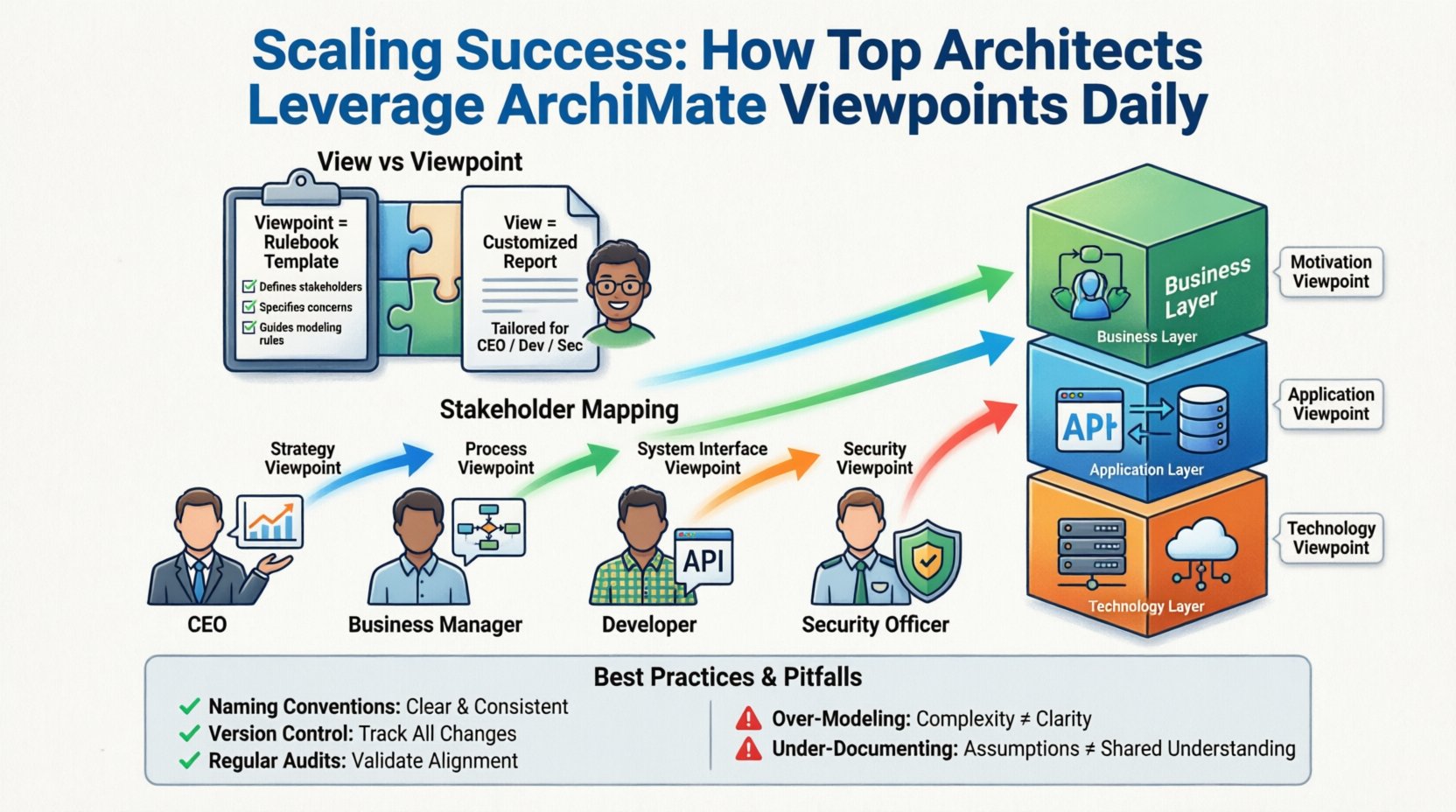
To leverage this methodology effectively, one must first grasp the fundamental difference between a View and a Viewpoint. In the context of architecture modeling, a Viewpoint defines the conventions, language, and concerns used to construct a view. It is the template. A View is the actual representation of the architecture for a specific stakeholder or group, created using that template.
Consider the Viewpoint as the rulebook for a specific type of report. It dictates what data must be included, how it should be visualized, and which terminology is allowed. The View is the actual report generated for a specific meeting or project phase. Confusing these two concepts often leads to models that are either too generic or too specific for their intended purpose.
Key Characteristics of a Viewpoint
- Target Audience: Who is consuming this information? (e.g., Business Managers, IT Staff, External Auditors)
- Concerns: What specific questions must this model answer? (e.g., Cost, Performance, Compliance)
- Language: Which ArchiMate concepts are permitted? (e.g., Business Objects, Application Services)
- Notation: How should the relationships be drawn? (e.g., Solid lines for flows, dashed for dependencies)
By defining these parameters upfront, architects ensure consistency across the entire enterprise. This consistency is vital when scaling. If one team uses a Viewpoint that emphasizes business processes and another emphasizes technology infrastructure, integrating their models becomes a nightmare. Standardizing the Viewpoints at the start saves significant time during the maintenance phase.
Aligning Viewpoints with Stakeholder Needs 🤝
The primary value of ArchiMate Viewpoints lies in their ability to tailor information delivery. No single diagram can satisfy everyone. Attempting to do so results in cluttered models that obscure the most important relationships. Successful architects map their Viewpoints directly to stakeholder personas. This alignment ensures that the architecture supports business goals rather than becoming an obstacle.
Mapping Stakeholders to Viewpoints
| Stakeholder Group | Primary Concerns | Recommended Viewpoint Focus |
|---|---|---|
| Executive Leadership | Strategy, ROI, Risk | Strategic Alignment, Value Flow |
| Business Managers | Processes, Capabilities, Performance | Business Process, Capability Map |
| System Architects | Interfaces, Data Flow, Integration | Application & Technology Interface |
| Developers | APIs, Service Contracts, Components | Application Component, Service |
| Security Officers | Access Control, Compliance, Threats | Security & Compliance, Risk Management |
Notice how the focus shifts from high-level value to granular components. A Strategic Alignment Viewpoint might show how a new product line supports the overall corporate mission. A Service Interface Viewpoint might show exactly how a customer database API connects to a payment gateway. Both are valid representations of the same enterprise, but they serve different purposes. Maintaining this separation is key to scalability.
Viewpoints Across Architecture Layers 📚
ArchiMate is structured around specific layers, ranging from Business to Technology. Each layer offers unique modeling capabilities. Effective architects do not mix these layers indiscriminately in every Viewpoint. Instead, they create specialized views that respect the boundaries and interactions between layers.
Business Layer Perspectives
The Business Layer is often the entry point for enterprise architecture. Here, Viewpoints focus on organizational structure, processes, and roles. A Business Process Viewpoint is essential for identifying bottlenecks. It allows analysts to trace the flow of work from initiation to completion without getting bogged down in the underlying software that executes the steps.
- Role Allocation: Who is responsible for this task?
- Process Flow: How does work move between departments?
- Capability Mapping: What abilities does the organization possess?
When scaling, the Business Layer often changes faster than the Technical Layer. By keeping Business Viewpoints distinct, architects can update processes without immediately triggering rework in the infrastructure models.
Application and Data Layer Perspectives
Once the business requirements are clear, the focus shifts to how applications support them. Viewpoints here must handle the complexity of software interactions. An Application Interaction Viewpoint highlights how different systems exchange data. This is crucial for understanding integration points and potential single points of failure.
Data is a critical asset in this layer. A Data Flow Viewpoint tracks information as it moves from creation to storage and eventually to consumption. This helps in managing data governance and ensuring compliance with regulations like GDPR. Without clear data flow views, data silos often form, making analytics impossible.
Technology and Infrastructure Perspectives
The Technology Layer deals with the physical and logical hardware. A Deployment Viewpoint is standard here. It maps software components to the nodes where they run. This is vital for capacity planning and disaster recovery strategies. Architects use this to visualize where resources are concentrated and where redundancy is lacking.
Infrastructure Viewpoints also help in cost management. By mapping virtual machines and physical servers to specific applications, finance teams can attribute infrastructure costs accurately. This transparency is necessary for justifying technology investments.
Best Practices for Consistency and Governance 🛡️
Creating Viewpoints is only half the battle. Maintaining them over time requires strict governance. As the enterprise evolves, models can become stale or inaccurate. A robust governance framework ensures that Viewpoints remain relevant and reliable.
Establishing Modeling Standards
Consistency is the enemy of chaos. All architects should follow the same naming conventions and diagramming rules. A standard library of Viewpoints should be created and maintained centrally. This library acts as a source of truth for how architecture should be represented.
- Naming Conventions: Define rules for naming objects (e.g., “Use full business names, not acronyms”).
- Diagram Layout: Specify preferred directions (e.g., “Flow left to right”).
- Version Control: Ensure every change to a Viewpoint is logged and attributed.
When standards are enforced, onboarding new architects becomes easier. They do not need to guess how to model a specific scenario; they refer to the standard library. This reduces the learning curve and accelerates project delivery.
Regular Reviews and Audits
Architecture is not a one-time activity. It is a continuous cycle of design, implementation, and review. Scheduled audits of Viewpoints ensure that the models reflect the current state of the enterprise. These reviews should involve both technical staff and business stakeholders.
During a review, ask the following questions:
- Is the Viewpoint still serving its intended audience?
- Are the relationships depicted still accurate?
- Has the stakeholder group changed, requiring a new Viewpoint?
- Is the data being updated regularly or has it become obsolete?
If a Viewpoint is no longer needed, it should be archived or retired. Cluttering the repository with unused views creates confusion. Pruning the library keeps it lean and useful.
Common Pitfalls to Avoid 🚫
Even experienced teams can stumble when implementing Viewpoints. Recognizing common mistakes helps in avoiding them. One frequent error is creating too many Viewpoints. While variety is good, excessive fragmentation makes it hard to see the big picture.
Over-Modeling
Attempting to model every single detail in every Viewpoint leads to information overload. A Viewpoint should answer specific questions, not document everything. If a detail is not relevant to the stakeholder’s concern, exclude it. This keeps the diagrams clean and readable.
Under-Documenting
Conversely, providing too little detail renders the Viewpoint useless. A Strategic Viewpoint without context is just a list of goals. A Technical Viewpoint without business context is just a list of servers. The key is to find the balance between abstraction and specificity.
Ignoring the Motivation Layer
The Motivation Layer is often overlooked, yet it is essential for understanding why changes are made. Viewpoints that include drivers, goals, and assessments help stakeholders understand the rationale behind architectural decisions. Without this context, teams may implement solutions that solve the wrong problems.
Scaling Architecture with Agile Methodologies 🚀
Modern development often follows Agile or DevOps practices. These methodologies require architecture to be more flexible and iterative. Traditional architecture models can feel static and slow. However, ArchiMate Viewpoints can adapt to this pace if managed correctly.
Incremental Refinement
Instead of building the entire architecture upfront, architects can use Viewpoints to support incremental delivery. A Viewpoint might represent the current state of a specific domain, with a roadmap for the next sprint. This allows the architecture to evolve alongside the software.
Automation and Tooling
While specific software names are not discussed here, automation is crucial for scaling. Scripting can be used to generate Viewpoints from existing system data. This reduces manual entry errors and ensures the models stay synchronized with the actual systems. Automation also enables the generation of reports for stakeholders without manual intervention.
Future-Proofing Your Architecture 🌐
The technology landscape changes rapidly. Cloud computing, microservices, and artificial intelligence are reshaping how systems operate. Viewpoints must be adaptable to these shifts. Rigid models that cannot accommodate new patterns will become obsolete quickly.
Embracing Modularity
Design Viewpoints with modularity in mind. Ensure that components can be added or removed without breaking the entire diagram. This is particularly important for cloud-native architectures where scaling is dynamic. A modular Viewpoint allows architects to show how services scale horizontally without redrawing the entire infrastructure map.
Continuous Learning
Architecture is a discipline that requires continuous learning. New patterns emerge regularly. Architects should stay updated on the latest industry trends and incorporate them into their Viewpoints where appropriate. This ensures that the architecture remains relevant and competitive.
Conclusion on Practical Application 🏁
Implementing ArchiMate Viewpoints is a strategic decision that pays dividends in clarity and efficiency. By focusing on stakeholder needs, maintaining consistency, and avoiding common pitfalls, organizations can scale their architecture without losing control. The goal is not to create a perfect model, but to create a useful tool for decision-making.
When architects leverage these viewpoints daily, they transform architecture from a static documentation exercise into a dynamic enabler of business success. The result is a more agile, resilient, and aligned enterprise capable of navigating complexity with confidence. The path to scaling success is paved with clear communication, and Viewpoints provide the language for that conversation.