In a world defined by volatility and rapid change, relying on a single forecast is no longer a viable strategy. Organizations that succeed do so not because they predicted the future perfectly, but because they prepared for several possible futures. This is the essence of scenario planning. When combined with the structural rigor of a PEST analysis, it creates a powerful lens for strategic foresight. This guide explores how to integrate Political, Economic, Social, and Technological factors into scenario building to navigate uncertainty with clarity and confidence.
Why Static Planning Fails in Dynamic Environments ⚠️
Traditional strategic planning often assumes a linear progression. It assumes that trends observed today will continue into tomorrow with minimal deviation. However, external forces rarely move in straight lines. A sudden regulatory shift, a global pandemic, or a breakthrough in artificial intelligence can disrupt established trajectories overnight.
Scenario planning acknowledges this reality. It does not attempt to predict the future; instead, it explores what the future could look like under different conditions. By mapping out multiple plausible outcomes, leaders can identify vulnerabilities and opportunities before they materialize. The PEST analysis provides the foundational data for these scenarios, ensuring that the external environment is thoroughly examined.
Understanding the PEST Framework 🔍
Before weaving PEST into scenarios, one must understand the components. PEST stands for Political, Economic, Social, and Technological. These categories represent the macro-environmental factors that influence an organization beyond its immediate control.
- Political: Government policies, trade regulations, tax laws, and political stability.
- Economic: Growth rates, exchange rates, inflation, and interest rates.
- Social: Demographics, cultural trends, health consciousness, and lifestyle changes.
- Technological: Innovation speed, automation, research and development activity, and infrastructure.
When used for scenario planning, these factors are not treated as static data points. They become variables that shift in intensity or direction, creating distinct narrative paths for the organization.
Step-by-Step: Integrating PEST into Scenario Planning 🛠️
Building scenarios requires a structured approach. The goal is to move from broad environmental scanning to specific, actionable narratives. Follow this framework to structure your planning process.
1. Define the Strategic Horizon ⏱️
Start by setting the timeframe. Are you planning for 1 year, 5 years, or 10 years? The horizon dictates which PEST factors are most relevant. For example, technological shifts may take a decade to mature, whereas political stability can change overnight.
2. Conduct a Deep PEST Scan 📊
Gather data for each category. Do not just list current conditions. Look for weak signals and emerging trends. Ask critical questions for each quadrant:
- Political: What new regulations are on the horizon? Is there a risk of trade barriers?
- Economic: How might inflation or currency fluctuation impact costs?
- Social: How is the workforce changing? Are consumer values shifting?
- Technological: Is there a disruptive technology entering the market?
3. Identify Key Drivers of Change 🚀
Not all factors carry equal weight. Some are predictable, while others are highly uncertain. Identify the two or three factors that are both critical to your success and highly uncertain. These become your scenario axes.
4. Construct the Scenarios 🗺️
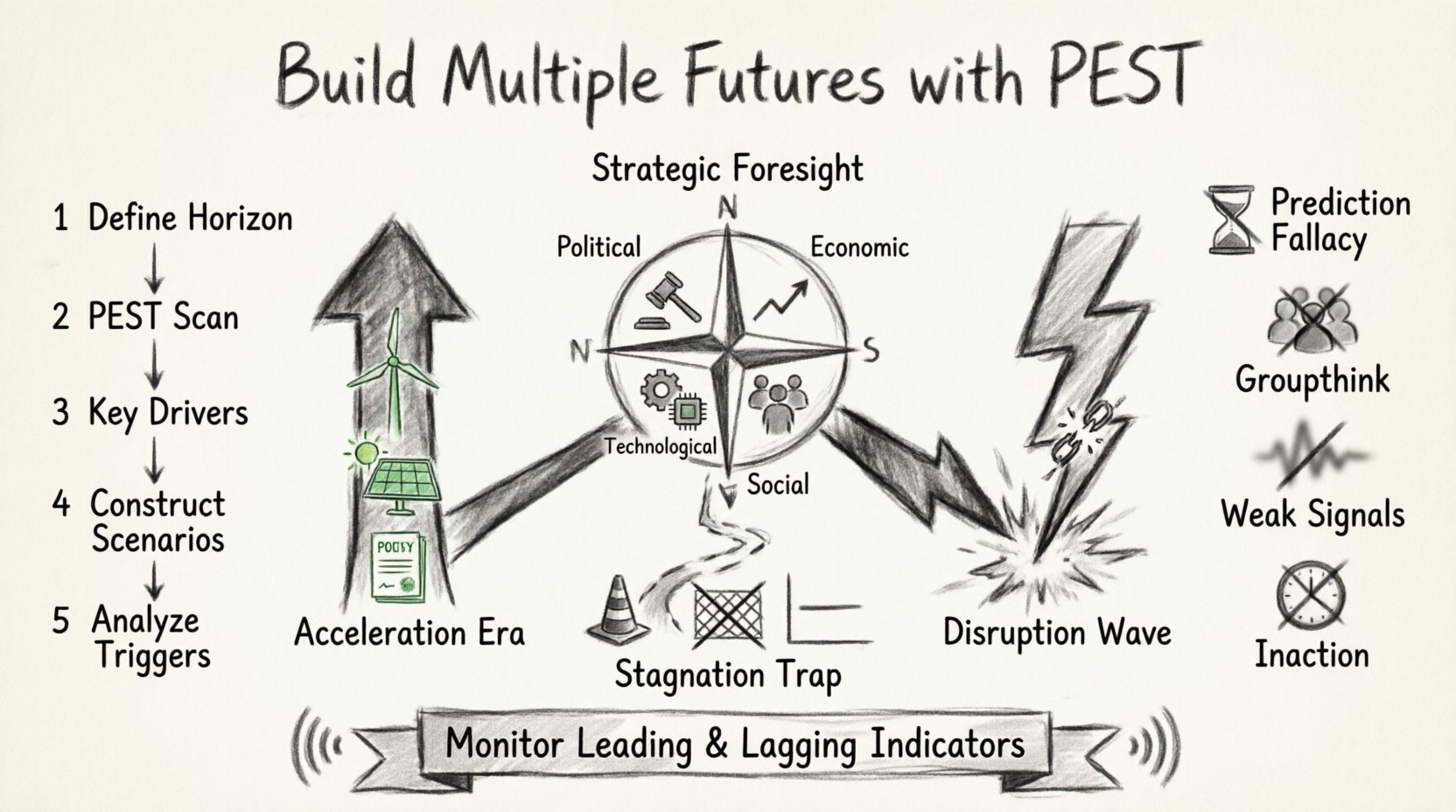
Combine the drivers to create distinct stories. A common method is to create three scenarios: a Base Case, a Best Case, and a Worst Case. Alternatively, you can create scenarios based on specific combinations of drivers, such as “High Growth/Low Regulation” or “Stagnation/High Regulation”.
5. Analyze Implications and Triggers 🔎
For each scenario, determine what it means for your operations. What would you need to invest in? What would you need to cut? Establish triggers—specific indicators that signal which scenario is unfolding.
Developing Scenarios Using PEST Factors 🧩
To make this concrete, let us look at how PEST factors can be manipulated to create different future narratives. Consider a hypothetical organization operating in the renewable energy sector.
Scenario A: The Acceleration Era 🚅
In this scenario, rapid technological progress meets favorable political support.
- Political: Governments implement aggressive carbon tax policies and offer subsidies for green energy adoption.
- Economic: Low interest rates make capital-intensive infrastructure projects affordable.
- Social: High public demand for sustainability drives consumer behavior.
- Technological: Breakthroughs in battery storage reduce costs and increase efficiency.
Scenario B: The Stagnation Trap 🛑
In this scenario, external pressures slow down progress despite internal capabilities.
- Political: Regulatory gridlock prevents new projects from getting permits.
- Economic: High inflation and rising interest rates increase the cost of borrowing.
- Social: Public apathy or resistance to infrastructure changes in local communities.
- Technological: Incremental improvements only, no major breakthroughs in efficiency.
Scenario C: The Disruption Wave 💥
In this scenario, unexpected external forces reshape the market entirely.
- Political: Geopolitical tensions disrupt supply chains for critical components.
- Economic: Global recession reduces overall demand for energy.
- Social: A shift in demographic patterns changes consumption habits.
- Technological: A competitor introduces a completely new technology that renders existing solutions obsolete.
Visualizing Scenarios for Clarity 📋
A table can effectively summarize the differences between scenarios, making it easier for stakeholders to compare risks and opportunities.
| Factor | Acceleration Era | Stagnation Trap | Disruption Wave |
|---|---|---|---|
| Political | Supportive Policies | Regulatory Gridlock | Supply Chain Tensions |
| Economic | Low Rates, High Investment | High Inflation, High Rates | Global Recession |
| Social | High Sustainability Demand | Local Community Resistance | Demographic Shifts |
| Technological | Battery Breakthroughs | Incremental Innovation | Disruptive Competitor Tech |
| Primary Risk | Overexpansion | Loss of Market Share | Obsolescence |
| Primary Opportunity | Market Dominance | Efficiency Optimization | Pivot Strategy |
Monitoring Triggers and Indicators 🚦
Scenarios are not static documents. They are living frameworks that require monitoring. You must define specific indicators that signal a shift from one scenario to another. This is known as signal monitoring.
- Leading Indicators: Metrics that predict future changes. For example, legislative bills introduced in parliament before they are passed.
- Lagging Indicators: Metrics that confirm a change has occurred. For example, a recorded drop in sales following a new tax implementation.
Assign ownership to these indicators. A specific team or individual should be responsible for tracking the key political, economic, social, or technological metrics that define your scenarios. When a trigger is hit, the organization activates the contingency plan associated with that scenario.
Common Pitfalls in Scenario Planning 🚧
Even with a robust framework, organizations can stumble. Understanding these common errors helps avoid them.
1. The Prediction Fallacy ⛔
Treating scenarios as predictions is a critical error. If a team believes Scenario A will happen, they ignore the preparation for Scenario B. Remember, the goal is flexibility, not accuracy.
2. Groupthink and Bias 🧠
Teams often gravitate toward optimistic scenarios or those that align with their existing beliefs. It is essential to challenge assumptions and invite diverse perspectives to ensure the scenarios are plausible, not just convenient.
3. Ignoring Weak Signals 🔇
Focusing only on loud, obvious trends can blind you to emerging changes. Weak signals in the technological or social categories often precede major shifts. Dedicate time to scanning the periphery of your industry.
4. Lack of Actionable Outputs 📉
Scenarios that remain in a presentation deck are useless. They must inform decision-making. Each scenario should result in specific strategic actions, resource allocations, or policy changes.
Integrating PEST with Other Strategic Tools 🤝
While PEST provides the macro-environmental context, it works best when integrated with other frameworks.
SWOT Analysis
Use the scenarios to stress-test your SWOT analysis. How does a “Worst Case” scenario impact your Weaknesses? Does a “Best Case” scenario amplify your Strengths? This cross-referencing ensures internal capabilities align with external possibilities.
Porter’s Five Forces
While PEST looks outward, Porter’s Five Forces looks at industry competition. Apply the scenario factors to industry rivalry. For instance, how does the “Disruption Wave” scenario affect the threat of new entrants?
Building a Culture of Foresight 🏛️
Scenario planning is not just a one-off exercise. It requires a culture that values adaptability and continuous learning. Leadership must communicate that uncertainty is normal and that preparing for multiple futures is a core competency.
- Regular Reviews: Schedule quarterly reviews of your scenarios. Update the PEST data as the world changes.
- Training: Train managers on how to think in scenarios rather than linear plans.
- Communication: Share insights from the scenarios with the wider organization to foster alignment.
Final Thoughts on Strategic Resilience 💪
Navigating the future requires more than just looking at historical data. It requires understanding the forces that shape the environment and preparing for the unexpected. By leveraging the PEST analysis framework, you ground your scenarios in reality while allowing for creative exploration of possibilities.
This approach moves you from a reactive stance to a proactive one. Instead of being surprised by change, you anticipate it. You build resilience into your strategy, ensuring that regardless of which future unfolds, your organization is equipped to respond effectively. The combination of structured analysis and flexible thinking creates a foundation for long-term success.
Start your PEST scan today. Identify your drivers. Build your scenarios. And prepare your organization for whatever comes next.