Enterprise architecture often suffers from a silent epidemic: ambiguity. Stakeholders look at diagrams and wonder, “What does this mean?” or “Why is this data here?”. The root cause frequently lies not in the data itself, but in the lens through which that data is presented. In the context of the ArhiMate modeling language, this lens is the Viewpoint.
Many architects approach the selection of a viewpoint as an afterthought. They default to the first option that appears in their software library or adopt a template from a previous project without critical evaluation. This approach leads to information overload, misalignment, and a repository that becomes a graveyard of unused models. To build an effective architecture practice, you must treat viewpoint selection as a strategic decision, not a technical convenience.
This guide provides a structured approach to selecting the correct viewpoint. It moves beyond simple definitions to explore the operational impact of these choices on your architecture repository, your stakeholders, and the broader governance framework. By the end, you will have a clear framework for defining, selecting, and maintaining viewpoints that drive value.
Understanding the Core Concepts: Viewpoint vs. View 🧩
Before selecting a viewpoint, it is essential to distinguish between two terms that are often used interchangeably but hold distinct meanings in the ArhiMate specification.
- View: A representation of a set of related concerns. It is the actual diagram or document you show to a stakeholder. It contains specific instances of elements (actors, processes, applications) and their relationships.
- Viewpoint: The specification for how a view is created. It defines the meta-model, the notation, the language, and the purpose. It is the rulebook for the view.
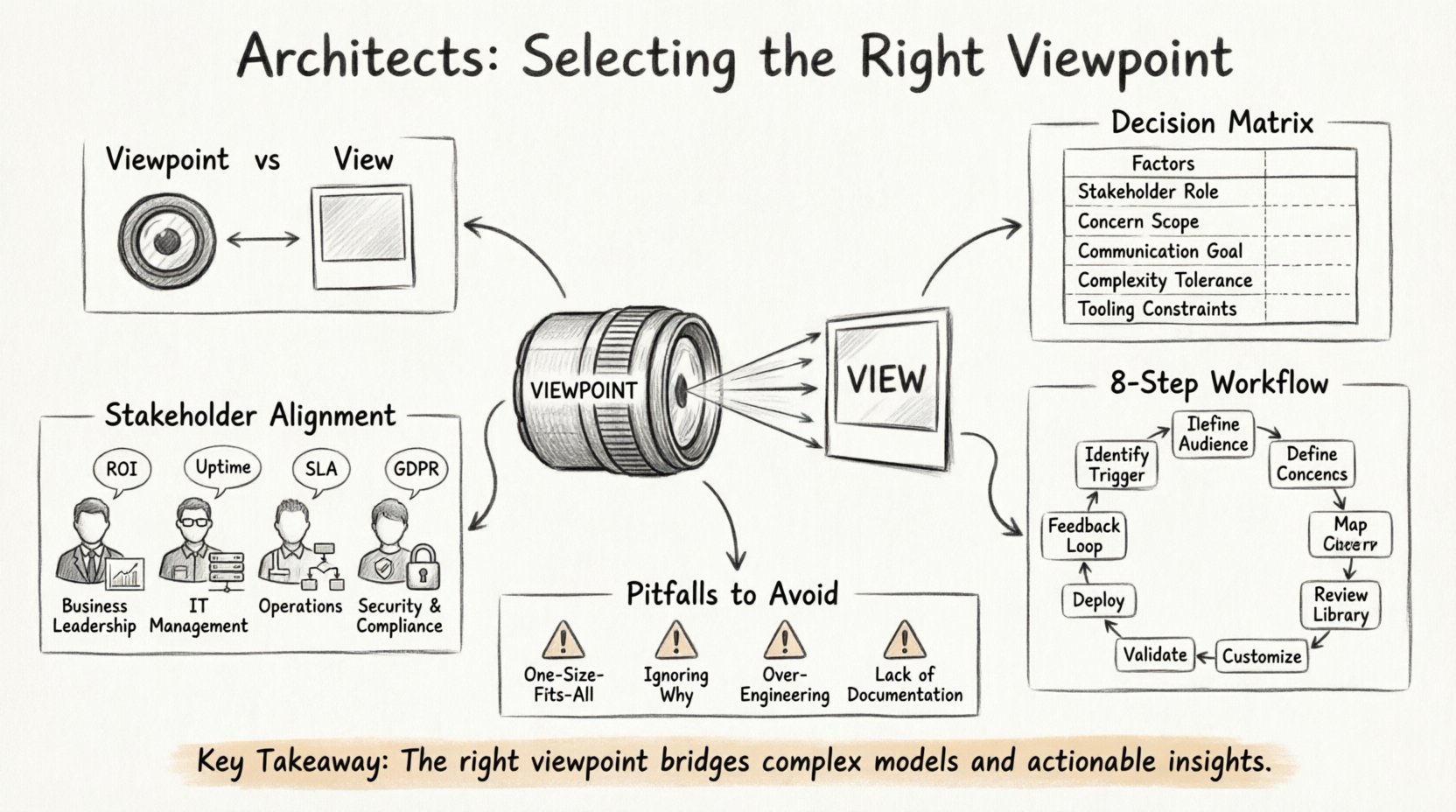
Think of the Viewpoint as the camera lens and the View as the photograph. You cannot take a clear photo without the correct lens for the subject. Similarly, you cannot communicate complex architectural decisions without a viewpoint tailored to the specific audience.
When selecting a viewpoint, you are essentially defining the contract of communication. You are answering three critical questions:
- Who is the audience? (Stakeholders)
- What are they concerned with? (Concerns)
- How should the information be structured? (Notation & Meta-model)
The Decision Matrix for Selection 📋
Selecting a viewpoint is rarely about finding a single “best” option. It is about finding the “right fit” for the current context. To assist in this process, consider the following criteria matrix. This table outlines the factors you must weigh before finalizing a viewpoint definition.
| Factor | Consideration | Impact on Selection |
|---|---|---|
| Stakeholder Role | Is the audience technical, executive, or operational? | Determines the level of abstraction and detail required. |
| Concern Scope | Is the concern business strategy, IT infrastructure, or security? | Dictates which layers of the ArhiMate model are active. |
| Communication Goal | Is the goal approval, implementation guidance, or analysis? | Defines the required metrics and relationships to highlight. |
| Complexity Tolerance | How much cognitive load can the audience handle? | Influences the density of the diagram and the vocabulary used. |
| Tooling Constraints | What capabilities does the modeling environment support? | Ensures the viewpoint is technically feasible to render. |
For instance, a viewpoint designed for a Chief Technology Officer (CTO) will differ significantly from one designed for a Lead Developer. The CTO needs to see the strategic alignment between business capabilities and applications. The developer needs to see the specific interfaces and data flows between services. If you use the CTO viewpoint for the developer, the information is too high-level. If you use the developer viewpoint for the CTO, the information is overwhelming and lacks strategic context.
Stakeholder Analysis and Alignment 👥
The success of an architecture initiative depends heavily on stakeholder buy-in. Viewpoints are the primary vehicle for securing this buy-in. Before defining a new viewpoint, you must conduct a rigorous stakeholder analysis.
Start by identifying the decision-makers and influencers. Map them to their specific concerns. Common categories include:
- Business Leadership: Concerned with capability, value streams, and strategic objectives.
- IT Management: Concerned with technology stack, integration points, and resource allocation.
- Operations: Concerned with availability, performance, and service delivery.
- Security & Compliance: Concerned with risk, access controls, and regulatory adherence.
Once mapped, you can assign specific viewpoints to these groups. A single architectural model can serve multiple viewpoints. This concept is known as multiple views from a single model. It ensures consistency across the enterprise while catering to diverse needs. However, do not attempt to create a universal viewpoint that satisfies everyone. A universal viewpoint often satisfies no one.
Key Questions for Stakeholder Alignment
- What specific decision does this stakeholder need to make based on this view?
- What information is missing from their current understanding?
- How does this view connect to their existing KPIs or metrics?
- Is the terminology used consistent with their domain language?
Using domain-specific terminology is crucial. If you are modeling a logistics network, avoid IT-centric jargon like “API” or “Microservice” when discussing physical distribution unless the audience is technical. Instead, use “Route” or “Hub”. The viewpoint should reflect the stakeholder’s mental model, not just the modeler’s.
Technical Considerations and Standards ⚙️
While the human element is paramount, the technical underpinnings of a viewpoint cannot be ignored. A viewpoint must be grounded in the ArhiMate meta-model to ensure semantic validity. However, the meta-model is vast, and using all of it in every view is unnecessary and confusing.
When defining the technical constraints of a viewpoint, consider the following:
- Layer Selection: ArhiMate is divided into layers (Business, Application, Technology, etc.). A viewpoint should activate only the layers relevant to the concern. Mixing layers without clear relationships can cause confusion.
- Relationship Types: The meta-model offers numerous relationship types (association, realization, usage, etc.). Select the subset required to tell the story. Overusing relationships creates a “spaghetti diagram” that is difficult to read.
- Profile Extensions: If standard ArhiMate concepts are insufficient, consider extensions. However, document these extensions clearly. Custom concepts should be the exception, not the rule, to maintain interoperability.
- Tooling Support: Ensure the tools you use to generate views can render the specific stereotypes and relationships defined in the viewpoint. If a tool does not support a specific relationship type, you cannot expect the viewpoint to function as intended.
Standardization plays a role here as well. Your organization should maintain a library of approved viewpoints. This prevents every architect from reinventing the wheel for every project. A standardized library reduces training time for new architects and ensures consistency in how information is presented across different projects.
Common Pitfalls to Avoid ⚠️
Even experienced architects can fall into traps when defining viewpoints. Recognizing these pitfalls early can save significant rework later.
1. The “One Size Fits All” Trap
Creating a single, comprehensive viewpoint that attempts to cover all layers and all stakeholders. This usually results in a diagram that is too complex for any specific audience to parse effectively.
2. Ignoring the “Why”
Designing a viewpoint because a template exists, rather than because a specific stakeholder need exists. Every viewpoint must have a defined purpose. If you cannot state the purpose in one sentence, the viewpoint is likely unnecessary.
3. Over-Engineering the Model
Using high-fidelity models for low-fidelity decisions. If a stakeholder needs to approve a budget, they do not need to see the specific database schema. They need to see the cost implications of the application layer. Matching the fidelity to the decision level is key.
4. Lack of Documentation
Defining the visual style without documenting the semantic meaning. A viewpoint is not just a style guide; it is a definition of meaning. Without documentation, future architects may interpret the elements differently, leading to data integrity issues in the repository.
Workflow for Adoption 🔄
To integrate viewpoint selection into your daily practice, follow a structured workflow. This ensures that the selection process is repeatable and auditable.
- Identify the Trigger: Determine what event necessitates a view. Is it a new project, a quarterly review, or an audit request?
- Define the Audience: List the specific individuals or groups who will consume the view.
- Map the Concerns: What specific questions must this view answer?
- Review the Library: Check existing viewpoints. Can an existing one be adapted?
- Customize if Needed: If no existing viewpoint fits, define a new one. Document the rationale.
- Validate: Present the draft viewpoint to a representative stakeholder. Does it answer their questions?
- Deploy: Generate the view and distribute it through the appropriate channel (repository, presentation, report).
- Feedback Loop: After use, gather feedback. Was the information sufficient? Was the terminology clear?
This workflow creates a feedback mechanism that continuously improves the quality of your architecture communication. It moves viewpoint selection from a random act to a disciplined process.
Maintaining Relevance 🌱
Once a viewpoint is established, it does not become static. Business strategies change, technology landscapes evolve, and stakeholder needs shift. A viewpoint that was relevant two years ago may be obsolete today.
Regular reviews of your viewpoint library are necessary. Schedule annual audits to assess the usage of each viewpoint. Ask:
- Is this viewpoint being used in active projects?
- Are there any deprecated concepts within this viewpoint?
- Has the stakeholder base changed significantly?
- Does the terminology still align with current industry standards?
Archiving old viewpoints is as important as creating new ones. Maintaining a cluttered repository confuses users. If a viewpoint has not been used in 12 months, consider archiving it or consolidating it with a more relevant option. This keeps the architecture practice lean and focused.
Integration with Governance Frameworks 🏛️
Viewpoint selection does not happen in a vacuum. It is part of the broader architecture governance framework. Governance ensures that the viewpoints you create adhere to organizational standards and support the enterprise architecture vision.
Integrate viewpoint definitions into your Architecture Board reviews. When a new viewpoint is proposed, it should undergo the same scrutiny as a new technology or a major process change. This ensures that the communication infrastructure of the architecture is as robust as the architecture itself.
Additionally, link viewpoints to the Architecture Repository. When a view is generated, it should be tagged with the viewpoint metadata. This allows you to query the repository for all views related to a specific concern. For example, you can retrieve all views related to “Security Risk” regardless of which project they belong to. This aggregation capability is a powerful asset for risk management.
Conclusion on Communication Strategy 🤝
Selecting the right viewpoint is a critical competency for any enterprise architect. It bridges the gap between complex technical models and actionable business insights. By treating viewpoint selection as a strategic activity, you ensure that your architecture work is understood, trusted, and utilized.
Remember that the goal is not to create the most complex model, but the most effective communication tool. Focus on the stakeholder, clarify the concern, and adhere to the standards. With a disciplined approach to viewpoint selection, you transform your architecture practice from a technical exercise into a strategic enabler.