

Enterprise architecture demands precision. When navigating complex organizational structures, clarity is paramount. Senior architects frequently encounter challenges when defining how information is presented to stakeholders. The concept of ArchiMate Viewpoints sits at the intersection of technical modeling and communication strategy. Understanding the distinction between a viewpoint and a view is not merely semantic; it determines the effectiveness of the architecture documentation.
This guide addresses the critical inquiries raised by experienced professionals in the field. We explore the structural integrity of modeling standards, the alignment with business goals, and the practical application of these definitions. The following sections provide deep technical insights without the fluff. Each answer is grounded in the architecture development lifecycle and practical implementation.
🔍 Understanding the Foundation
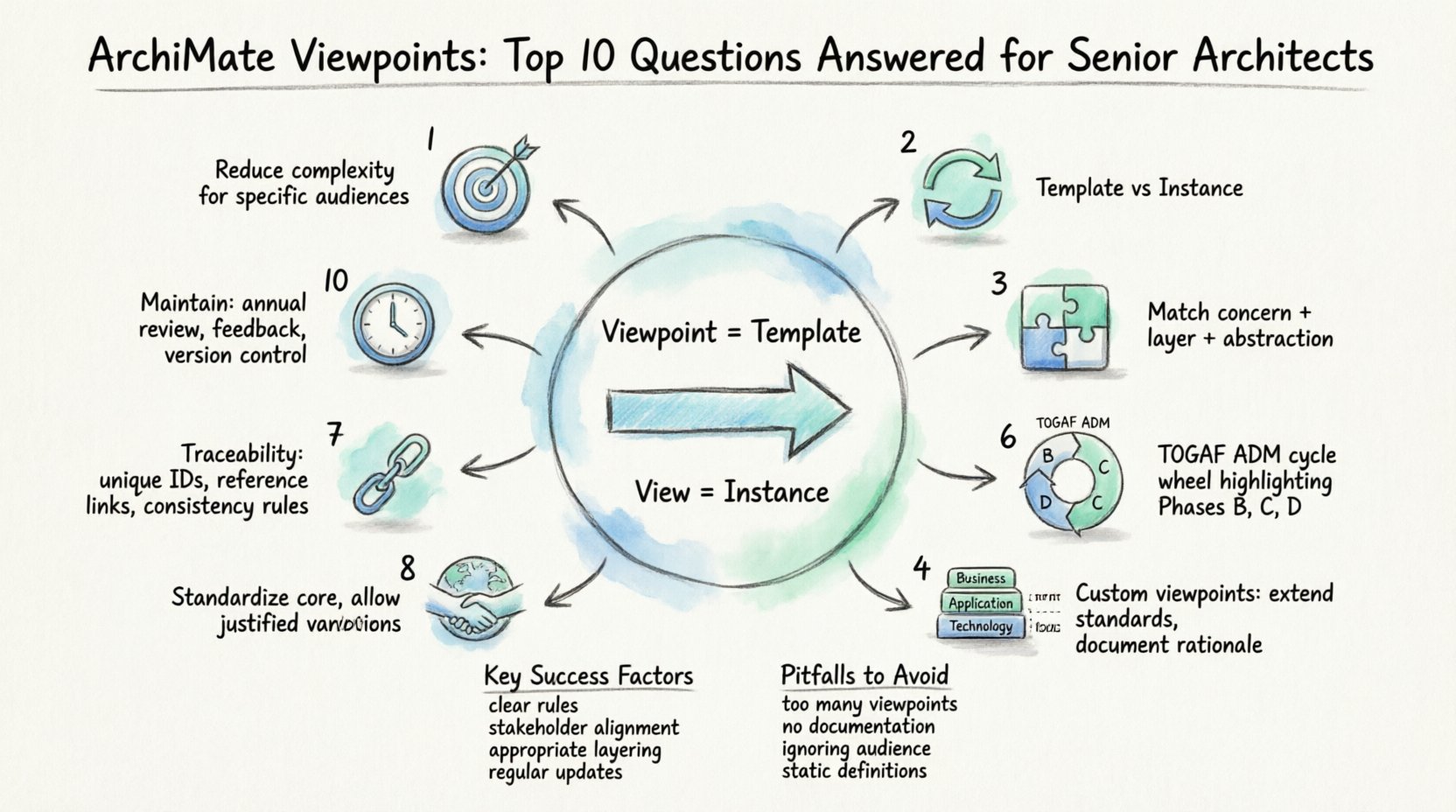
Before diving into specific questions, it is essential to establish a shared vocabulary. In the context of enterprise architecture frameworks, a Viewpoint defines the conventions for constructing a specific type of view. It acts as a template. A View is the actual artifact created using that template, representing a specific instance of the model relevant to a particular stakeholder group.
Senior architects often struggle with the abstraction levels required. The goal is to filter information effectively. Too much detail obscures the big picture. Too little detail renders the model useless for decision-making. Viewpoints provide the mechanism to control this abstraction.
❓ The Top 10 Questions
1️⃣ What is the primary purpose of a Viewpoint? 🎯
The primary purpose is to reduce complexity for a specific audience. Stakeholders have different concerns. A C-level executive requires high-level business value and risk assessment. A developer requires data flow and interface specifications. A single model cannot satisfy both effectively without becoming unreadable.
- Filtering Information: Viewpoints define which elements and relationships are visible.
- Consistency: They ensure all views for a specific concern follow the same notation rules.
- Communication: They bridge the gap between technical reality and stakeholder perception.
Without defined viewpoints, architecture documentation becomes a chaotic mix of layers and concerns, leading to misinterpretation and poor decision-making.
2️⃣ How do Viewpoints differ from Views? 🔄
This is a common source of confusion. The difference lies in definition versus instance.
| Aspect | Viewpoint | View |
|---|---|---|
| Nature | Template / Standard | Instance / Artifact |
| Lifetime | Long-term, reusable | Project-specific, temporal |
| Usage | Defines rules for creation | Displays specific data |
A viewpoint is established once for a specific concern type. It is applied repeatedly. A view is created when a specific project or decision requires a snapshot of the architecture based on that viewpoint.
3️⃣ How should I select the right Viewpoint for a stakeholder? 🧩
Selection relies on understanding the stakeholder’s decision-making context. Do not default to standard templates without analysis.
- Identify the Concern: Is the concern financial, technical, or operational?
- Identify the Layer: Do they need to see business processes, application services, or infrastructure?
- Identify the Abstraction: Do they need conceptual, logical, or physical detail?
Mapping the concern to the appropriate layer and abstraction level ensures the resulting view provides actionable insights rather than noise.
4️⃣ Can I create Custom Viewpoints? 🛠️
Yes. While standard viewpoints exist for common concerns like Business Process or Technology Infrastructure, customization is often necessary. Organizations have unique terminologies and specific regulatory requirements that standard definitions may not cover.
When creating a custom viewpoint, adhere to these principles:
- Extend Standard Definitions: Use existing element types where possible to maintain compatibility.
- Document the Rationale: Explain why the standard was insufficient for the custom version.
- Validate with Stakeholders: Ensure the custom notation is understood by the intended audience.
Over-customization can lead to fragmentation. Use custom viewpoints sparingly and only when necessary for clarity.
5️⃣ How do Viewpoints handle Layering? 🏗️
ArchiMate is structured into layers: Business, Application, and Technology, with Strategy and Implementation also playing roles. A viewpoint must define which layers are active in a specific view.
Common layering strategies include:
- Single Layer: Focuses on one domain (e.g., Technology Infrastructure).
- Vertical Slice: Shows a cross-section of layers for a specific business function (e.g., Order Processing across Business, App, and Tech).
- Horizontal Slice: Shows a specific layer across the entire enterprise (e.g., All Applications).
Choosing the correct layering strategy depends on the question being answered. A vertical slice is better for impact analysis. A horizontal slice is better for asset inventory.
6️⃣ What is the relationship between Viewpoints and the TOGAF Architecture Development Method (ADM)? 📚
The ADM cycle drives the creation of architecture. Viewpoints are artifacts used throughout the phases, particularly in Phase B (Business Architecture), Phase C (Information Systems Architectures), and Phase D (Technology Architecture).
Integration points include:
- Phase B: Define Business Viewpoints to map processes to organizational units.
- Phase C & D: Define Application and Technology Viewpoints to align services with infrastructure.
- Architecture Governance: Viewpoints ensure compliance with standards during the implementation phase.
Using viewpoints within ADM ensures that the outputs of each phase are tailored to the specific needs of the stakeholders involved in that phase.
7️⃣ How do I ensure Traceability across Views? 🔗
Traceability ensures that changes in one view are reflected or acknowledged in others. Viewpoints facilitate this by defining the relationships that must be preserved.
Key strategies for maintaining traceability:
- Unique Identifiers: Ensure every element has a distinct ID across the model.
- Reference Links: Use explicit relationship types to link elements between views.
- Consistency Rules: Define constraints in the viewpoint that prevent incompatible changes.
Without traceability, the architecture becomes a set of isolated diagrams. Viewpoints enforce the structural rules that keep the model coherent.
8️⃣ Should Viewpoints be Standardized across the Enterprise? 🌐
Standardization reduces cognitive load. If every department uses a different notation for the same concept, integration fails.
Benefits of standardization:
- Reusability: Templates can be shared across projects.
- Training: Staff only need to learn one set of rules.
- Tooling: Modeling tools can be configured to enforce standards automatically.
However, flexibility is required. A standardized set of core viewpoints should exist, with provisions for project-specific variations where justified.
9️⃣ How do Viewpoints interact with other Modeling Standards? 🤝
Enterprise architecture rarely exists in a vacuum. Viewpoints often need to incorporate concepts from BPMN, UML, or SysML.
Interaction strategies:
- Mapping: Define how elements in one standard map to ArchiMate elements.
- Integration: Use specialized viewpoints that allow embedding diagrams from other standards.
- Focus: Keep ArchiMate as the core, using other standards for detail within specific views.
Viewpoints act as the control mechanism for this integration, ensuring that external notations do not clutter the core architectural model.
🔟 How do I maintain Viewpoints over time? ⏳
Architecture evolves. Business processes change, and technology stacks shift. Viewpoints must evolve with them.
Maintenance steps:
- Periodic Review: Audit viewpoints annually to ensure relevance.
- Feedback Loop: Gather input from stakeholders on the usability of current views.
- Version Control: Manage changes to viewpoint definitions as strictly as model data.
Neglecting maintenance leads to obsolete documentation. A viewpoint that no longer reflects current organizational structure becomes a liability.
📊 Summary of Key Considerations
The table below summarizes the critical aspects of managing ArchiMate Viewpoints effectively.
| Focus Area | Key Action | Expected Outcome |
|---|---|---|
| Definition | Define clear rules for elements | Consistent modeling |
| Stakeholder Fit | Align with decision needs | Clear communication |
| Layering | Select appropriate layers | Reduced complexity |
| Maintenance | Regular reviews and updates | Long-term relevance |
⚠️ Common Pitfalls to Avoid
Even experienced architects can stumble when implementing viewpoints. Awareness of these pitfalls helps maintain quality.
- Too Many Viewpoints: Creating a unique viewpoint for every minor variation leads to fragmentation. Consolidate where possible.
- Lack of Documentation: A viewpoint without documentation is a black box. Explain the rules clearly.
- Ignoring the Audience: Technical views for business stakeholders cause confusion. Always tailor the abstraction level.
- Static Definitions: Treating viewpoints as set in stone ignores the dynamic nature of enterprise environments.
🚀 Final Thoughts
Effective enterprise architecture relies on the ability to communicate complex information clearly. ArchiMate Viewpoints provide the structural foundation for this communication. By answering the top questions regarding their definition, application, and maintenance, senior architects can build robust frameworks.
The goal is not to create more diagrams, but to create the right diagrams for the right people. This requires discipline, adherence to standards, and a willingness to iterate. When viewpoints are managed correctly, they become a strategic asset rather than a documentation burden.
Continual refinement of these practices ensures that the architecture function remains relevant and valuable. Focus on the stakeholder value, and the technical modeling will follow.