


Executive Summary
In today’s fast-paced organizational environments, timely and effective decision-making hinges on structured, time-bound discussions. This case study presents a meticulously designed business process that ensures up to five critical organizational issues are evaluated within a strict 7-day window. Leveraging Business Process Model and Notation (BPMN), the process integrates asynchronous email moderation with synchronous conference calls, synchronizing both streams under a unified timeline. By combining proactive reminders, conditional logic, and automated time constraints, the workflow guarantees closure, prevents scope creep, and delivers actionable outcomes—making it a model for agile, data-driven governance.
The Challenge: Balancing Depth, Speed, and Accountability
Organizations frequently face the challenge of discussing complex issues without falling into the trap of endless deliberation. Without clear boundaries, discussions can stall, lose focus, or drift beyond their intended scope. This process addresses these risks head-on by embedding temporal discipline into every phase of the discussion lifecycle.
The core objective is clear: to evaluate a curated set of issues—up to five—within exactly seven calendar days, ensuring that strategic decisions are not delayed by procedural inertia.
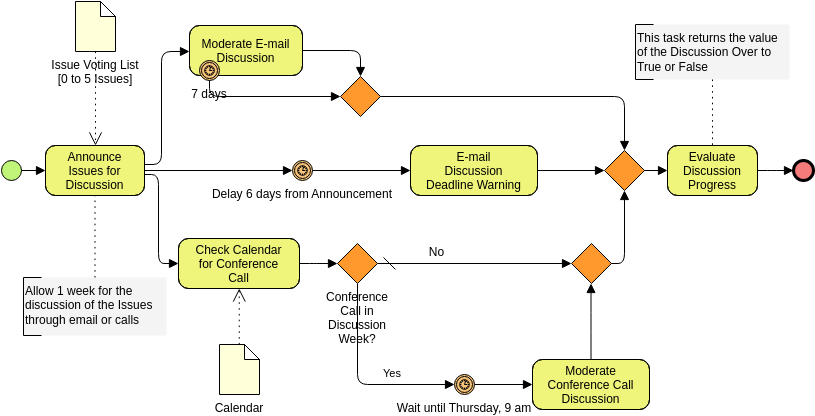
Phase 1: Initiation – Launching the 7-Day Clock
The process begins with a single trigger:
“Announce Issues for Discussion”
This task serves as the formal kickoff, activated when an issue list is finalized. The input is a “Issue Voting List”, containing between 0 and 5 items selected through prior stakeholder input or governance review.
Upon initiation:
-
A 7-day lifecycle is automatically established.
-
The process immediately branches into three parallel execution paths, enabling simultaneous engagement across multiple communication channels.
This parallelism is not merely efficient—it is strategic. It allows for:
-
Continuous asynchronous input via email.
-
Proactive deadline awareness.
-
Synchronized real-time discussion, where applicable.
Phase 2: Parallel Execution Paths – Synchronizing Communication Streams
To maximize participation and ensure no channel is neglected, the workflow splits into three distinct, concurrent paths:
| Path | Activity | Control Mechanism |
|---|---|---|
| Path A: Email Moderation | Continuous moderation of electronic correspondence from stakeholders. | 7-day Timer Boundary Event: Automatically terminates email discussions exactly 7 days after initiation. No exceptions. |
| Path B: Deadline Management | Proactive participant notification. | 6-day Intermediate Timer: Triggers a formal “Email Discussion Deadline Warning” 24 hours before the 7-day cutoff. Ensures last-minute engagement. |
| Path C: Call Coordination | Management of synchronous discussion via conference call. | Conditional Logic: Checks “Calendar Data” to determine if a call is scheduled during the discussion week. |
Key Insights on Parallelism
-
Path A ensures that written input—critical for thoughtful, reflective contributions—is captured and managed throughout the week.
-
Path B acts as a behavioral nudge, leveraging psychological timing (24-hour warning) to encourage final contributions.
-
Path C introduces flexibility: if no call is scheduled, the process skips the wait and proceeds directly to evaluation, avoiding unnecessary delays.
Phase 3: Conditional Logic & Convergence – Intelligent Flow Control
The true power of this process lies in its conditional intelligence.
Path C feeds into an Exclusive Gateway:
“Conference Call in Discussion Week?”
This decision point evaluates the organization’s calendar data to determine whether a synchronous call is planned.
-
If NO: The path merges seamlessly into the final evaluation phase. No waiting. No overhead.
-
If YES: The process pauses at an Intermediate Timer Event, set for Thursday at 9:00 AM—a deliberate design choice to align with mid-week momentum and ensure the call occurs within the window.
Only after this time point is reached does the process proceed to:
“Moderate Conference Call Discussion”
This ensures that the call is held at a predictable, scheduled time, without risking last-minute conflicts or missed opportunities.
All three paths converge at a final Exclusive Gateway, which serves as the final gate before evaluation.
Phase 4: Convergence and Evaluation – Delivering Closure
The process reaches its climax with:
“Evaluate Discussion Progress”
This is not a mere formality—it is a critical decision point that determines whether the discussion has met its objectives.
Key Outputs and Logic
-
Output: A boolean variable:
Discussion Over: True/False-
True: All issues have been adequately discussed, inputs collected, and consensus or assessment reached. -
False: The process may require escalation or extension (though the 7-day window is strictly enforced).
-
-
Termination: Upon completion, the process reaches the End Event, signaling that:
-
Discussion results are finalized.
-
Data is captured and ready for the next stage (e.g., executive review, action planning, or voting).
-
This outcome is not subjective. It is data-driven, based on:
-
Volume and quality of email contributions.
-
Attendance and engagement in the conference call (if held).
-
Timeliness of inputs against the 7-day boundary.
Key BPMN Elements: The Architecture of Discipline
The process is built on robust BPMN constructs that enforce structure, accountability, and clarity.
| Element Type | Description | Purpose in Process |
|---|---|---|
| Data Objects | Issue Voting List, Calendar |
Provide essential context and constraints. The list defines the scope; the calendar dictates timing. |
| Timer Events | Boundary (7 days), Intermediate (6 days, Thu 9am) | Enforce absolute adherence to the 7-day deadline. Prevents drift and ensures predictability. |
| Gateways | Exclusive (Diamond shapes) | Enable conditional routing based on real-time data (e.g., meeting schedule). Avoids unnecessary waiting. |
| Tasks | Yellow Rounded Rectangles | Represent discrete, actionable steps—moderation, warnings, call coordination—ensuring clarity and ownership. |
✅ Design Insight: The use of boundary events (especially the 7-day hard cutoff) transforms the process from a flexible framework into a time-bound contract with the organization.
Business Logic & Strategic Constraints: Why This Works
This process is more than a workflow—it’s a governance mechanism. Its design reflects deep strategic thinking:
1. Anti-Scope Creep: Dual-Timer Discipline
-
The 6-day warning ensures awareness.
-
The 7-day hard stop enforces closure.
Together, they prevent the discussion from becoming an open-ended debate.
2. Resource Efficiency: Smart Conditional Logic
-
The “Calendar Check” eliminates wasted time.
-
If no call is scheduled, the process skips the wait, reducing administrative overhead and accelerating decision cycles.
3. Data-Driven Outcomes: From Talk to Action
-
Every input is captured and evaluated.
-
The final
Discussion Overflag is not a guess—it’s a measurable outcome based on process completion.
This output triggers the next phase of the business cycle—ensuring continuity and accountability.
4. Scalability & Flexibility
-
The process handles 0 to 5 issues.
-
It adapts to the presence or absence of meetings.
It’s scalable across departments, teams, or even enterprise-wide initiatives.
Conclusion: A Blueprint for Agile Governance
This 7-day structured discussion process exemplifies how BPMN can transform organizational communication from chaotic dialogue into disciplined, time-bound decision-making. By combining:
-
Parallel execution,
-
Conditional logic,
-
Automated timers, and
-
Data-driven convergence,
It creates a self-regulating system that ensures:
-
Speed without sacrificing depth,
-
Inclusivity without endless deliberation,
-
Accountability through measurable outcomes.
In an age where attention is scarce and time is finite, this process isn’t just efficient—it’s essential.
Organizations seeking to make faster, smarter, and more transparent decisions should adopt this model—not as a rigid template, but as a framework for intelligent governance.
Appendix: Recommended Implementation Steps
-
Integrate with Calendar Systems (e.g., Outlook, Google Calendar) to enable real-time “Calendar Check.”
-
Automate Timer Events using BPMN-compliant workflow engines (e.g., Camunda, Bizagi, or Microsoft Power Automate).
-
Define “Adequate Discussion” Criteria in the evaluation task (e.g., minimum contributions, consensus threshold).
-
Train Moderators on the process flow and timing expectations.
-
Monitor Process KPIs: Duration, participation rate, closure rate, and evaluation accuracy.
Final Thought:
The most powerful decisions aren’t made in endless meetings—they’re made within a framework that respects time, respects input, and respects closure.
This process does all three.
Resource
-
BPMN Diagram and Tools – Visual Paradigm: This resource provides a comprehensive overview of BPMN diagramming capabilities and integrated tools designed specifically for business analysts and process designers.
-
What is BPMN? – Visual Paradigm Guide: An introductory guide explaining the purpose, structure, and benefits of Business Process Model and Notation (BPMN) in business process design.
-
BPMN Notation Overview – Visual Paradigm Guide: This guide offers a comprehensive overview of notation elements, including events, activities, gateways, and artifacts used to model professional business processes.
-
How to Draw a BPMN Diagram – Visual Paradigm Tutorial: A step-by-step tutorial on creating professional diagrams using an intuitive interface and modeling best practices.
-
Understanding Pools and Lanes in BPMN – Visual Paradigm User Guide: A detailed explanation of how to use pools and lanes to represent different departments, organizations, or roles within a process.
-
How to Create a BPMN Conversation Diagram in Visual Paradigm: A guide on creating and using Conversation Diagrams to model interactions between different business partners.
-
BPMN – A Comprehensive Guide: This article discusses the vision behind BPMN 2.0, aiming to establish a unified specification for notation, metamodels, and interchange.
-
Integrating BPMN and UML for Enhanced Modeling: A resource explaining how to combine BPMN and UML for more effective business and system modeling.
-
How to Animate Business Processes with Visual Paradigm: A tutorial on creating dynamic, animated business process diagrams for improved visualization and communication.
-
Comprehensive Guide to Visual Paradigm for Business Process Modeling: An in-depth guide on leveraging the platform for the end-to-end modeling lifecycle, from design to implementation and analysis.