Strategic planning relies on a clear understanding of the external environment. The PEST analysis framework—Political, Economic, Social, and Technological—provides a structured approach to scan these macro-environmental factors. However, the quality of your strategic decisions is directly tied to the reliability of the data feeding this framework. A PEST analysis built on unverified assumptions or outdated statistics can lead to significant missteps.
Validation is the process of confirming the accuracy, relevance, and timeliness of the information collected. It transforms a simple list of factors into a robust foundation for decision-making. Without rigorous checks, organizations risk basing growth strategies on noise rather than signal. This guide outlines the methodologies for verifying data across all four dimensions of the PEST model.
Understanding the Hierarchy of Data Sources 📚
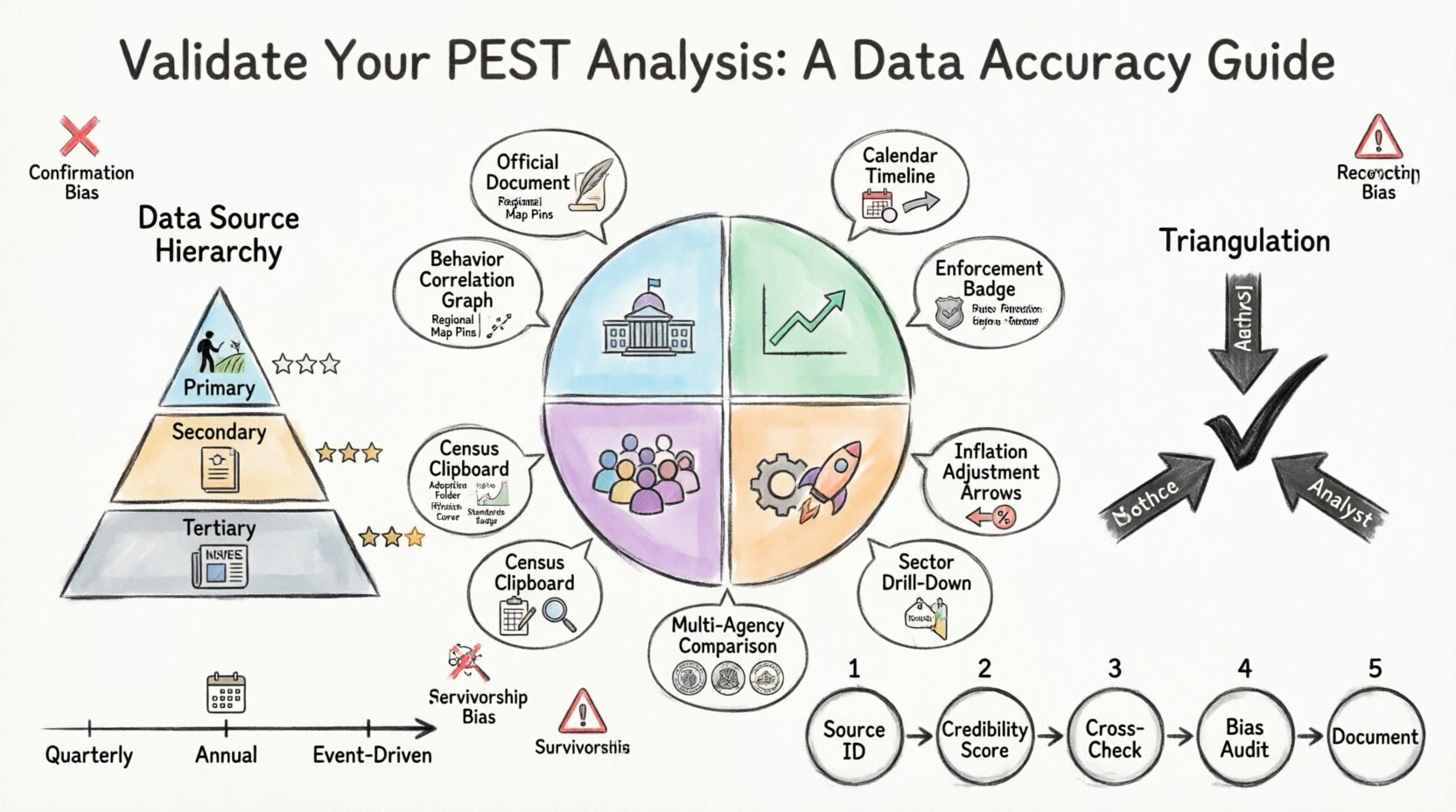
Not all information holds the same weight. Before validating specific factors, it is crucial to categorize sources by their reliability. Data originates from various points, each with different levels of scrutiny and potential bias.
- Primary Sources: Data collected directly from the field, such as internal sales records, direct customer surveys, or proprietary market research. These offer high relevance but require validation for sampling bias.
- Secondary Sources: Data published by third parties, such as government reports, academic journals, or industry associations. These are generally more stable but may lack specific context.
- Tertiary Sources: Summaries or compilations of primary and secondary data, such as news articles or blog posts. These are useful for awareness but should not be cited as primary evidence for strategic pivots.
To ensure accuracy, prioritize primary and high-quality secondary sources. Tertiary sources serve best as pointers to the original documentation.
Source Reliability Matrix
| Source Type | Reliability Score | Best Used For |
|---|---|---|
| Government Official Reports | High | Economic indicators, Legislation |
| Peer-Reviewed Journals | High | Technological trends, Social behavior |
| Industry Association Data | Medium-High | Market size, Sector growth |
| News Media | Medium | Current events, Political shifts |
| Anonymous Forums | Low | Consumer sentiment (unverified) |
Validating Political Factors 🏛️
Political factors encompass government policies, trade restrictions, tax laws, and political stability. These elements often change rapidly and carry high risk if misinterpreted.
Verification Steps for Political Data
- Consult Official Gazettes: Legislation and policy changes are first published in official government records. Relying on news summaries can lead to missing nuances in the actual text of the law.
- Check Implementation Timelines: A law passing parliament does not mean it is immediately effective. Verify the implementation date and any grace periods.
- Assess Enforcement Levels: A regulation may exist on paper but lack enforcement in certain regions. Historical data on enforcement can predict future behavior.
- Monitor Stakeholder Reactions: Observe how lobbying groups and industry bodies respond to proposed changes. Their opposition or support often signals the practical impact of the policy.
For example, a change in tariff rates might appear beneficial on a spreadsheet but fail to account for retaliatory measures from trade partners. Cross-referencing trade agreements with customs data ensures the political factor is understood in context.
Validating Economic Indicators 📈
Economic data drives demand forecasting and pricing strategies. Common indicators include GDP growth, inflation rates, exchange rates, and interest rates. Economic data is often lagging, meaning it reflects past performance rather than future conditions.
Ensuring Economic Data Integrity
- Adjust for Inflation: Historical economic figures must be adjusted for inflation to allow for accurate year-over-year comparison.
- Verify Exchange Rate Stability: If operating internationally, exchange rate volatility can skew revenue projections. Use hedging data to understand potential currency risks.
- Compare Multiple Agencies: Different government bodies may publish slightly different figures for the same metric. Compare data from the central bank, treasury, and international organizations like the IMF or World Bank.
- Contextualize Sector Performance: A national GDP growth rate might mask a decline in a specific industry. Always drill down to sector-specific economic reports.
Discrepancies between official statistics and private sector surveys often indicate data quality issues. When government unemployment rates differ significantly from private payroll data, investigate the methodology behind the calculations.
Validating Social Dynamics 👥
Social factors include demographics, cultural trends, lifestyle changes, and population health. These trends evolve slowly but have profound long-term impacts.
Methodologies for Social Validation
- Use Census Data: Government census data provides the most reliable demographic breakdown. Ensure the data is the most recent release available.
- Correlate with Consumer Behavior: Demographic shifts should manifest in purchasing patterns. Validate assumptions about age or income groups by analyzing actual sales data.
- Monitor Cultural Sentiment: Social trends are often driven by cultural shifts. Use social listening tools to gauge sentiment, but verify these findings with academic sociological studies.
- Regional Nuances: A trend in one region may not apply to another. Validate data at the local or regional level rather than relying on national averages.
For instance, an assumption that a population is aging might be accurate nationally, but a specific city might be experiencing an influx of young professionals. Regional validation prevents misalignment with local market needs.
Validating Technological Shifts 🚀
Technological factors cover innovation rates, automation, R&D activity, and technology incentives. This area changes the fastest, making obsolescence a real risk.
Technological Verification Checklist
- Review Patent Filings: Patents indicate where innovation is directed. Analyzing patent databases reveals which technologies are being prioritized by competitors and researchers.
- Track Adoption Rates: A new technology exists only if it is adopted. Look for market penetration data rather than just technical specifications.
- Assess Infrastructure Readiness: Technology requires infrastructure. A 5G network is useless without compatible devices and local tower coverage. Validate infrastructure availability.
- Identify Standards Bodies: Industry standards dictate compatibility. Verify if a technology is becoming an industry standard or remains a proprietary niche.
Technology hype often outpaces reality. Validate claims of “disruptive innovation” by looking for actual revenue generation in the sector. If a technology generates no revenue, it may be a solution looking for a problem.
Cross-Verification and Triangulation 🔍
Triangulation involves using three or more independent methods or sources to confirm a finding. This is the gold standard for data validation in strategic analysis.
- Method Triangulation: Combine qualitative interviews with quantitative surveys and observational data.
- Data Source Triangulation: Compare government data with private industry reports and academic research.
- Investigator Triangulation: Have different analysts review the same data set to identify individual biases.
When all three sources point to the same conclusion, confidence in the data increases significantly. If the sources contradict, further investigation is required to resolve the discrepancy.
Common Pitfalls in Validation
| Pitfall | Description | Mitigation Strategy |
|---|---|---|
| Confirmation Bias | Seeking data that supports pre-existing beliefs. | Actively seek disconfirming evidence. |
| Recency Bias | Overweighting the most recent data points. | Analyze long-term trends over 5-10 years. |
| Survivorship Bias | Focusing on successful entities and ignoring failures. | Study companies that exited the market. |
| Availability Heuristic | Relying on information that is immediately available. | Conduct deep-dive research beyond headlines. |
Identifying and Mitigating Bias 🧠
Bias is the enemy of accuracy. Even the most rigorous data collection process can be skewed by human interpretation. Recognizing cognitive biases helps maintain objectivity.
- Selection Bias: Ensure the sample size is representative. If surveying only premium customers, you miss the mass market perspective.
- Reporting Bias: Companies may underreport negative financial data or overreport success. Look for audit reports to verify financial claims.
- Observer Bias: Analysts may interpret ambiguous data in a way that fits their expectations. Blind analysis techniques can help reduce this.
Establishing a peer review process within the strategy team helps catch these biases. Have a colleague challenge the data sources and the conclusions drawn from them.
Establishing a Maintenance Schedule 📅
Data validity decays over time. A PEST analysis is not a one-time exercise but a living document. Establishing a schedule for data refresh is essential.
- Quarterly Reviews: Check for changes in political regulations and economic indicators that shift quarterly.
- Annual Deep Dives: Conduct a full re-verification of social and technological trends annually.
- Event-Driven Updates: Trigger an immediate review if a major event occurs, such as a geopolitical conflict, pandemic, or breakthrough technology announcement.
Set alerts for key data releases. For example, subscribe to RSS feeds from central banks and government trade departments. This ensures you are notified of new data the moment it is published, rather than waiting for a scheduled review.
Implementing a Validation Workflow
To operationalize these concepts, integrate validation steps into your standard planning workflow.
- Step 1: Source Identification: List every data point and its origin.
- Step 2: Credibility Assessment: Score each source based on the reliability matrix.
- Step 3: Cross-Check: Compare findings against at least one other independent source.
- Step 4: Bias Audit: Review the analysis for confirmation bias or recency bias.
- Step 5: Documentation: Record the validation process and data limitations in the report.
Documentation is critical for accountability. If a decision fails due to incorrect data, the audit trail shows whether the data was flawed or the interpretation was flawed.
Conclusion on Accuracy
Accuracy in PEST analysis is not about finding perfect data, as that does not exist. It is about understanding the limitations of your data and managing the risks associated with it. By applying rigorous validation techniques, organizations can navigate uncertainty with greater confidence.
The effort required to verify data pays dividends in strategic alignment. A validated PEST analysis reduces the likelihood of surprise disruptions and allows for proactive rather than reactive planning. Commit to the discipline of validation to ensure your strategic foundation remains solid.