


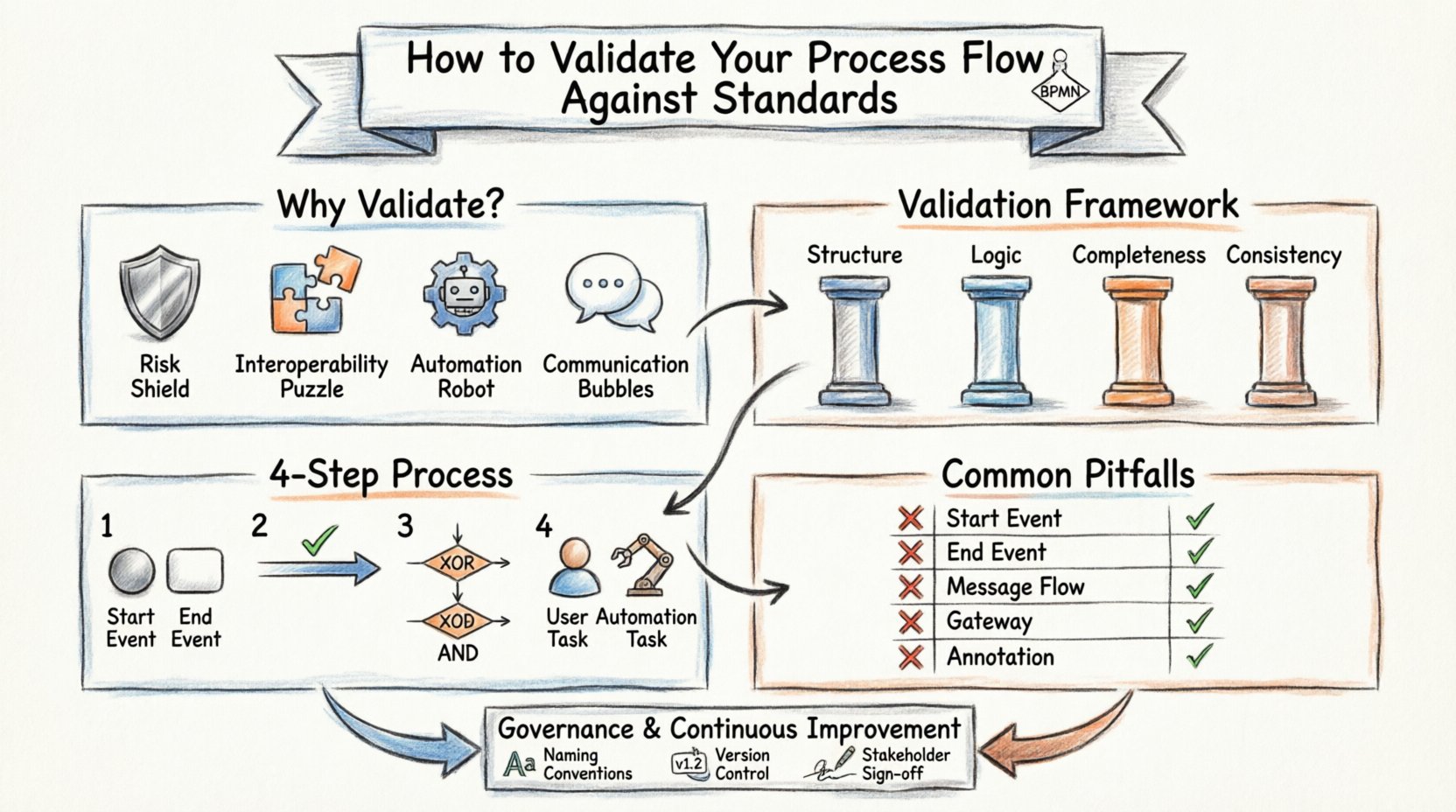
Creating a business process model is only the first step. A diagram that looks correct on a screen may contain logical errors that cause failures when the process is executed or automated. Validating your process flow against standards ensures that your models are not just visually appealing, but technically sound and compliant with industry norms. This guide explores the systematic approach to verifying Business Process Model and Notation (BPMN) models.
Why Validation Matters 🎯
Process models serve as the blueprint for organizational operations. When these blueprints are flawed, the consequences can be significant. Errors in flow logic can lead to bottlenecks, compliance violations, or system crashes during automation. Validation acts as a quality gate before any implementation begins.
Adhering to validation standards provides several distinct benefits:
- Reduced Risk: Catching logic errors early prevents costly rework later in the deployment phase.
- Interoperability: Standardized models ensure that different teams or systems can interpret the flow correctly.
- Automation Readiness: Robust models are easier to convert into executable scripts or workflow engines.
- Clear Communication: A validated model removes ambiguity for stakeholders reviewing the business requirements.
Core BPMN Standards Overview 🏗️
To validate effectively, you must understand the rules you are validating against. The Business Process Model and Notation (BPMN) specification is the international standard for business process modeling. While there are various versions, BPMN 2.0 is currently the most widely adopted.
Validation generally covers two main dimensions:
1. Syntactic Validation
This checks if the model follows the graphical rules of the notation. Are the shapes used correctly? Are the connections valid? For example, a gateway cannot connect directly to another gateway without an intermediate flow element.
2. Semantic Validation
This checks if the model makes logical sense. Does the process start and end correctly? Are all paths covered? Does the logic align with the actual business reality? A model can be syntactically correct but semantically broken.
The Validation Framework 🔍
A structured approach ensures nothing is overlooked. We recommend a four-pillar framework for validation. Each pillar addresses a specific aspect of the process model integrity.
- Structure: Are the pools, lanes, and flows arranged correctly?
- Logic: Do the gateways and events function as intended?
- Completeness: Are all necessary steps included without unnecessary complexity?
- Consistency: Does the terminology and style match organizational standards?
Step-by-Step Validation Process 📝
Executing the validation requires a methodical review. Follow these steps to ensure your process flow is robust.
Step 1: Check Start and End Events
Every process must have a clear beginning and a definitive end. This is the most common oversight in early drafts.
- Ensure there is exactly one Start Event per process lane or pool.
- Verify that the Start Event is a circle, not a rounded rectangle.
- Confirm there is at least one End Event.
- Check that End Events reflect the correct outcome (e.g., Success, Error, Cancel).
Step 2: Verify Flow Connections
The arrows connecting elements dictate the sequence. Broken connections can cause the engine to get stuck.
- Ensure all flows are directed arrows; undirected lines are invalid.
- Check that no two elements are connected directly if a gateway or task is required in between.
- Validate that Message Flows are only used between Pools or Participants, not within a single Pool.
- Confirm that Sequence Flows do not cross the boundary of a Pool.
Step 3: Analyze Gateways
Gateways control the path of the process. Misconfigured gateways are a frequent source of deadlocks.
- Exclusive Gateways: Ensure paths cover all possible outcomes (e.g., Yes/No). If a condition is missing, the process may hang.
- Parallel Gateways: Verify that every Parallel Split (AND) has a matching Join (AND). One cannot exist without the other in the same branch.
- Inclusive Gateways: Ensure default paths are defined if multiple conditions fail.
Step 4: Review Task Types
The work performed within the process must be clearly defined.
- Ensure no sub-process is left empty.
- Check that manual tasks are clearly distinguished from automated service tasks.
- Verify that user tasks have assigned roles or participants defined in the metadata.
Common Validation Failures ⚠️
Even experienced modelers make mistakes. Reviewing these common pitfalls can help you spot issues faster during your own validation.
| Standard Rule | Validation Check | Common Error |
|---|---|---|
| Start Event | Exactly one per process | Multiple start events or no start event |
| End Event | At least one per process | Process loops indefinitely without exit |
| Message Flow | Between Pools only | Connecting elements within the same Pool |
| Gateway | Match Split with Join | Parallel Split without a Parallel Join |
| Text Annotations | Non-executable | Placing logic inside annotation text |
Notice how the table highlights the relationship between the rule, the check, and the error. This format helps in creating a checklist for your team.
Ensuring Consistency and Governance 🛡️
Validation is not a one-time event. Processes evolve, and standards change. To maintain integrity over time, you need a governance strategy.
1. Establish Naming Conventions
Consistent naming reduces confusion. Define rules for how tasks, events, and pools are named.
- Use action verbs for tasks (e.g., “Approve Invoice” not “Invoice Approval”).
- Keep names concise but descriptive.
- Avoid acronyms unless they are universally understood within the organization.
2. Define Version Control
Every change to a process model should be tracked. This allows you to revert if a new version introduces errors.
- Assign version numbers to every model (e.g., v1.0, v1.1).
- Document the reason for changes in the model metadata.
- Archive old versions for audit purposes.
3. Stakeholder Sign-off
Automated checks are powerful, but human insight is irreplaceable. Business stakeholders must verify that the model matches reality.
- Conduct walkthrough sessions with process owners.
- Ask specific questions about edge cases (e.g., “What happens if the data is missing?”).
- Get formal approval before moving to the development phase.
Handling Complex Scenarios 🧩
Simple flows are easy to validate, but enterprise processes are rarely simple. Complex scenarios require additional attention.
Event-Based Gateways
These gateways wait for an event to occur rather than a condition. They are prone to deadlocks if the event never arrives.
- Ensure a timeout mechanism is defined where appropriate.
- Verify that the event is reachable from the start point.
- Check that the event is not triggered by the same process instance it is waiting for (unless intended).
Transaction Sub-processes
These ensure that a set of tasks either all succeed or all fail together. They are critical for financial or data integrity processes.
- Verify that the transaction sub-process has a specific error boundary event.
- Ensure that compensation handlers are defined for rollback scenarios.
- Confirm that the sub-process does not contain parallel gateways that could cause state inconsistencies.
Continuous Improvement Cycle 🔄
Once validation is complete and the process is live, the work does not end. Real-world execution often reveals gaps that were not visible during modeling.
- Monitor Performance: Use execution logs to identify bottlenecks.
- Gather Feedback: Ask the users performing the tasks about difficulties.
- Update Models: Reflect changes in the model when the process changes.
- Re-validate: Run the validation checks again on the updated model.
This cycle ensures that your process documentation remains a living asset rather than a static document that quickly becomes obsolete.
Final Thoughts on Process Integrity ✅
Validating your process flow against standards is a discipline that separates professional modeling from casual diagramming. By adhering to syntactic rules and semantic logic, you create models that are reliable, maintainable, and ready for automation.
Remember that the goal is not perfection in the first draft, but a systematic approach to finding and fixing errors. Use the framework provided here as a foundation, and adapt the checks to fit your specific organizational needs. With consistent validation, your process models will become a trusted source of truth for the entire organization.
Start applying these checks to your current projects. The time invested in validation now will save significant resources during implementation and operation later.