

Enterprise Architecture (EA) modeling is a discipline built on precision. Yet, too many organizations find themselves drowning in diagrams that confuse rather than clarify. The culprit is often not the modeling tool or the talent within the team, but the underlying strategy for ArchiMate viewpoints. A viewpoint defines what an observer sees and how they see it. When this strategy is misaligned with stakeholder needs, the result is a repository of unused models that cost money to maintain but yield no insight.
This guide dissects the common structural failures in viewpoint strategies. We will explore the mechanics of the ArchiMate language, the psychology of stakeholder engagement, and the governance frameworks required to keep your architecture repository relevant. By the end, you will have a clear roadmap to transform your modeling efforts from a bureaucratic exercise into a strategic asset.
🧭 Understanding the Core Purpose of Viewpoints
Before diagnosing failure, we must define success. In the ArchiMate framework, a viewpoint is not just a specific diagram type. It is a description of the concerns of a particular group of stakeholders. A view is the concrete instantiation of that viewpoint—a specific model slice.
Many teams treat viewpoints as generic templates. They create a “Business Viewpoint” that is then used for every business stakeholder. This is a fundamental error. A C-level executive has different concerns than a process owner. A process owner has different needs than a developer.
Effective viewpoint strategies answer three critical questions:
- Who is the audience? Define the specific roles and their information needs.
- What is the concern? Are they looking at cost, risk, capability, or flow?
- What is the scope? Is this a high-level strategic map or a detailed application interface definition?
When these questions are not answered during the design phase, the architecture repository becomes a graveyard of context-less diagrams. Stakeholders stop consulting the models because they cannot find the information relevant to their daily decisions.
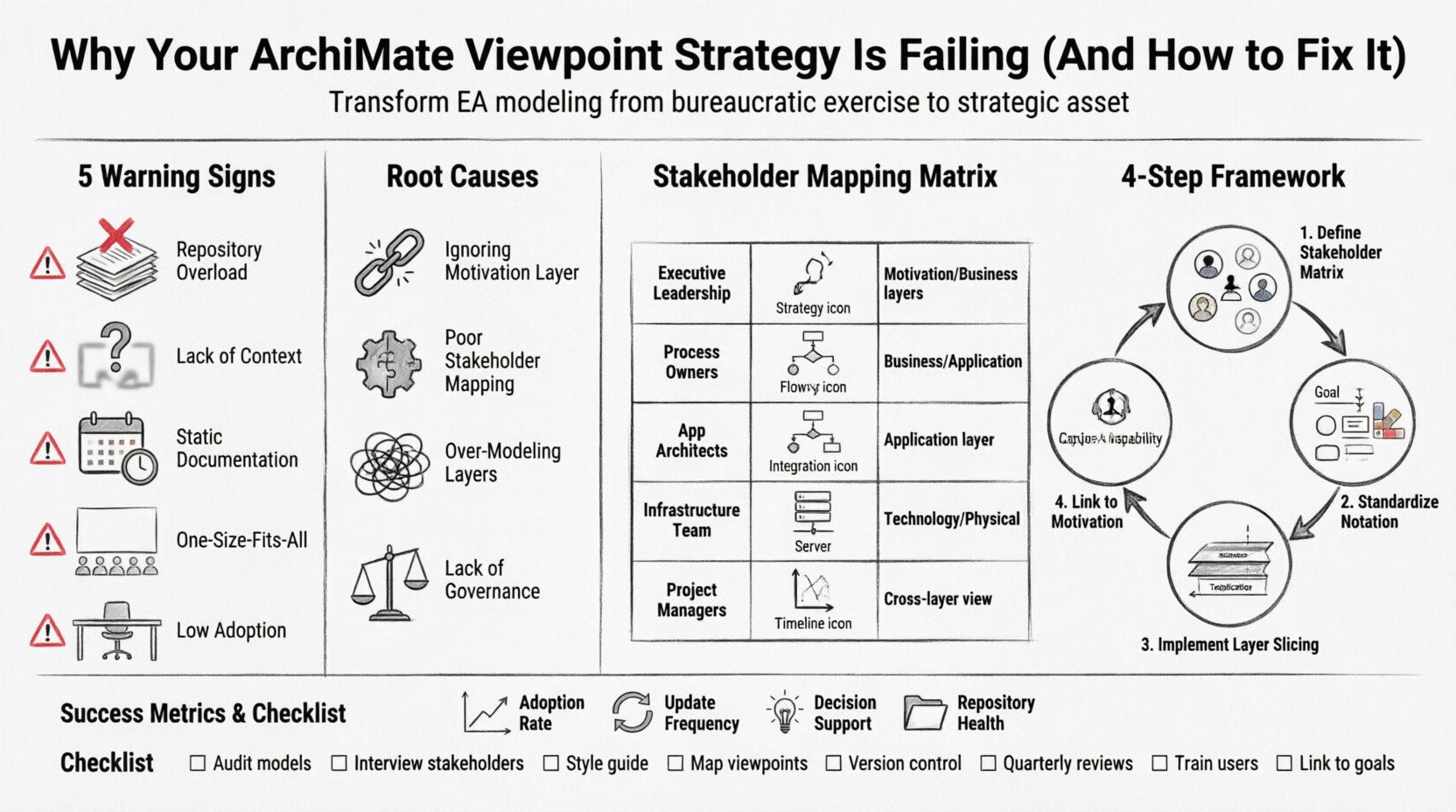
🚩 5 Signs Your Strategy Is Off-Track
Identifying a failing strategy requires observation of usage patterns and feedback loops. If your EA practice exhibits the following symptoms, the viewpoint definition is likely the root cause.
1. The Repository Overload
When the number of models exceeds the number of active stakeholders, maintenance becomes a burden. If you have fifty views but only three people ever open them, the strategy has failed. Quantity does not equal value. A curated set of high-impact views is superior to a comprehensive archive of unused artifacts.
2. Lack of Context in Models
Stakeholders ask, “What does this mean?” or “Why is this here?” immediately after viewing a diagram. A good viewpoint strategy embeds context into the presentation. Labels, legends, and specific layer focus should be standardized. If the model requires a lecture to be understood, the viewpoint is too complex.
3. Static Documentation
Models are created and then forgotten. They are not updated when the business changes. This usually happens because the viewpoint does not map to a living process. If the model is not tied to a specific governance trigger, such as a change request or a budget review, it will rot.
4. One-Size-Fits-All Approach
Using the same diagram style for the Board of Directors and the IT Operations team is a critical error. The Board needs strategic alignment and capability maps. The Operations team needs dependency maps and interface definitions. Blurring these lines creates noise.
5. Low Adoption Rates
The ultimate metric of a viewpoint strategy is adoption. If developers ignore the application layer models, or if business leaders ignore the process flows, the communication channel is broken. The model must serve the user, not the modeler.
📉 The Root Causes of Viewpoint Overload
Why do these failures happen? It is rarely a lack of effort. It is usually a misalignment between the modeling language and the business reality.
Ignoring the Motivation Layer
ArchiMate includes a Motivation Layer (Goals, Principles, Drivers, Assessments, Stakeholders, Requirements). Many teams skip this layer entirely. Without it, models lack purpose. A capability map without a linked strategic goal is just a drawing. A viewpoint strategy must explicitly include motivation elements to justify why a business capability exists.
Poor Stakeholder Mapping
Teams often assume they know what stakeholders need. They create a “standard” view based on a guess. This leads to models that are technically correct but practically useless. The strategy must begin with an interview process to map concerns to specific viewpoints.
Over-Modeling the Layers
ArchiMate is divided into layers: Business, Application, Technology, and Physical. There is also the Motivation layer. Teams often try to model all relationships across all layers simultaneously. This creates spaghetti diagrams that are impossible to read. Viewpoints should slice the architecture vertically or horizontally to isolate concerns.
Lack of Governance
Without a governance framework, any modeler can create any view. This leads to inconsistent notation, duplicate models, and conflicting definitions. A viewpoint strategy requires strict standards on naming conventions, color coding, and layer usage.
🔨 Building a Sustainable Viewpoint Framework
To fix these issues, you must rebuild the strategy from the ground up. This involves defining the structure, the content, and the lifecycle of your viewpoints.
Step 1: Define the Stakeholder Matrix
Create a matrix that lists all key stakeholder groups. For each group, define their primary concern. Use this matrix to dictate the types of views you will produce. Do not create a view unless a stakeholder group has a defined need for it.
Step 2: Standardize Notation and Styling
Consistency is key to readability. Define a style guide for your architecture models. This includes:
- Color Coding: Assign specific colors to specific layers or domains.
- Shape Definitions: Standardize how applications, processes, and roles are represented.
- Labeling: Use a consistent naming convention (e.g., Domain-Function-Role).
Step 3: Implement Layer Slicing
Adopt a strategy of vertical slicing. Instead of showing everything, show a specific slice relevant to the concern. For example, a “Technology Infrastructure Viewpoint” should focus on the Technology and Physical layers, hiding the Business layer details unless they are directly relevant to the infrastructure decision.
Step 4: Link to Motivation
Every significant view should link back to a Goal or Requirement in the Motivation Layer. This provides the “why” behind the “what.” It allows stakeholders to trace a technical dependency back to a business driver.
🤝 Mapping Stakeholders to Models
Below is a structural guide to mapping stakeholder groups to appropriate ArchiMate viewpoints. This table serves as a template for organizing your repository.
| Stakeholder Group | Primary Concern | Suggested ArchiMate Layers | View Focus |
|---|---|---|---|
| Executive Leadership | Strategic Alignment, ROI, Risk | Motivation, Business | Capability Maps, Value Streams, Strategic Goals |
| Business Process Owners | Efficiency, Handoffs, Bottlenecks | Business, Application | Process Flows, Application Interaction, Value Streams |
| Application Architects | Integration, Data Flow, Dependencies | Application, Business | Application Communication, Service Interfaces |
| Infrastructure Team | Performance, Reliability, Hardware | Technology, Physical | Deployment Diagrams, Network Topology |
| Project Managers | Scope, Timeline, Deliverables | Motivation, Business, Application | Requirements, Project Roadmaps, Capability Gaps |
Notice the variance in complexity. The Executive Leadership view is high-level and strategic. The Infrastructure Team view is technical and detailed. A single model cannot serve both. This reinforces the need for a diverse viewpoint strategy.
⚖️ Governance Without Bureaucracy
One of the biggest fears in EA is that governance will slow down delivery. However, without governance, the architecture becomes incoherent. The goal is lightweight governance that enforces standards without creating bottlenecks.
Establish a Review Board: Create a small group of senior architects responsible for validating new viewpoints. They do not need to approve every diagram, but they should audit the strategy periodically.
Define Version Control: Treat architecture models as code. Use versioning to track changes over time. This allows stakeholders to see the evolution of the architecture and revert if necessary.
Automate Where Possible: If your modeling environment supports it, automate the generation of standard views. This reduces the manual effort required to maintain consistency.
🔄 Maintenance & Evolution
A viewpoint strategy is not a one-time project. It is a living system. The business changes, and the models must change with it. Here is how to maintain relevance.
Regular Audits
Schedule a quarterly review of the model repository. Identify models that have not been accessed or updated in six months. Archive or delete these models. This keeps the repository clean and focused.
Feedback Loops
Create a mechanism for stakeholders to report issues with the models. If a diagram is confusing or outdated, they should be able to flag it. This feedback informs the evolution of the viewpoint strategy.
Training and Enablement
Ensure that the people using the models understand how to read them. Provide training on the notation and the specific viewpoints. A well-designed model is useless if the audience cannot interpret it.
📈 Measuring Success
How do you know if the fix is working? Track these metrics over time.
- Adoption Rate: How many stakeholders are actively viewing the models?
- Update Frequency: Are the models being updated regularly to reflect business changes?
- Decision Support: Are decisions being made based on the architecture data? (e.g., “We changed this process because the model showed a bottleneck.”)
- Repository Health: Is the number of obsolete models decreasing?
These metrics provide a quantitative way to assess the value of the viewpoint strategy. They move the conversation from “we have models” to “we have useful information.”
🛠 Practical Implementation Checklist
Use this checklist to guide your immediate next steps in refining your ArchiMate strategy.
- ☐ Audit existing models for relevance and accuracy.
- ☐ Interview key stakeholders to identify current information gaps.
- ☐ Define a standard notation and style guide for all diagrams.
- ☐ Map stakeholder groups to specific viewpoint types.
- ☐ Implement a version control system for architecture artifacts.
- ☐ Establish a quarterly review cycle for the model repository.
- ☐ Train stakeholders on how to interpret and use the models.
- ☐ Link all major views to Motivation Layer elements (Goals/Requirements).
🏁 Moving Forward
A failing ArchiMate viewpoint strategy is a symptom of a deeper disconnect between architecture and business. By shifting focus from comprehensive modeling to targeted communication, you can restore the value of your enterprise architecture. The goal is not to create more diagrams, but to create the right diagrams for the right people.
Start by auditing your current repository. Identify the views that are being used and the ones that are ignored. Use that data to redefine your viewpoint definitions. Align your layers, standardize your notation, and enforce lightweight governance. With these changes, your architecture practice will transition from a documentation burden to a strategic driver.
Remember, the value of an architecture model lies in its ability to inform decision-making. If the model sits in a repository and is never opened, it has no value. Focus on the audience, not the tool. Focus on the concern, not the complexity. And focus on the lifecycle, not the launch.