


Customer journey mapping has become a staple in customer experience (CX) strategy. Yet, a significant number of organizations treat these maps as decorative artifacts rather than functional tools. Often, a beautifully designed diagram sits on a server or in a binder, gathering digital dust while the underlying business processes remain unchanged. This disconnect between visualization and execution is the primary reason why journey mapping initiatives often fail to deliver measurable results.
To move beyond superficial mapping, you must understand the structural weaknesses that undermine the process. This guide details the specific reasons why these initiatives crumble and provides a framework for correcting course before you begin. We will explore the intersection of data, human behavior, and organizational alignment without relying on buzzwords or unproven promises.
🎭 The Illusion of Understanding
Many teams believe that drawing a flowchart equates to empathy. There is a distinct difference between a visual representation of a process and a deep understanding of the customer’s emotional state. A map that tracks clicks and page views is a technical diagram, not a journey map. When organizations confuse the two, they miss the critical emotional peaks and valleys that drive loyalty or churn.
The failure often begins with the definition of the customer. If the persona is based on internal stereotypes rather than validated research, the entire map is built on shaky ground. You are essentially navigating a landscape you have never visited. This leads to solutions that solve the wrong problems for the wrong people.
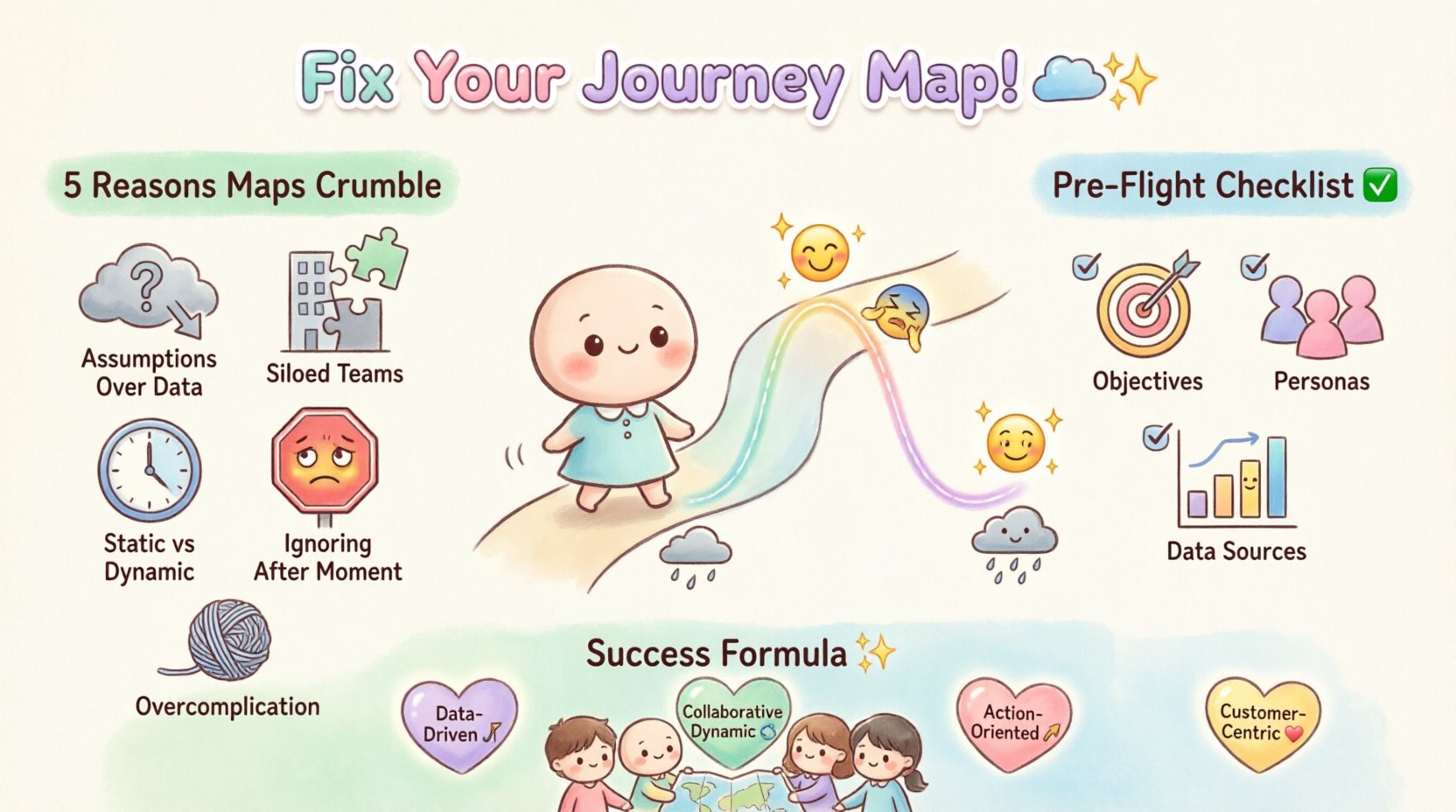
🧱 5 Reasons Your Map Crumbles Under Pressure
Before attempting to create a new map, review your organization against these common failure points. Identifying these risks early prevents wasted resources and team frustration.
1. Assumptions Over Data 📉
The most pervasive error is relying on intuition. Stakeholders often speak confidently about what the customer wants because they project their own needs onto the user base. Without empirical evidence, the map becomes a reflection of internal bias.
- Internal Bias: Assuming customers think like employees.
- Missing Context: Ignoring the environment in which the customer operates.
- Outdated Information: Using data from three years ago for current strategies.
2. Siloed Teams 🏢
Customer journeys rarely stay within a single department. A purchase decision involves marketing, sales, support, and logistics. When these groups work in isolation, the journey map becomes fragmented. Marketing promises one thing, sales delivers another, and support handles the fallout.
If the map is owned solely by the CX team, other departments will not feel responsible for the experience gaps identified in the document. Cross-functional ownership is non-negotiable for success.
3. Static vs. Dynamic 🔄
A journey map is a snapshot in time. Markets change, technology evolves, and customer expectations shift. A map created once and filed away is obsolete before it is published. It must be treated as a living document that is updated regularly.
- Seasonal Fluctuations: Behavior changes during holidays or sales events.
- Product Updates: New features alter how users interact with the system.
- Market Disruption: Competitors introduce new standards.
4. Ignoring the “After” Moment 🛑
Most maps focus heavily on the acquisition and conversion phases. They stop short once the transaction is complete. However, retention and advocacy are determined by the post-purchase experience. If the onboarding process is confusing or the support response is slow, the journey effectively fails regardless of the initial sale.
5. Overcomplication 🌀
Teams often try to map every single interaction across every channel simultaneously. This creates a “spaghetti map” that is too complex to analyze. It is better to focus on specific, high-value journeys first, such as the “First Purchase” or “Support Resolution” flow, rather than attempting to capture the entire lifetime value in one diagram.
🏗️ The Pre-Flight Checklist
Fixing the journey mapping process requires preparation. Before drawing a single line, ensure you have addressed the foundational elements. This checklist ensures you are building on solid ground.
Define Clear Objectives 🎯
What is the specific business problem you are trying to solve? Is it reducing churn? Improving onboarding speed? Increasing cross-sell revenue? Without a clear goal, the map lacks direction and stakeholders cannot measure success.
Identify Key Personas 👥
Select the specific customer segments you are mapping. A generic “customer” is too broad. Focus on the high-value segments or those experiencing the most friction. For example, mapping the journey of a new enterprise client differs significantly from a self-serve small business user.
Gather Data Sources 📊
Compile the evidence that will populate the map. This includes quantitative data (analytics, CRM data) and qualitative data (interviews, surveys). Ensure the data is recent and relevant to the specific journey you are analyzing.
| Data Type | Source | Insight Provided |
|---|---|---|
| Quantitative | Web Analytics | Drop-off points, time on page |
| Qualitative | Customer Interviews | Emotional drivers, pain points |
| Operational | CRM Logs | Service interaction history |
| Feedback | NPS / CSAT Surveys | Satisfaction scores, verbatim comments |
🤝 Stakeholder Alignment
A journey map is a cross-functional tool. It requires input from multiple departments to be accurate and actionable. If you only involve the marketing team, the operational realities will be missed. If you only involve support, the acquisition context is lost.
Create a steering committee that includes representatives from Product, Sales, Marketing, Support, and IT. Their role is to validate the steps in the journey and commit to addressing the identified gaps. This shared ownership prevents the “throw it over the wall” mentality.
📈 Measuring Impact
Once the map is created and changes are implemented, you must measure the outcome. Without metrics, you cannot know if the mapping effort was worthwhile. Define Key Performance Indicators (KPIs) that align with the journey stages.
- Conversion Rate: Does the map improve the move from awareness to purchase?
- Time to Value: Are customers achieving their goals faster?
- Support Ticket Volume: Does the map reduce confusion and calls?
- Customer Retention: Are users staying longer after the initial purchase?
🔄 Iteration and Maintenance
Treating the map as a static deliverable is a critical failure point. You need a governance model for updates. Schedule quarterly reviews to assess if the journey still reflects reality. If a process has changed, the map must reflect that change immediately.
Establish a feedback loop where frontline employees report discrepancies. Customer support agents hear the raw voice of the customer daily. If they report a process that no longer exists, the map is out of date. Incorporate their insights into the next iteration.
🚀 Moving from Map to Action
A map without action is a museum piece. The value of the map lies in the opportunities it reveals. You must translate insights into a backlog of improvement tasks.
1. Prioritize High-Impact Gaps 🔥
Not every friction point is worth fixing immediately. Use a matrix to prioritize based on effort versus impact. Focus on “quick wins” that deliver high customer value with low implementation effort. This builds momentum and trust in the initiative.
2. Assign Ownership 🧑💼
Every identified issue must have an owner. A task cannot be assigned to “the team.” It needs a specific individual or department responsible for execution. Set clear deadlines and check-in points to ensure progress.
3. Communicate Changes 📢
Once changes are made, communicate them internally. The team needs to know that their input led to real changes. This reinforces the value of the journey mapping process and encourages continued participation.
🛠️ Common Pitfalls in Execution
Even with a plan, execution can go wrong. Be vigilant against these common traps during the implementation phase.
- Skipping the Research Phase: Do not skip interviews to save time. You will waste more time fixing incorrect assumptions later.
- Focusing on Channels Over People: Do not map the website, then the app, then the store. Map the person moving between these channels.
- Ignoring Internal Experience: The employee journey impacts the customer journey. If internal processes are broken, the customer will feel it.
- Lack of Executive Sponsorship: If leadership does not support the changes, resources will not be allocated, and the map will be ignored.
🧠 Deep Dive: The Emotional Journey
One of the most overlooked aspects of journey mapping is the emotional component. A linear flow of steps does not capture the stress, excitement, or confusion a customer feels. To fix this, add an emotional curve to your map.
Plot the customer’s emotional state at each touchpoint. Is it low or high? Why does it drop? For example, a customer might feel excited when browsing products but anxious when entering payment details. Addressing the anxiety at that specific moment can dramatically improve conversion.
- Positive Peaks: Identify moments of delight and replicate them.
- Negative Valleys: Identify moments of frustration and eliminate them.
- Thresholds: Determine the emotional point where a customer gives up.
🔍 Validating the Map
Before finalizing the map, validate it with real customers. Do not rely solely on internal knowledge. Conduct usability testing or shadowing sessions to watch the journey unfold in real-time. This step often reveals gaps between what the team thinks happens and what actually happens.
Ask specific questions during validation:
- Did this step match your expectation?
- Was the information clear?
- Did you feel supported during this interaction?
- What was your primary concern at this stage?
📉 The Cost of Inaction
Ignoring these failure points has a tangible cost. Customers who experience friction are less likely to return. In a competitive market, friction is a churn driver. Every unresolved pain point in the journey represents revenue lost.
Furthermore, internal teams suffer. When the journey is unclear, employees struggle to make decisions. They face conflicting directives from different departments. A clear, shared map provides a single source of truth that aligns the entire organization.
📝 Summary of Critical Success Factors
To ensure your customer journey mapping initiative succeeds, adhere to these core principles:
- Data-Driven: Base every step on evidence, not opinion.
- Collaborative: Involve all relevant departments in the creation process.
- Dynamic: Update the map regularly to reflect market changes.
- Action-Oriented: Convert insights into tangible improvements.
- Customer-Centric: Focus on the human experience, not just the transaction.
By addressing the structural weaknesses that typically cause failure, you can transform journey mapping from a theoretical exercise into a practical engine for growth. The goal is not just to draw a picture, but to understand the customer well enough to serve them better. This requires discipline, data, and a commitment to continuous improvement.
Start with a clear scope. Gather the right data. Align your stakeholders. And remember that the map is a tool for change, not just documentation. When you treat the journey as a living system, you unlock the potential for sustained customer satisfaction and business performance.
🚀 Next Steps
Begin by auditing your current journey maps. Do they exist? Are they accurate? If they are outdated, initiate a cleanup process. If they do not exist, start with a single high-value journey. Do not attempt to boil the ocean. Focus on one path, fix it, measure the results, and then expand. This incremental approach builds confidence and capability within the organization.
Remember, the journey never truly ends. As your customers evolve, your map must evolve with them. Stay alert to feedback, remain flexible in your strategy, and keep the customer at the center of every decision you make.