


Conducting a PEST analysis is often viewed as a compliance exercise or a strategic formality. Organizations gather data on Political, Economic, Social, and Technological factors and place them in a report that sits on a shelf. However, the true value of this framework lies not in the analysis itself, but in the execution that follows. Without a clear path from insight to action, the macro-environmental scan remains an academic exercise rather than a driver of growth.
This guide explores the mechanics of translating abstract PEST findings into concrete business decisions. We will move beyond data collection and focus on the operational steps required to integrate macro-environmental intelligence into daily strategy. The goal is to create a robust link between external shifts and internal resource allocation.
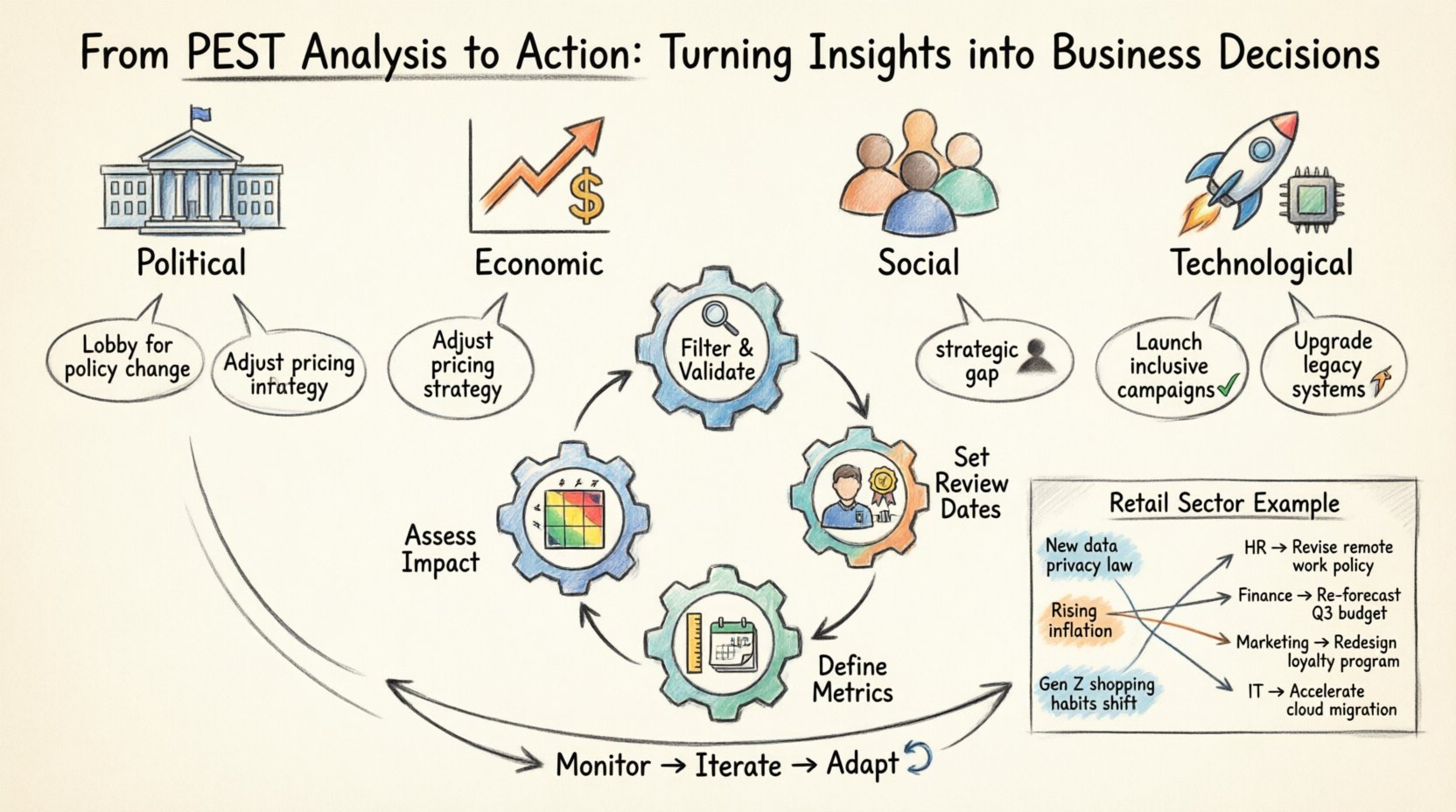
Understanding the Strategic Gap 🕳️
Many organizations suffer from a disconnect between their strategic planning and their operational reality. A PEST analysis highlights external pressures, yet leadership teams often fail to adjust their internal processes accordingly. This gap exists for several reasons:
- Data Overload: Teams gather too much information without a method to filter signal from noise.
- Static Planning: Strategies are often set annually and do not account for dynamic external changes.
- Siloed Information: Political insights might be in legal, while economic trends are in finance, preventing a holistic view.
- Lack of Ownership: No specific role is assigned to monitor and act on these external factors.
To close this gap, you must treat the PEST analysis as a living document that feeds directly into decision-making protocols. It requires a shift from “reporting” to “recommending”.
Deep Dive: Translating Political Factors into Policy 🏛️
Political factors encompass government policies, political stability, trade restrictions, and tax laws. These are often the most rigid constraints a business faces. Translating these findings requires a focus on compliance and risk mitigation.
1. Regulatory Changes
When a PEST analysis identifies a shift in legislation, the immediate action is a compliance audit. For example, if new environmental regulations are proposed, the decision is not just about avoiding fines. It is about supply chain restructuring.
- Assessment: How does the new law impact current production methods?
- Action: Allocate budget for equipment upgrades or process changes.
- Decision: Pause expansion in regions with high regulatory uncertainty.
2. Trade and Tariffs
Geopolitical tensions often lead to trade barriers. If the analysis shows rising tariffs on imported raw materials, the business decision involves sourcing strategy.
- Assessment: Calculate the cost impact of tariffs on the bottom line.
- Action: Identify alternative suppliers in different regions.
- Decision: Diversify the vendor base to reduce dependency on single countries.
Deep Dive: Translating Economic Factors into Financial Strategy 💰
Economic factors include inflation rates, exchange rates, interest rates, and GDP growth. These metrics directly influence purchasing power and cost of capital. Ignoring these signals leads to financial misalignment.
| Economic Indicator | Impact on Business | Concrete Decision |
|---|---|---|
| Rising Inflation | Increased cost of goods and labor | Adjust pricing models or renegotiate supplier contracts |
| High Interest Rates | Expensive borrowing costs | Delay capital expenditure projects or use cash reserves |
| Currency Fluctuation | Volatility in import/export costs | Implement hedging strategies or price in foreign currency |
| Recession Risk | Reduced consumer spending | Focus on cost reduction and essential product lines |
When economic indicators shift, the budgeting process must become more agile. Instead of a fixed annual budget, consider rolling forecasts that adjust based on economic triggers identified in the PEST analysis.
Deep Dive: Translating Social Factors into Market Position 🧑
Social factors involve demographics, cultural trends, health consciousness, and lifestyle changes. These are often the most volatile factors because they reflect human behavior. Ignoring social shifts leads to brand irrelevance.
1. Demographic Shifts
If the analysis shows an aging population in a key market, the product line must evolve. The decision involves R&D priorities and marketing messaging.
- Assessment: Is the target audience shrinking or growing?
- Action: Redesign products for accessibility or longevity.
- Decision: Shift marketing spend to channels preferred by the demographic.
2. Cultural Values
Social movements can change consumer expectations overnight. For instance, a shift towards sustainability is not just a trend but a demand.
- Assessment: How does the brand align with current values?
- Action: Update supply chain ethics and communication.
- Decision: Rebrand or pivot offerings to match social expectations.
Business decisions here are often about brand trust. A failure to adapt to social norms can result in reputational damage that is harder to fix than a financial loss.
Deep Dive: Translating Technological Factors into Innovation 🚀
Technological factors cover automation, R&D activity, and the pace of obsolescence. This is the factor that drives the most rapid change in modern business. Failing to act on technological insights leads to competitive disadvantage.
1. Emerging Technologies
Identifying a new technology in the PEST analysis requires a decision on adoption. Do you build, buy, or partner?
- Assessment: Is the technology mature enough for integration?
- Action: Invest in pilot programs to test feasibility.
- Decision: Allocate capital to integrate the technology if ROI is positive.
2. Obsolescence Risk
Existing technologies may become outdated. This forces a decision on legacy system maintenance versus modernization.
- Assessment: What is the cost of maintaining old systems versus moving to new ones?
- Action: Plan a phased migration strategy.
- Decision: Halt development of legacy features to focus on new platforms.
The key here is speed. Technological advantages are often temporary. The decision process must be faster than the rate of innovation.
A Framework for Decision Translation 🔄
To ensure consistency across all PEST factors, implement a structured framework. This prevents ad-hoc reactions and ensures every finding is processed the same way.
Step 1: Filter and Validate
Not all data is actionable. Filter findings based on relevance to your specific industry and geography. Ask: Does this factor directly impact our revenue or cost structure?
Step 2: Assess Impact and Probability
Use a risk matrix to score findings. High impact and high probability findings take priority. Low impact and low probability findings can be monitored but not acted upon immediately.
Step 3: Assign Ownership
Every decision derived from the PEST analysis must have an owner. If a political risk is identified, Legal owns the mitigation. If an economic trend is found, Finance owns the budget adjustment.
Step 4: Define Metrics
Decisions must be measurable. Define what success looks like. If the decision is to diversify suppliers, the metric is the percentage of spend with new vendors.
Step 5: Set Review Dates
Decisions are not permanent. Set dates to review the effectiveness of the decision against the original PEST finding.
Risk Assessment and Mitigation Planning 🛡️
PEST analysis is inherently a risk identification tool. Once you have identified risks, you must develop mitigation plans. This moves the conversation from “what could happen” to “what will we do if it happens”.
- Contingency Planning: Develop backup plans for critical failures. If a specific government policy changes, what is the fallback?
- Insurance and Hedging: Use financial instruments to protect against economic volatility.
- Scenario Planning: Run simulations based on different PEST outcomes. How does the business survive a recession? How does it grow during a boom?
This proactive approach reduces panic when external events occur. The decision to prepare in advance is a strategic advantage.
Communication and Stakeholder Alignment 🗣️
Even the best decisions fail if stakeholders do not understand the rationale. Communication is a critical part of execution.
1. Executive Briefing
Summarize the PEST findings for the board in terms of financial impact and strategic risk. Avoid jargon. Focus on the bottom line implications.
2. Departmental Alignment
Ensure that operational teams understand how the external environment affects their daily work. If interest rates rise, the sales team needs to know how to pitch financing options.
3. Transparency
Share the monitoring process. When teams know they are part of a broader strategic scan, they contribute better data.
Monitoring and Iteration 🔄
A PEST analysis is not a one-time event. The environment changes continuously. Execution requires a feedback loop.
- Continuous Monitoring: Set up alerts for key indicators identified in the initial analysis.
- Quarterly Reviews: Re-evaluate the PEST factors every quarter. Are the assumptions still valid?
- Trigger-Based Updates: If a specific event occurs (e.g., an election result), trigger an immediate re-analysis.
By maintaining this cycle, the organization remains agile. The decision to monitor continuously is more important than the decision made today.
Case Study Applications 📝
Consider a retail company facing these PEST findings:
- Political: New minimum wage laws.
- Economic: High inflation.
- Social: Preference for online shopping.
- Technological: Rise of mobile payment systems.
The concrete decisions would be:
- HR: Review staffing models and automate inventory tasks to offset wage increases.
- Finance: Adjust pricing strategy to maintain margins without losing volume.
- Marketing: Shift budget from print to digital channels.
- IT: Upgrade point-of-sale systems to accept mobile payments.
Each decision directly addresses a finding. This is the essence of execution.
Common Pitfalls to Avoid ⚠️
Even with a framework, mistakes happen. Be wary of these common errors during the execution phase.
- Confirmation Bias: Only looking for data that supports existing plans.
- Analysis Paralysis: Gathering too much data and delaying decisions.
- Ignoring Weak Signals: Focusing only on obvious threats and missing subtle trends.
- Lack of Follow-through: Making decisions but failing to allocate resources to implement them.
Staying vigilant against these pitfalls ensures the PEST analysis remains a tool for success rather than a source of anxiety.
Final Thoughts on Strategic Agility 🧭
The transition from analysis to action defines the success of any strategic initiative. A PEST analysis provides the map, but execution provides the movement. By using the frameworks outlined above, organizations can ensure that external insights drive internal change.
Focus on ownership, measurement, and continuous monitoring. Treat the environment as a dynamic force that requires constant adaptation. When you align your decisions with the macro-environment, you reduce risk and position the business for sustainable growth.
Start today. Review your current PEST data. Identify one actionable insight. Assign an owner. Set a timeline. This is how abstract data becomes concrete progress.
Related posts:
 Definitive Overview: The Complete Guide to PEST Analysis for Startup Founders
 Component Breakdown: PEST Analysis Explained: A Beginner’s Guide to the 4 Key Forces
 Quick Start: How to Run a PEST Analysis in Under 2 Hours for Your New Business
 Comprehensive Walkthrough: Step-by-Step PEST Analysis for Small Business Owners