
Expanding a franchise across multiple locations introduces a complex layer of strategic planning. Unlike a single-unit operation, a multi-location business must account for diverse regulatory environments, fluctuating local economies, and varying consumer behaviors. This is where a tailored PEST analysis for franchises becomes essential. It provides a structured framework to evaluate external factors that influence business performance on a regional level.
Standard business models often assume a homogenous market. However, franchise networks operate in a mosaic of distinct micro-markets. A strategy that works in a metropolitan hub may fail in a rural community. Understanding these differences requires a deep dive into Political, Economic, Social, and Technological factors specific to each location. This guide outlines how to adapt this framework for multi-location operations without relying on proprietary tools.
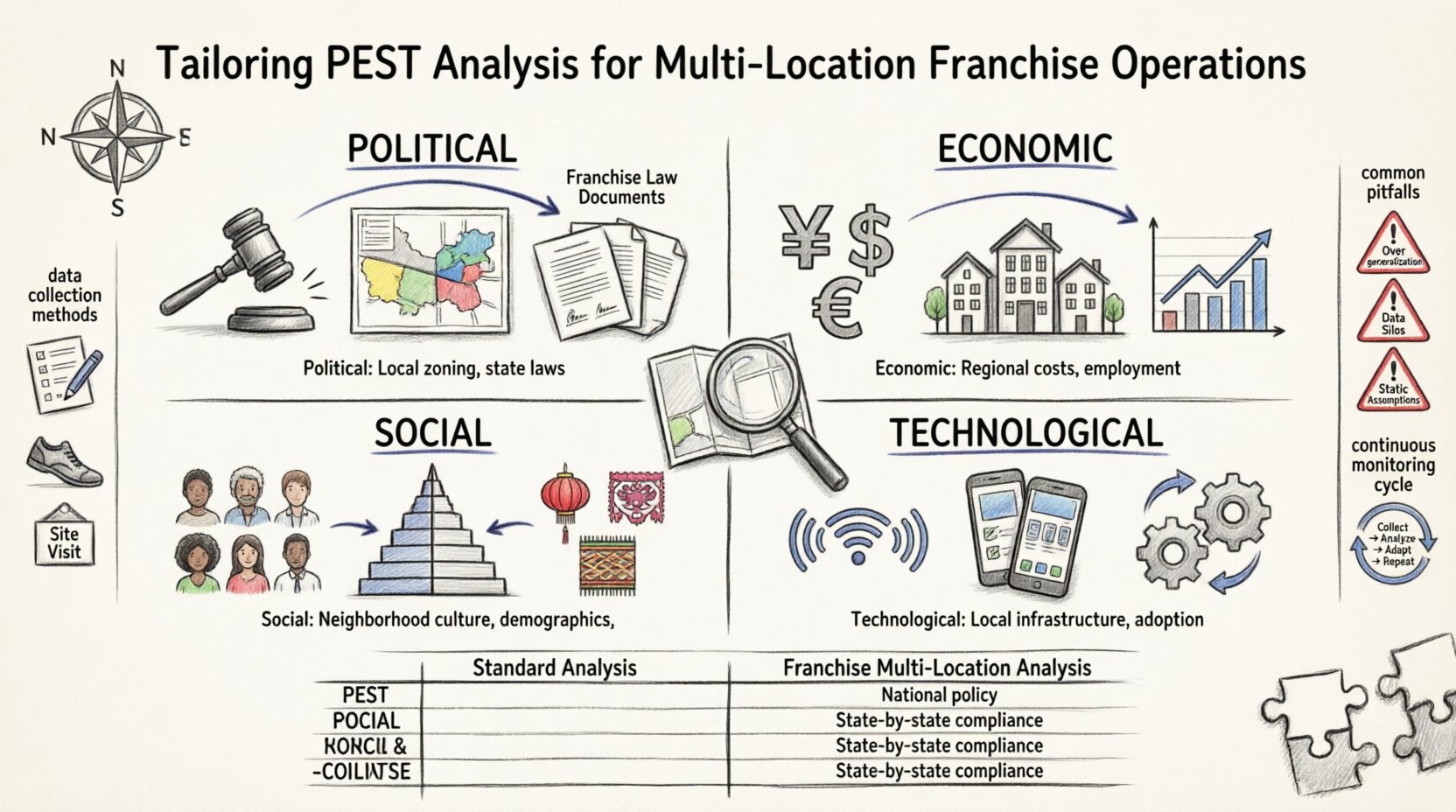
🧩 Understanding the Core Framework
The PEST analysis is a strategic tool used to identify the key external factors affecting an organization. In the context of franchise expansion, it shifts from a broad national view to a granular local view. The four pillars remain the same, but their application changes significantly.
- Political: Laws, government policies, and trade restrictions.
- Economic: Economic growth, interest rates, exchange rates, and inflation.
- Social: Cultural aspects, population growth, age distribution, and health consciousness.
- Technological: Innovations, R&D activity, automation, and technological incentives.
For a franchisee or franchisor, the goal is not just to list these factors, but to understand how they interact within a specific geography. A change in minimum wage in one state impacts labor costs differently than a similar change in another due to existing wage floors. This nuance is critical for accurate forecasting.
📉 Why Standard Analysis Falls Short for Franchises
Many businesses make the mistake of applying a national PEST analysis to all locations. This approach overlooks the volatility inherent in local markets. A single report cannot capture the specific zoning laws of a municipality or the specific economic downturn of a local industry. When planning multi-location operations, reliance on generalized data leads to inaccurate budgeting and missed opportunities.
Consider the following discrepancies that a standard analysis might miss:
- Regulatory Variance: Health codes for food franchises differ by county. Licensing requirements for service franchises vary by state.
- Local Economic Health: A national GDP growth figure may hide a recession in a specific industrial region.
- Demographic Shifts: Urban areas may see an influx of young professionals, while rural areas face aging populations.
- Infrastructure Gaps: Internet reliability for a tech-enabled service varies wildly between zip codes.
To mitigate risk, the analysis must be localized. This means conducting separate assessments for clusters of locations or specific high-priority regions. It allows the organization to identify where a new site is viable and where it poses unnecessary financial risk.
⚖️ Political Factors: Navigating Local and National Regulations
Political stability and government intervention directly impact operational costs and compliance requirements. For multi-location businesses, the political landscape is not uniform. A franchise operating in several states faces a patchwork of regulations.
1. Franchise Law and Franchising Regulations
Franchising is heavily regulated in many jurisdictions. Understanding the legal framework is the first step. Some regions have specific disclosure requirements that go beyond federal laws. Others have restrictions on termination fees or renewal terms. Ignoring these can lead to costly litigation or forced site closures.
- Disclosure Documents: Ensure compliance with local disclosure laws before signing agreements.
- Termination Clauses: Review local laws regarding contract termination to protect long-term investments.
- Registration: Some states require franchise registration before sales can commence.
2. Zoning and Land Use Laws
Site selection is heavily influenced by local zoning ordinances. A location that looks perfect on a map may be zoned for industrial use only. Commercial zoning often comes with specific restrictions on signage, hours of operation, and parking requirements.
- Compliance Checks: Verify zoning status before signing a lease.
- Permitting: Understand the timeline for obtaining necessary permits, as this delays opening.
- Environmental Regulations: Some areas have strict rules regarding waste disposal or emissions.
3. Labor Laws and Tax Policies
Minimum wage laws, overtime rules, and benefit mandates vary by location. A franchise in a high-cost area may face significantly higher labor costs than one in a low-cost area. Similarly, corporate tax structures can affect the net profit of the regional headquarters.
- Wage Floors: Monitor local minimum wage increases that may outpace national trends.
- Payroll Taxes: Account for local payroll taxes that impact the bottom line.
- Union Activity: Assess the likelihood of unionization in specific industrial sectors within a region.
💰 Economic Conditions: Assessing Regional Financial Health
Economic indicators drive consumer spending power. For a franchise, this means understanding the disposable income of the local population. National economic reports often mask local disparities. A strong national economy might still coincide with a struggling local manufacturing hub.
1. Local Cost of Living and Income Levels
The cost of living determines how much money a customer has available for discretionary spending. In high-cost urban centers, residents may have higher incomes but also higher fixed costs, potentially reducing spend on non-essential services. Conversely, lower-cost areas may have less disposable income overall.
- Disposable Income: Calculate the percentage of income available after taxes and essential bills.
- Employment Rates: High unemployment rates directly correlate to reduced foot traffic.
- Wage Growth: Monitor if local wages are keeping pace with inflation.
2. Real Estate Costs and Availability
Commercial real estate is a major capital expenditure. Rent prices fluctuate based on local demand and availability. In some regions, landlords may require higher security deposits or longer lease terms. In others, there may be a surplus of vacant space, offering negotiation leverage.
- Rent per Square Foot: Compare costs across potential locations to ensure ROI.
- Lease Terms: Understand local market norms for lease duration and renewal options.
- Property Taxes: Factor in annual property tax assessments into the operating budget.
3. Inflation and Interest Rates
Local inflation rates can differ from the national average. If local inflation is high, suppliers may raise prices faster than the franchise can adjust menu or service prices. Interest rates affect the cost of borrowing for expansion.
- Supplier Contracts: Lock in rates where possible if local inflation is predicted to rise.
- Financing Costs: Evaluate the cost of capital for new site development.
- Pricing Strategy: Determine if price increases are feasible based on local purchasing power.
👥 Social Dynamics: Cultural Nuances and Demographics
Consumer behavior is deeply rooted in culture. What resonates in one community may fall flat in another. A successful multi-location strategy must adapt to the social fabric of each area. This involves looking at demographics, cultural values, and lifestyle trends.
1. Demographic Shifts
Population density, age distribution, and household size dictate the demand for specific products or services. An area with a high concentration of young families may require different offerings than an area dominated by retirees.
- Age Groups: Align product offerings with the dominant age demographic.
- Family Structure: Consider household size when determining portion sizes or service packages.
- Population Growth: Prioritize areas with positive growth trends for future expansion.
2. Cultural Preferences and Brand Perception
Brand perception varies by region. A brand known for speed in one city may be viewed as low-quality in another where service is valued over speed. Local cultural norms influence customer expectations regarding hospitality and interaction.
- Brand Alignment: Ensure marketing messages align with local cultural values.
- Community Engagement: Participate in local events to build trust and visibility.
- Language: Consider language barriers in customer service and signage.
3. Lifestyle and Health Trends
Health consciousness and lifestyle choices impact purchasing decisions. An area with a strong fitness culture may prefer healthier menu options or eco-friendly products. Ignoring these trends can make a location seem out of touch.
- Dietary Trends: Adjust offerings to include local dietary preferences (e.g., vegan, gluten-free).
- Wellness Focus: Highlight health benefits if relevant to the local market.
- Environmental Awareness: Adopt sustainable practices if the local community values them.
📡 Technological Infrastructure: Connectivity and Adoption
Technology acts as both an enabler and a barrier. In the modern economy, connectivity and digital adoption are prerequisites for many business models. A franchise relying on digital ordering or remote management tools needs robust infrastructure.
1. Internet Connectivity and Reliability
High-speed internet is critical for point-of-sale systems, inventory management, and customer Wi-Fi. Rural areas or older urban districts may suffer from unreliable connections, leading to operational downtime.
- Service Providers: Identify available providers and their reliability ratings.
- Redundancy: Plan for backup internet solutions to prevent disruption.
- Cost: Factor in the cost of high-speed installation and monthly fees.
2. Mobile Usage and Digital Adoption
Customer interaction often happens on mobile devices. In areas with high smartphone penetration, a mobile app or mobile-optimized website is essential. In areas with lower adoption, traditional marketing may still be more effective.
- App Usage: Determine the level of mobile app adoption for loyalty programs.
- Online Ordering: Assess the demand for contactless or delivery ordering.
- Payment Methods: Ensure support for local digital payment preferences.
3. Automation and Equipment Availability
Access to modern equipment and automation tools can improve efficiency. Some regions may have a skilled labor pool capable of managing advanced machinery, while others may require more manual labor.
- Labor Skills: Assess the technical skill level of the local workforce.
- Supply Chain: Ensure local availability of necessary hardware or equipment.
- Support: Check for local technical support services.
📊 Building the Franchise-Specific PEST Matrix
To visualize the differences between a standard analysis and a franchise-specific one, consider the following comparison table. This matrix helps in identifying where the focus needs to shift.
| Factor | Standard Business Analysis | Franchise Multi-Location Analysis |
|---|---|---|
| Political | National trade policies and federal tax laws. | Local zoning, state franchise laws, municipal permits. |
| Economic | National GDP and inflation rates. | Local cost of living, regional employment, real estate costs. |
| Social | General population demographics. | Neighborhood culture, local lifestyle trends, specific demographics. |
| Technological | Industry-wide tech trends. | Local internet infrastructure, mobile adoption rates, tech support. |
Using this matrix, teams can prioritize data collection. Instead of gathering national news, they should focus on local government meeting minutes, regional economic reports, and neighborhood surveys. This targeted approach ensures resources are spent on information that directly impacts site viability.
🛠️ Execution and Data Gathering Strategies
Conducting this analysis requires a disciplined approach to data collection. Without relying on external software, manual and collaborative methods yield the best results. The process involves gathering, verifying, and interpreting data.
1. Primary Data Collection
- Local Surveys: Conduct surveys among potential customers in the target area.
- Stakeholder Interviews: Speak with local business owners, chamber of commerce members, and real estate agents.
- Site Visits: Physically visit locations to observe traffic patterns and neighborhood conditions.
2. Secondary Data Sources
- Census Data: Access public demographic data for specific zip codes.
- Government Reports: Review local economic development plans and zoning maps.
- Industry Reports: Look for regional breakdowns in industry-specific publications.
3. Cross-Functional Collaboration
Involve different departments in the analysis. Legal teams should review political factors. Finance teams should analyze economic data. Marketing teams should assess social trends. This ensures a holistic view where blind spots are minimized.
- Legal Review: Confirm compliance with all local regulations.
- Financial Modeling: Adjust projections based on local cost structures.
- Marketing Strategy: Tailor messaging to local social dynamics.
⚠️ Common Pitfalls in Multi-Location Planning
Even with a solid framework, errors can occur. Being aware of common mistakes helps in avoiding them. The following list highlights frequent issues observed in multi-location strategies.
- Overgeneralization: Assuming one location represents the whole market. Always drill down to the zip code level.
- Ignoring Regulations: Failing to update analysis as laws change. Regulations evolve frequently.
- Static Analysis: Treating PEST as a one-time event. External factors change rapidly.
- Data Silos: Keeping data in one department. Information must flow across the organization.
- Cost Neglect: Focusing on revenue potential without accounting for local operational costs.
🔄 Continuous Monitoring and Adaptation
The business environment is dynamic. A PEST analysis conducted today may be obsolete in six months. Continuous monitoring is required to maintain strategic alignment. This involves setting up a system for regular reviews.
- Quarterly Reviews: Schedule regular check-ins to update key data points.
- Trigger Events: Establish criteria for immediate analysis updates (e.g., new local law passed).
- Feedback Loops: Gather feedback from franchisees and store managers on local changes.
- Scenario Planning: Prepare plans for best-case and worst-case scenarios based on PEST data.
By maintaining a living document rather than a static report, the organization remains agile. This agility allows for quicker responses to emerging threats or opportunities. It turns the PEST analysis from a compliance exercise into a strategic asset.