


Introduction
In the fast-paced world of Agile development, documentation often becomes the bottleneck. Traditional drag-and-drop diagramming tools require constant context switching, breaking the developer’s flow and making version control a nightmare. For Agile teams who live in their IDEs and manage infrastructure as code, diagrams should be no different.
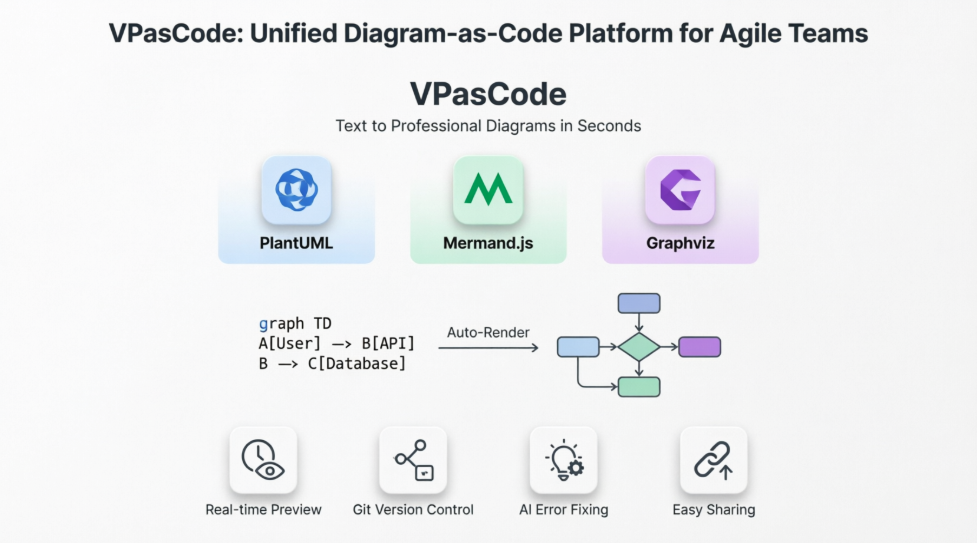
Enter VPasCode (Visual Paradigm as Code), a unified, browser-based platform that transforms text into professional, high-fidelity diagrams in seconds. By bringing together the power of PlantUML, Mermaid.js, and Graphviz into a single seamless environment, VPasCode allows software engineers, system architects, and business analysts to treat diagrams exactly like code: lightweight, version-controllable, and instantly renderable. This case study explores how an experienced Visual Paradigm user and Agile developer can leverage VPasCode to streamline workflows, enhance team collaboration, and maintain architectural clarity without leaving the code editor mindset.
The Agile Developer’s Dilemma: Why Diagram-as-Code?
For years, Agile teams have struggled with the “diagram decay” problem. A whiteboard sketch from Sprint Planning is rarely updated by Sprint Review. Drag-and-drop tools create binary files that don’t play nice with Git diffs, making it difficult to track who changed what in an architecture diagram.
VPasCode solves this by adopting a Diagram-as-Code (DaC) approach. Whether you are defining a complex microservices architecture or a simple user journey, you write it in text. This means:
-
Git-Native Friendly: Store your diagrams as raw text files alongside your source code.
-
Zero-Setup Cloud Access: No software downloads or local dependencies required; it runs entirely in the browser.
-
Real-Time Preview: See your graphics live-render instantly as you type, providing immediate feedback.
Unified Workspace: One Editor, Three Powerful Engines
VPasCode brings the world’s most popular open-source diagramming syntaxes into one cohesive cloud editor. Instead of juggling multiple tools, you have native parsing and rendering for three major engines:
-
PlantUML: The gold standard for robust enterprise and software architecture diagrams.
-
Mermaid.js: Perfect for modern, markdown-inspired charts, timelines, and flowcharts.
-
Graphviz: Ideal for leveraging the DOT language for complex network topologies and data structures.
Deep Dive: PlantUML for Enterprise Architecture
PlantUML remains the powerhouse for detailed technical modeling. VPasCode supports a vast library of PlantUML diagram types, including Sequence, Use Case, Class, Activity, Component, Deployment, State, ArchiMate, and Entity Relationship Diagrams (ERD).
Modeling Complex Systems: The Library Management Example
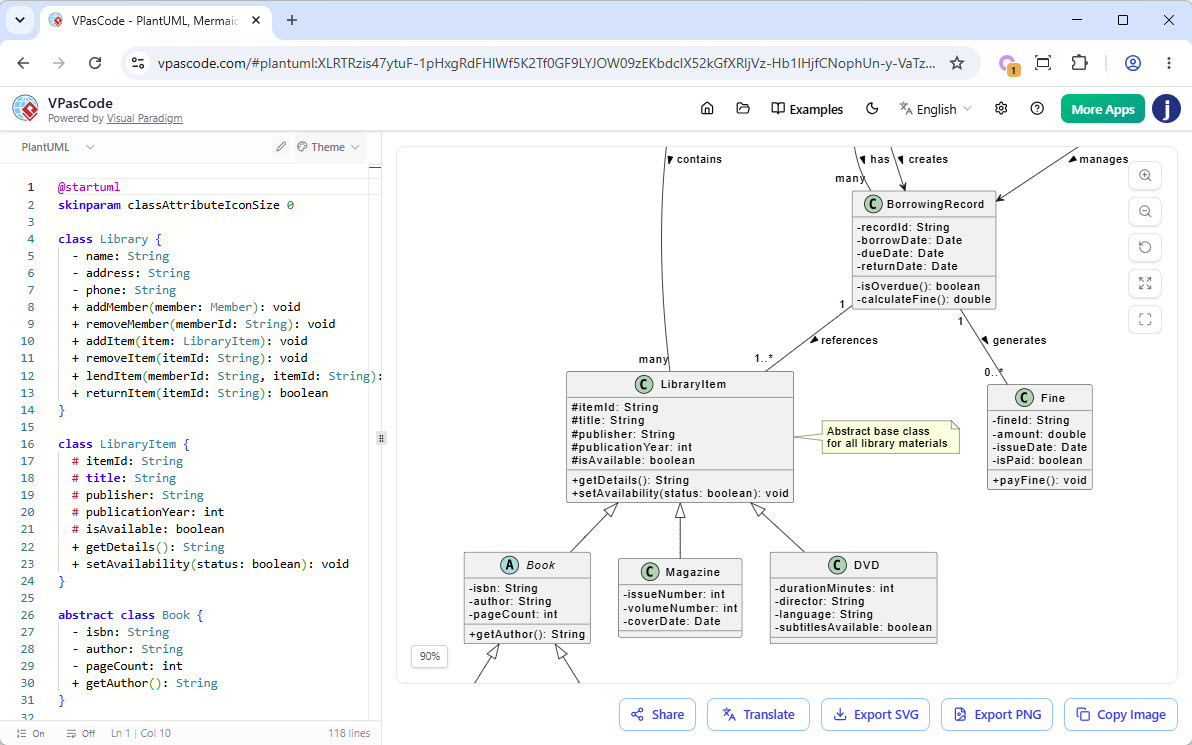
Consider a Library Management System. Using PlantUML in VPasCode, we can model inheritance, composition, and aggregation clearly. The code below defines the relationships between Library, Member, LibraryItem, and various subclasses like EBook and PrintedBook.
@startuml

class Library {
  - name: String
  - address: String
  - phone: String
  + addMember(member: Member): void
  + removeMember(memberId: String): void
  + addItem(item: LibraryItem): void
  + removeItem(itemId: String): void
  + lendItem(memberId: String, itemId: String): boolean
  + returnItem(itemId: String): boolean
}

class LibraryItem {
  # itemId: String
  # title: String
  # publisher: String
  # publicationYear: int
  # isAvailable: boolean
  + getDetails(): String
  + setAvailability(status: boolean): void
}

abstract class Book {
  - isbn: String
  - author: String
  - pageCount: int
  + getAuthor(): String
}

class EBook {
  - fileSizeMB: double
  - format: String
  - downloadUrl: String
  + download(): void
}

class PrintedBook {
  - shelfLocation: String
  - condition: String
  + getShelfLocation(): String
}

class Magazine {
  - issueNumber: int
  - volumeNumber: int
  - coverDate: Date
}

class DVD {
  - durationMinutes: int
  - director: String
  - language: String
  - subtitlesAvailable: boolean
}

class Member {
  - memberId: String
  - name: String
  - email: String
  - phone: String
  - membershipDate: Date
  + borrowItem(item: LibraryItem): boolean
  + returnItem(item: LibraryItem): boolean
  + getBorrowedItems(): List
}

class BorrowingRecord {
  - recordId: String
  - borrowDate: Date
  - dueDate: Date
  - returnDate: Date
  - isOverdue(): boolean
  - calculateFine(): double
}

class Fine {
  - fineId: String
  - amount: double
  - issueDate: Date
  - isPaid: boolean
  + payFine(): void
}

class Librarian {
  - staffId: String
  - department: String
  + processBorrowing(member: Member, item: LibraryItem): void
  + processReturn(item: LibraryItem): void
  + generateReport(): void
  + manageInventory(): void
}

' Inheritance relationships
LibraryItem <|-- Book
LibraryItem <|-- Magazine
LibraryItem <|-- DVD
Book <|-- EBook
Book <|-- PrintedBook

' Composition and Aggregation

Library "1" -- "many" Member : has >
Library "1" -- "many" LibraryItem : contains >
Library "1" -- "many" Librarian : employs >

Member "1" -- "many" BorrowingRecord : has >
BorrowingRecord "1" -- "1..*" LibraryItem : references >
BorrowingRecord "1" -- "0..*" Fine : generates >

' Association
Librarian --> BorrowingRecord : manages >
Member --> BorrowingRecord : creates >

note top of Library : Central system that manages\nmembers, items, and lending
note right of LibraryItem : Abstract base class\nfor all library materials
@enduml
Handling Logic Flows: ATM Cash Withdrawal
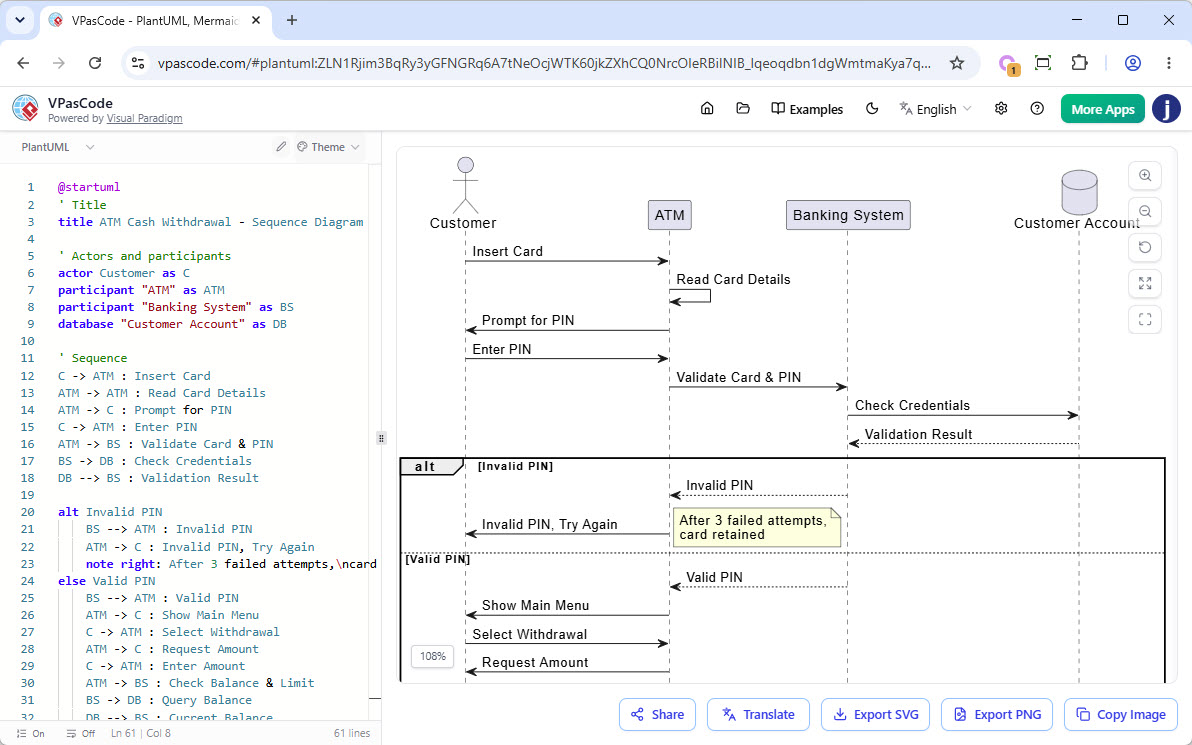
Sequence diagrams are critical for understanding interactions between system components. The following example models an ATM cash withdrawal, highlighting alternative flows such as invalid PINs and insufficient funds using PlantUML’s alt blocks.
@startuml
' Title
title ATM Cash Withdrawal - Sequence Diagram

' Actors and participants
actor Customer as C
participant "ATM" as ATM
participant "Banking System" as BS
database "Customer Account" as DB

' Sequence
C -> ATM : Insert Card
ATM -> ATM : Read Card Details
ATM -> C : Prompt for PIN
C -> ATM : Enter PIN
ATM -> BS : Validate Card & PIN
BS -> DB : Check Credentials
DB --> BS : Validation Result

alt Invalid PIN
    BS --> ATM : Invalid PIN
    ATM -> C : Invalid PIN, Try Again
    note right: After 3 failed attempts,\ncard retained
else Valid PIN
    BS --> ATM : Valid PIN
    ATM -> C : Show Main Menu
    C -> ATM : Select Withdrawal
    ATM -> C : Request Amount
    C -> ATM : Enter Amount
    ATM -> BS : Check Balance & Limit
    BS -> DB : Query Balance
    DB --> BS : Current Balance

    alt Insufficient Funds
        BS --> ATM : Insufficient Balance
        ATM -> C : Transaction Declined\n(Display Balance)
        C -> ATM : Cancel Transaction
        ATM -> C : Return Card
    else Sufficient Funds
        BS --> ATM : Approved
        ATM -> ATM : Dispense Cash
        ATM -> C : Dispense Cash
        C -> ATM : Take Cash
        ATM -> BS : Confirm Cash Dispensed
        BS -> DB : Debit Account & Log Transaction
        DB --> BS : Update Complete
        BS --> ATM : Transaction Complete
        ATM -> C : Print Receipt
        alt Receipt Requested
            C -> ATM : Take Receipt
        else No Receipt
            C -> ATM : Decline Receipt
        end
        ATM -> C : Return Card
        C -> ATM : Take Card
    end
end

ATM -> C : Thank You / Transaction End

@enduml
Business Process Modeling: Insurance Claim System
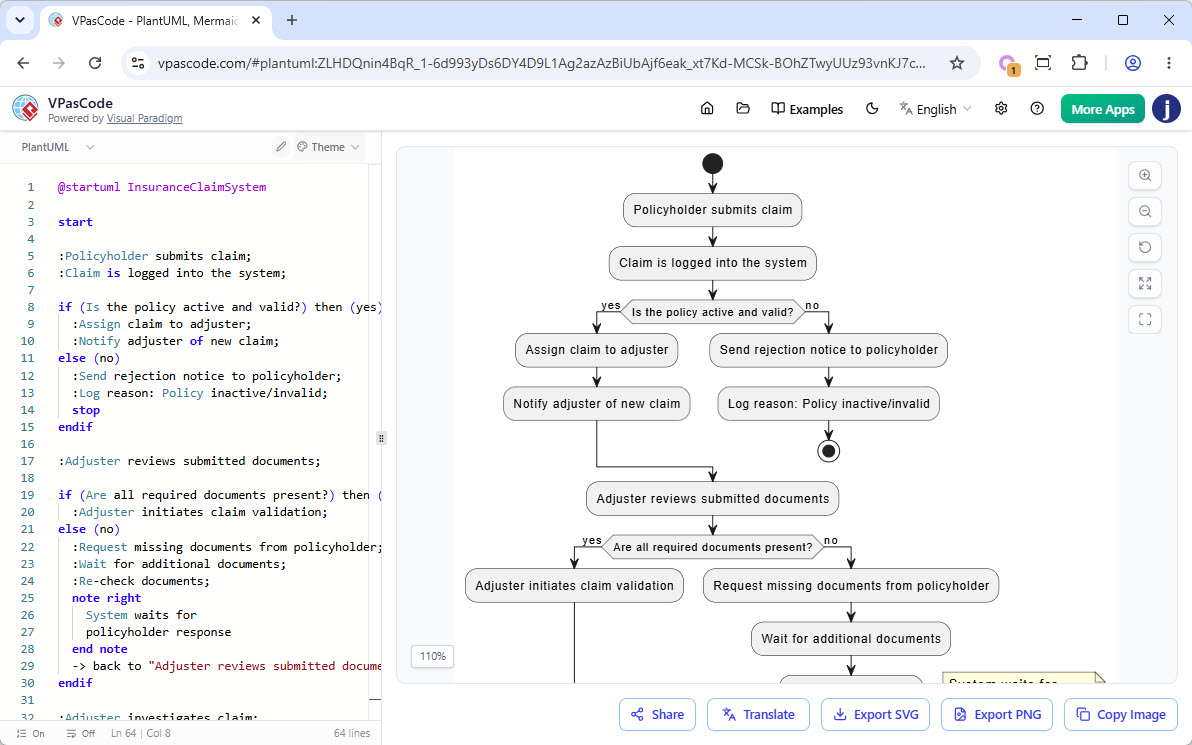
Activity diagrams help visualize workflow logic. The example below models an insurance claim process, capturing decision points like policy validity and document completeness.
@startuml InsuranceClaimSystem

start

:Policyholder submits claim;
:Claim is logged into the system;

if (Is the policy active and valid?) then (yes)
  :Assign claim to adjuster;
  :Notify adjuster of new claim;
else (no)
  :Send rejection notice to policyholder;
  :Log reason: Policy inactive/invalid;
  stop
endif

:Adjuster reviews submitted documents;

if (Are all required documents present?) then (yes)
  :Adjuster initiates claim validation;
else (no)
  :Request missing documents from policyholder;
  :Wait for additional documents;
  :Re-check documents;
  note right
    System waits for
    policyholder response
  end note
  -> back to "Adjuster reviews submitted documents";
endif

:Adjuster investigates claim;
:Contact witnesses/experts if needed;
:Estimate damage/loss amount;

if (Is claim valid based on policy terms?) then (yes)
  :Calculate approved amount;
  :Apply deductible if applicable;
else (no)
  :Send rejection notice with reason;
  :Log decision in system;
  stop
endif

:Generate settlement offer;
:Send settlement offer to policyholder;

:Policyholder reviews offer;

if (Does policyholder accept the offer?) then (yes)
  :Process payment;
  :Update claim status to "Settled";
  :Send confirmation to policyholder;
  :Log closure details;
else (no)
  :Escalate to dispute resolution;
  :Negotiate settlement;
  :Update offer;
  -> back to "Send settlement offer to policyholder";
endif

stop

@enduml
State Machines: Smoke Detection System
For embedded systems or IoT devices, state diagrams are essential. This example shows a smoke detection system transitioning between standby, monitoring, and alarm states.
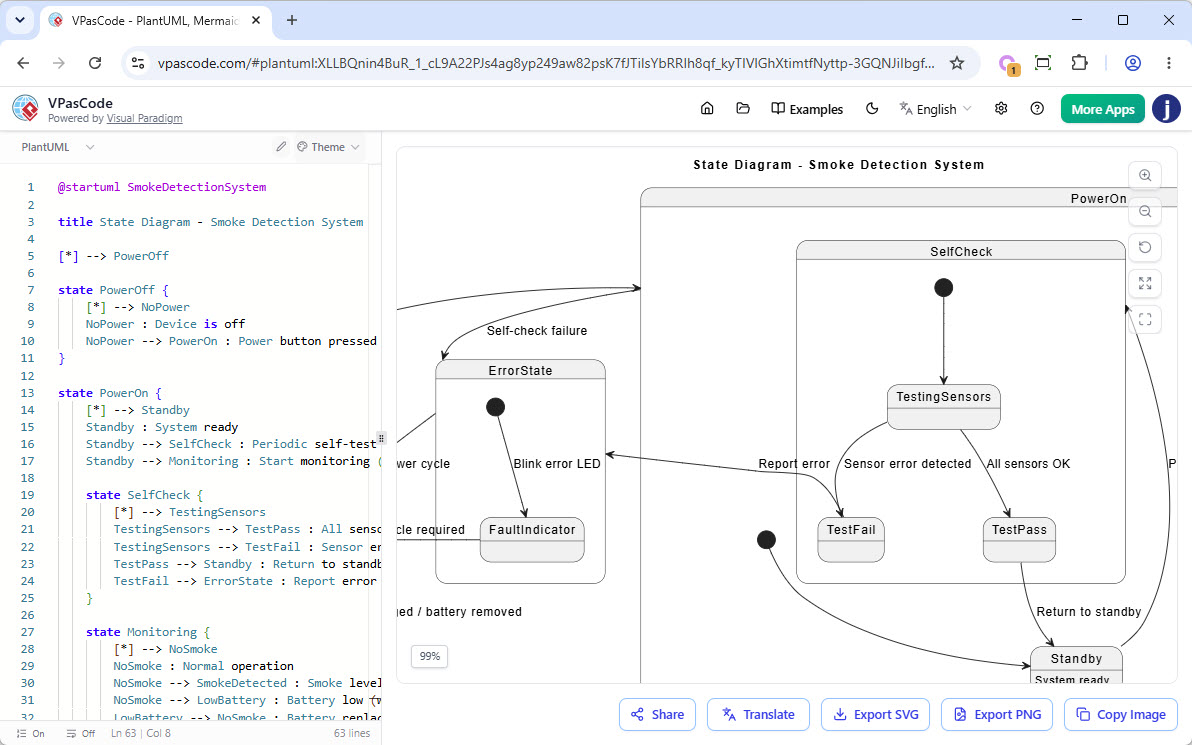
@startuml SmokeDetectionSystem

title State Diagram - Smoke Detection System

[*] --> PowerOff

state PowerOff {
    [*] --> NoPower
    NoPower : Device is off
    NoPower --> PowerOn : Power button pressed
}

state PowerOn {
    [*] --> Standby
    Standby : System ready
    Standby --> SelfCheck : Periodic self-test (every 24h)
    Standby --> Monitoring : Start monitoring (sensor active)

    state SelfCheck {
        [*] --> TestingSensors
        TestingSensors --> TestPass : All sensors OK
        TestingSensors --> TestFail : Sensor error detected
        TestPass --> Standby : Return to standby
        TestFail --> ErrorState : Report error
    }

    state Monitoring {
        [*] --> NoSmoke
        NoSmoke : Normal operation
        NoSmoke --> SmokeDetected : Smoke level > threshold
        NoSmoke --> LowBattery : Battery low (wireless)
        LowBattery --> NoSmoke : Battery replaced

        state SmokeDetected {
            [*] --> InitialAlert
            InitialAlert --> ConfirmedSmoke : Smoke persists > 5 sec
            InitialAlert --> FalseAlarm : Smoke clears < 5 sec FalseAlarm --> NoSmoke : Reset
            ConfirmedSmoke --> AlarmActive
        }

        state AlarmActive {
            [*] --> SoundAlarm : Activate siren & lights
            SoundAlarm --> SendNotification : Notify control panel / app
            SendNotification --> WaitForReset
            WaitForReset --> AlarmActive : Smoke still present
            WaitForReset --> ResetSystem : Reset button pressed
            ResetSystem --> NoSmoke : System resets
        }
    }
}

state ErrorState {
    [*] --> FaultIndicator : Blink error LED
    FaultIndicator --> PowerOff : Manual power cycle required
}

PowerOn --> ErrorState : Self-check failure
ErrorState --> PowerOff : Power cycle

PowerOff --> [*] : System unplugged / battery removed

@enduml
High-Level Architecture: Courier System Component Diagram
Component diagrams provide a high-level view of system architecture. This example illustrates a courier management system, showing how client apps, backend services, message queues, and databases interact.
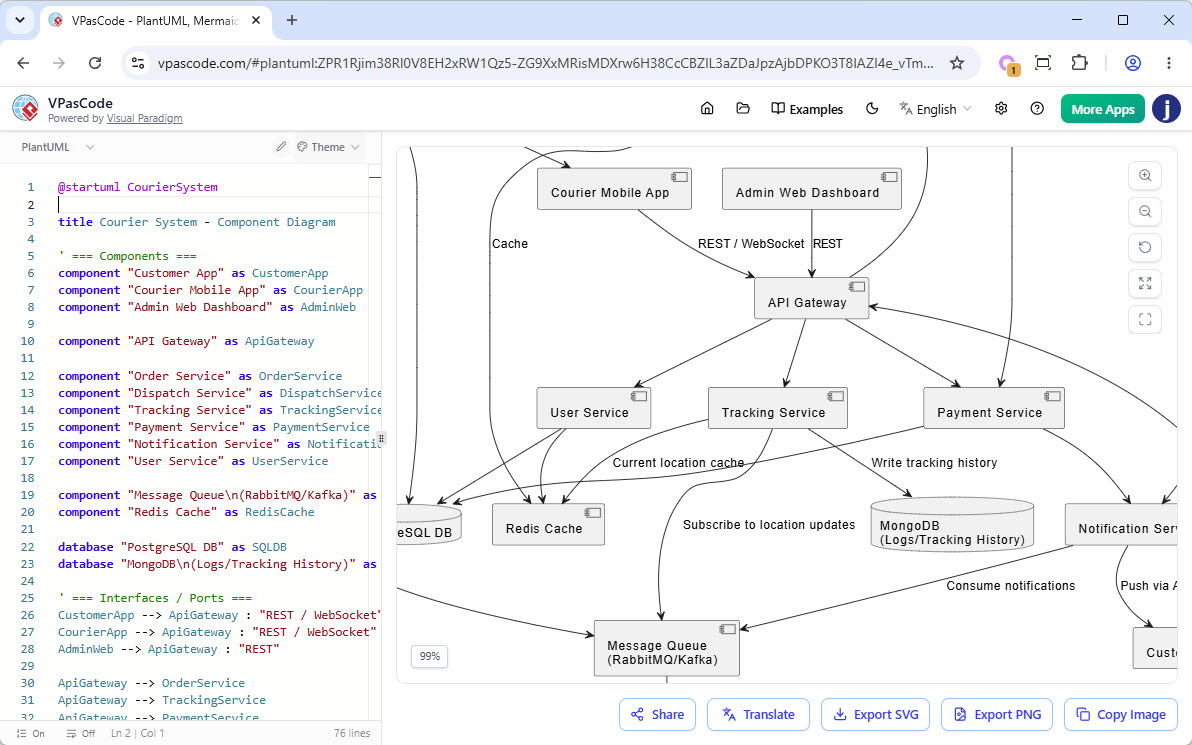
@startuml CourierSystem

title Courier System - Component Diagram

' === Components ===
component "Customer App" as CustomerApp
component "Courier Mobile App" as CourierApp
component "Admin Web Dashboard" as AdminWeb

component "API Gateway" as ApiGateway

component "Order Service" as OrderService
component "Dispatch Service" as DispatchService
component "Tracking Service" as TrackingService
component "Payment Service" as PaymentService
component "Notification Service" as NotificationService
component "User Service" as UserService

component "Message Queue\n(RabbitMQ/Kafka)" as MessageQueue
component "Redis Cache" as RedisCache

database "PostgreSQL DB" as SQLDB
database "MongoDB\n(Logs/Tracking History)" as MongoLogs

' === Interfaces / Ports ===
CustomerApp --> ApiGateway : "REST / WebSocket"
CourierApp --> ApiGateway : "REST / WebSocket"
AdminWeb --> ApiGateway : "REST"

ApiGateway --> OrderService
ApiGateway --> TrackingService
ApiGateway --> PaymentService
ApiGateway --> UserService

' === Service Dependencies ===
OrderService --> DispatchService : "gRPC / REST"
OrderService --> PaymentService
OrderService --> NotificationService
OrderService --> SQLDB : "JDBC"
OrderService --> RedisCache : "Cache"

DispatchService --> MessageQueue : "Publish events"
DispatchService --> CourierApp : "Push via API Gateway"
DispatchService --> SQLDB

TrackingService --> MessageQueue : "Subscribe to location updates"
TrackingService --> MongoLogs : "Write tracking history"
TrackingService --> RedisCache : "Current location cache"

PaymentService --> SQLDB
PaymentService --> NotificationService

NotificationService --> MessageQueue : "Consume notifications"
NotificationService --> CustomerApp : "Push via API Gateway"

UserService --> SQLDB
UserService --> RedisCache

' === Notes ===
note right of OrderService
  Handles parcel creation,
  pricing, and order status
end note

note right of DispatchService
  Matches orders with couriers,
  optimizes routes
end note

note bottom of MessageQueue
  Async events: order_created,
  location_updated,
  delivery_status_changed
end note

@enduml
Infrastructure as Code: Deployment Diagram
VPasCode also supports deployment diagrams, allowing teams to visualize physical infrastructure. This example shows an AWS architecture with Load Balancers, EC2 instances, and RDS databases.
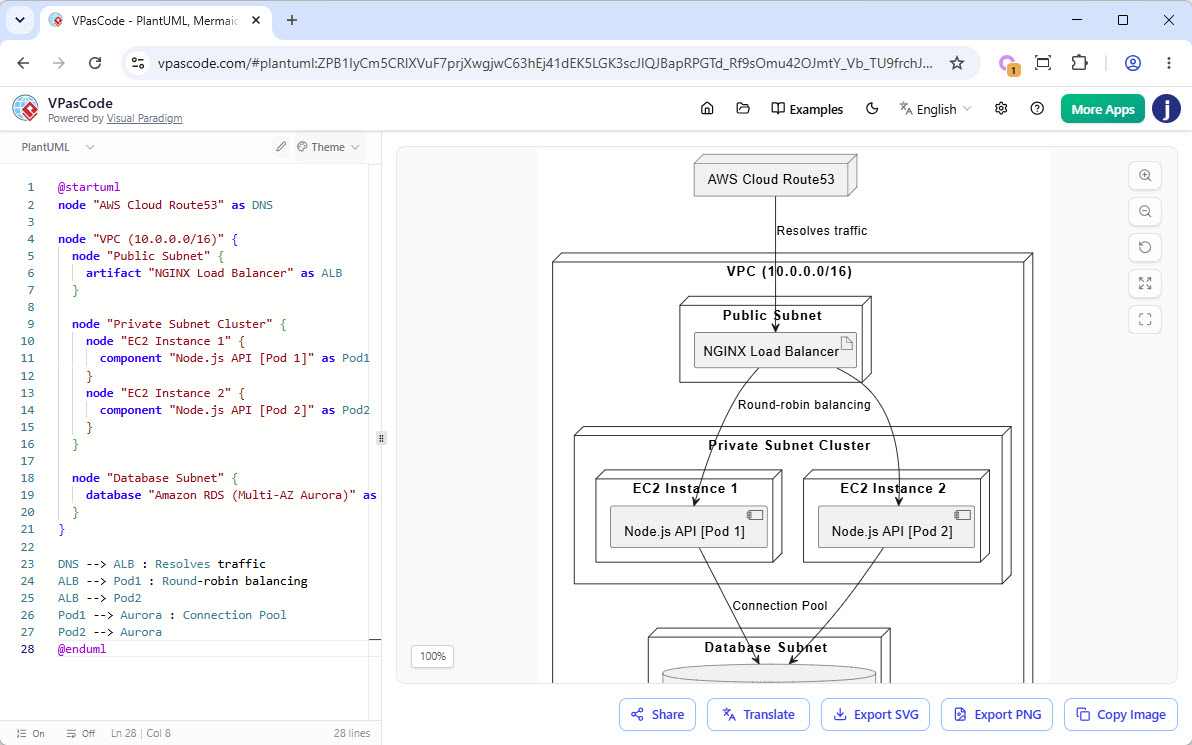
@startuml
node "AWS Cloud Route53" as DNS

node "VPC (10.0.0.0/16)" {
  node "Public Subnet" {
    artifact "NGINX Load Balancer" as ALB
  }

  node "Private Subnet Cluster" {
    node "EC2 Instance 1" {
      component "Node.js API [Pod 1]" as Pod1
    }
    node "EC2 Instance 2" {
      component "Node.js API [Pod 2]" as Pod2
    }
  }

  node "Database Subnet" {
    database "Amazon RDS (Multi-AZ Aurora)" as Aurora
  }
}

DNS --> ALB : Resolves traffic
ALB --> Pod1 : Round-robin balancing
ALB --> Pod2
Pod1 --> Aurora : Connection Pool
Pod2 --> Aurora
@enduml
Enterprise Architecture: ArchiMate Support
For enterprise architects, VPasCode supports ArchiMate notation, enabling the modeling of business, application, and technology layers. This example illustrates the interaction between business processes and underlying technology services in an internet browser context.
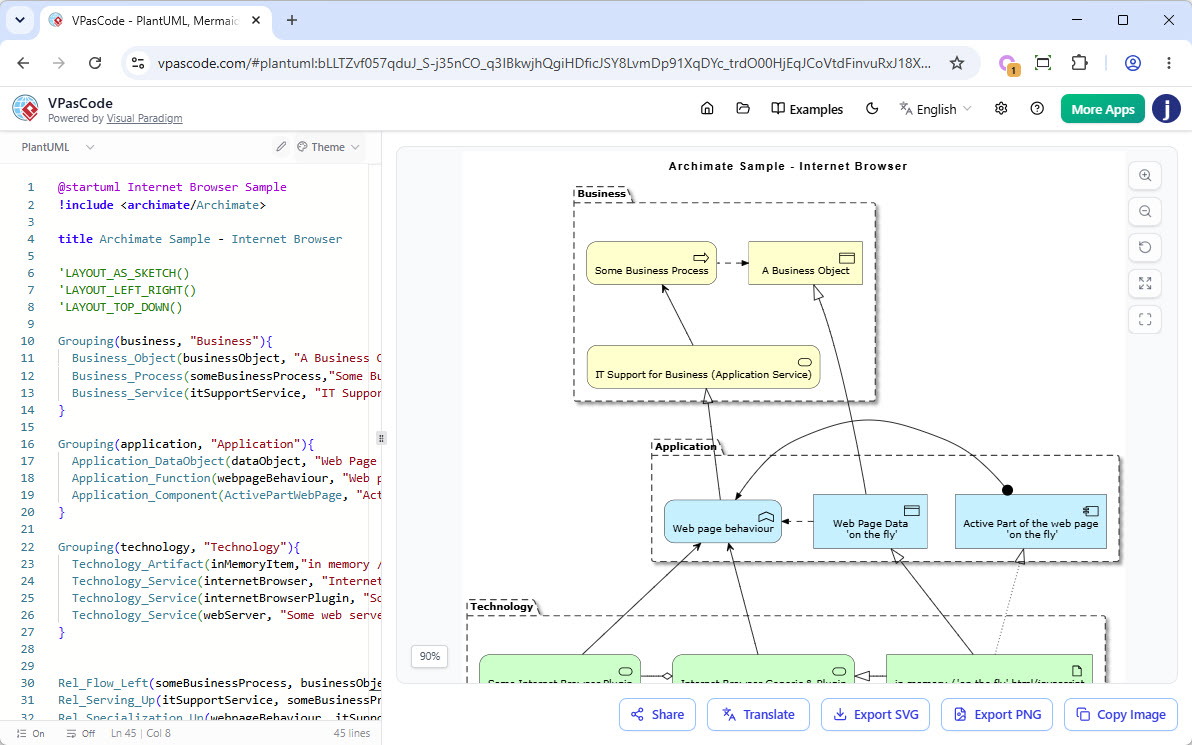
@startuml Internet Browser Sample
!include <archimate/Archimate>

title Archimate Sample - Internet Browser

'LAYOUT_AS_SKETCH()
'LAYOUT_LEFT_RIGHT()
'LAYOUT_TOP_DOWN()

Grouping(business, "Business"){
  Business_Object(businessObject, "A Business Object")
  Business_Process(someBusinessProcess,"Some Business Process")
  Business_Service(itSupportService, "IT Support for Business (Application Service)")
}

Grouping(application, "Application"){
  Application_DataObject(dataObject, "Web Page Data \n 'on the fly'")
  Application_Function(webpageBehaviour, "Web page behaviour")
  Application_Component(ActivePartWebPage, "Active Part of the web page \n 'on the fly'")
}

Grouping(technology, "Technology"){
  Technology_Artifact(inMemoryItem,"in memory / 'on the fly' html/javascript")
  Technology_Service(internetBrowser, "Internet Browser Generic & Plugin")
  Technology_Service(internetBrowserPlugin, "Some Internet Browser Plugin")
  Technology_Service(webServer, "Some web server")
}


Rel_Flow_Left(someBusinessProcess, businessObject, "")
Rel_Serving_Up(itSupportService, someBusinessProcess, "")
Rel_Specialization_Up(webpageBehaviour, itSupportService, "")
Rel_Flow_Right(dataObject, webpageBehaviour, "")
Rel_Specialization_Up(dataObject, businessObject, "")
Rel_Assignment_Left(ActivePartWebPage, webpageBehaviour, "")
Rel_Specialization_Up(inMemoryItem, dataObject, "")
Rel_Realization_Up(inMemoryItem, ActivePartWebPage, "")
Rel_Specialization_Right(inMemoryItem,internetBrowser, "")
Rel_Serving_Up(internetBrowser, webpageBehaviour, "")
Rel_Serving_Up(internetBrowserPlugin, webpageBehaviour, "")
Rel_Aggregation_Right(internetBrowser, internetBrowserPlugin, "")
Rel_Access_Up(webServer, inMemoryItem, "")
Rel_Serving_Up(webServer, internetBrowser, "")

@enduml
Data Modeling: Cinema Ticket ERD
Entity Relationship Diagrams (ERD) are crucial for database design. VPasCode supports both standard and Chen ERD notations. This example models a cinema ticket system, defining entities like Customer, Movie, Show, and Booking.
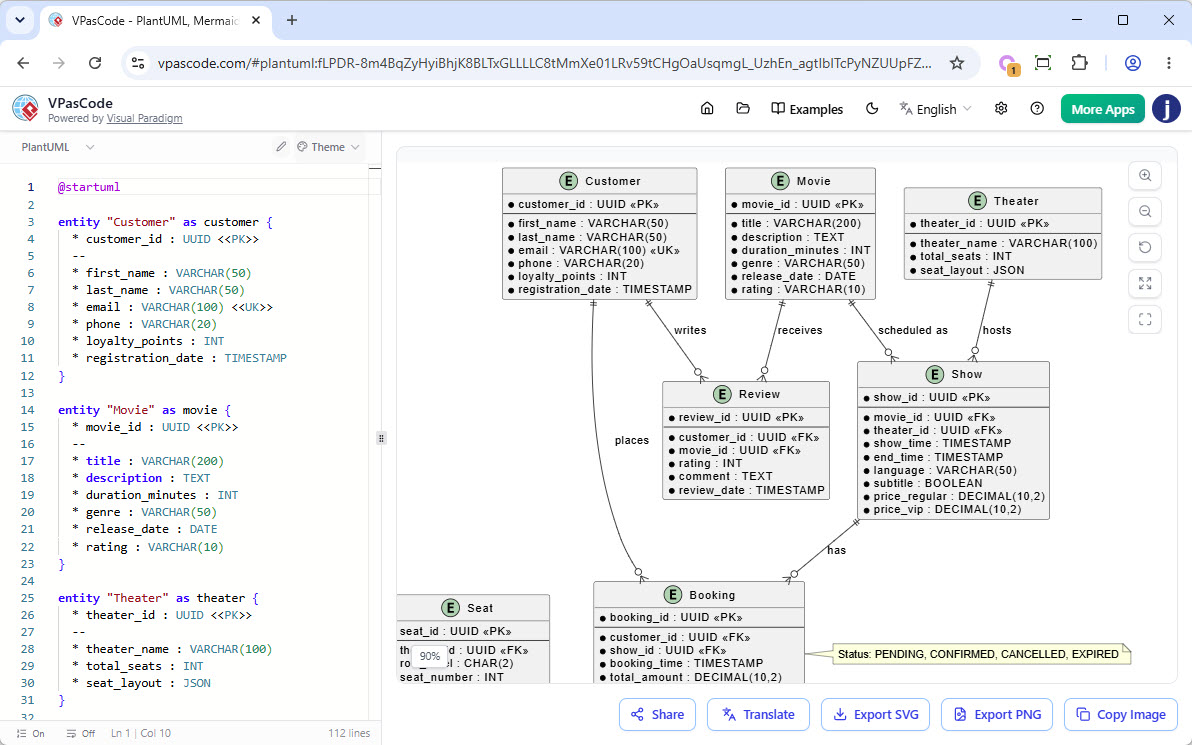
@startuml

entity "Customer" as customer {
  * customer_id : UUID <>
  --
  * first_name : VARCHAR(50)
  * last_name : VARCHAR(50)
  * email : VARCHAR(100) <>
  * phone : VARCHAR(20)
  * loyalty_points : INT
  * registration_date : TIMESTAMP
}

entity "Movie" as movie {
  * movie_id : UUID <>
  --
  * title : VARCHAR(200)
  * description : TEXT
  * duration_minutes : INT
  * genre : VARCHAR(50)
  * release_date : DATE
  * rating : VARCHAR(10)
}

entity "Theater" as theater {
  * theater_id : UUID <>
  --
  * theater_name : VARCHAR(100)
  * total_seats : INT
  * seat_layout : JSON
}

entity "Show" as show {
  * show_id : UUID <>
  --
  * movie_id : UUID <>
  * theater_id : UUID <>
  * show_time : TIMESTAMP
  * end_time : TIMESTAMP
  * language : VARCHAR(50)
  * subtitle : BOOLEAN
  * price_regular : DECIMAL(10,2)
  * price_vip : DECIMAL(10,2)
}

entity "Seat" as seat {
  * seat_id : UUID <>
  --
  * theater_id : UUID <>
  * row_label : CHAR(2)
  * seat_number : INT
  * seat_type : VARCHAR(20)
  * is_accessible : BOOLEAN
}

entity "Booking" as booking {
  * booking_id : UUID <>
  --
  * customer_id : UUID <>
  * show_id : UUID <>
  * booking_time : TIMESTAMP
  * total_amount : DECIMAL(10,2)
  * status : VARCHAR(20)
  * payment_method : VARCHAR(30)
  * transaction_id : VARCHAR(100)
}

entity "BookingSeat" as booking_seat {
  * booking_id : UUID <<FK,PK>>
  * seat_id : UUID <<FK,PK>>
  --
  * ticket_price : DECIMAL(10,2)
  * discount_applied : DECIMAL(10,2)
}

entity "Payment" as payment {
  * payment_id : UUID <>
  --
  * booking_id : UUID <>
  * amount : DECIMAL(10,2)
  * payment_date : TIMESTAMP
  * payment_status : VARCHAR(20)
  * payment_gateway : VARCHAR(30)
  * gateway_reference : VARCHAR(200)
}

entity "Review" as review {
  * review_id : UUID <>
  --
  * customer_id : UUID <>
  * movie_id : UUID <>
  * rating : INT
  * comment : TEXT
  * review_date : TIMESTAMP
}

' Relationships
customer ||--o{ booking : "places"
movie ||--o{ show : "scheduled as"
theater ||--o{ show : "hosts"
show ||--o{ booking : "has"
booking ||--|{ booking_seat : "contains"
seat ||--o{ booking_seat : "assigned to"
booking ||--|| payment : "has"
customer ||--o{ review : "writes"
movie ||--o{ review : "receives"

note right of booking : Status: PENDING, CONFIRMED, CANCELLED, EXPIRED
note left of seat : seat_type: REGULAR, VIP, COUPLES
note right of payment : payment_status: PENDING, SUCCESS, FAILED, REFUNDED

@enduml
Mermaid.js: Markdown-Friendly Diagrams
For teams that document heavily in Markdown (such as in GitHub READMEs or Confluence), Mermaid.js is the ideal choice. VPasCode renders Mermaid natively in the browser, supporting flowcharts, class diagrams, sequence diagrams, Gantt charts, mind maps, and more.
Healthcare Decision Flowchart
This flowchart guides patients through a healthcare decision-making process, from symptom recognition to treatment.
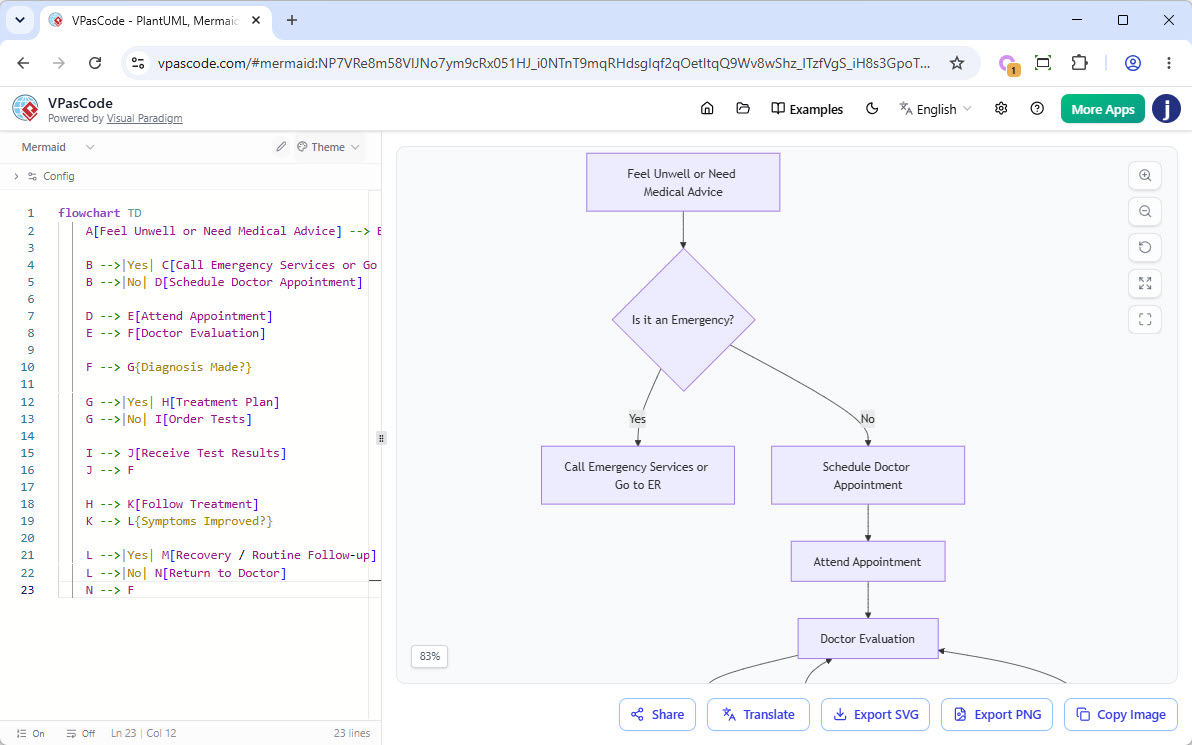
flowchart TD
    A[Feel Unwell or Need Medical Advice] --> B{Is it an Emergency?}

    B -->|Yes| C[Call Emergency Services or Go to ER]
    B -->|No| D[Schedule Doctor Appointment]

    D --> E[Attend Appointment]
    E --> F[Doctor Evaluation]

    F --> G{Diagnosis Made?}

    G -->|Yes| H[Treatment Plan]
    G -->|No| I[Order Tests]

    I --> J[Receive Test Results]
    J --> F

    H --> K[Follow Treatment]
    K --> L{Symptoms Improved?}

    L -->|Yes| M[Recovery / Routine Follow-up]
    L -->|No| N[Return to Doctor]
    N --> F
Graphviz: Network Topologies and Data Structures
Graphviz uses the DOT language to create complex graphs. It is particularly useful for visualizing network topologies, dependency trees, and data structures.
Data-Center Network Topology
This graph illustrates a simplified data-center network, showing hosts connected through interconnected switches with trunk links and failover connections.
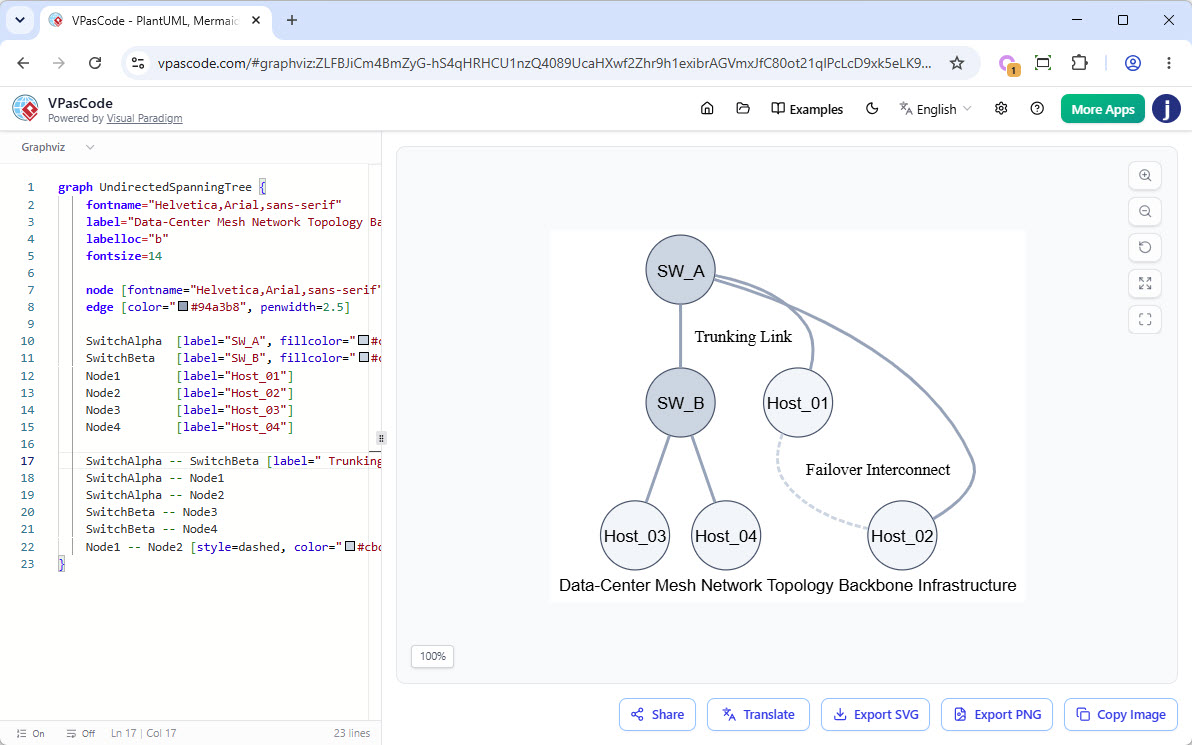
graph UndirectedSpanningTree {
    fontname="Helvetica,Arial,sans-serif"
    label="Data-Center Mesh Network Topology Backbone Infrastructure"
    labelloc="b"
    fontsize=14

    node [fontname="Helvetica,Arial,sans-serif", shape=circle, style=filled, color="#475569", fillcolor="#f1f5f9", width=0.8, fixedsize=true]
    edge [color="#94a3b8", penwidth=2.5]

    SwitchAlpha  [label="SW_A", fillcolor="#cbd5e1"]
    SwitchBeta   [label="SW_B", fillcolor="#cbd5e1"]
    Node1        [label="Host_01"]
    Node2        [label="Host_02"]
    Node3        [label="Host_03"]
    Node4        [label="Host_04"]

    SwitchAlpha -- SwitchBeta [label=" Trunking Link", weight=5]
    SwitchAlpha -- Node1
    SwitchAlpha -- Node2
    SwitchBeta -- Node3
    SwitchBeta -- Node4
    Node1 -- Node2 [style=dashed, color="#cbd5e1", label=" Failover Interconnect"]
}
AI-Native Automation: Supercharging Your Workflow
VPasCode isn’t just a text editor; it’s an AI-powered assistant. While the free tier provides essential multi-engine support, real-time preview, and flexible exports (PNG/SVG), the paid features unlock groundbreaking AI capabilities.
Key AI Features:
-
Natural Language to Diagram: Translate plain English architecture descriptions directly into clean, ready-to-render code scripts.
-
AI Code Error Fixing: Stuck on a syntax error? The built-in AI analyzes your PlantUML, Mermaid, or Graphviz code and fixes errors automatically.
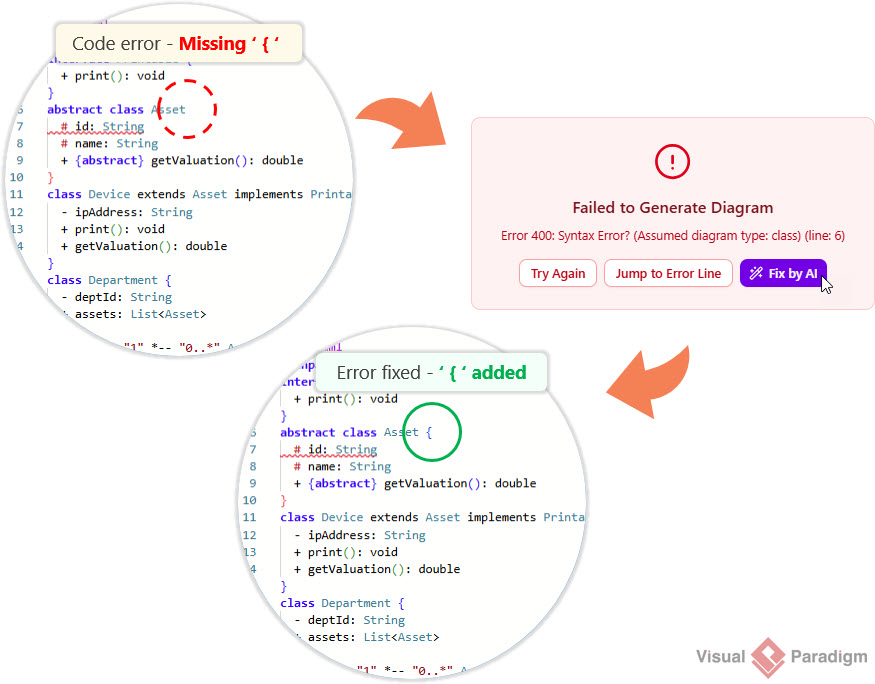
-
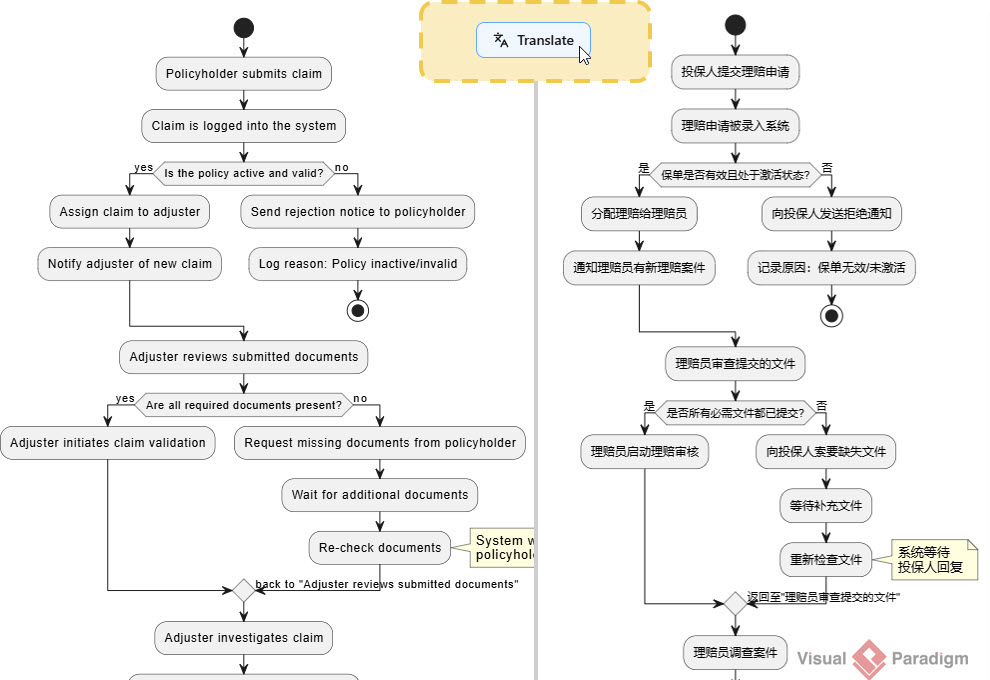
AI Diagram Translation: Seamlessly translate text and labels within your diagrams into multiple languages with a single click, keeping syntax structures intact.
Sharing and Collaboration
VPasCode makes sharing effortless. You can generate a unique, persistent web URL to share live diagrams with teammates or clients for collaborative reviews. For formal documentation, you can download your work as high-quality PNG images or scalable SVG vector graphics.
Accessing Premium Features
If you are an existing Visual Paradigm user, you may already have access to these premium AI features:
-
Visual Paradigm Online Combo Edition (or higher).
-
Visual Paradigm Desktop Professional Edition (or higher) with an active maintenance contract.
Note for Desktop Users: Visual Paradigm Professional Edition (or higher) users with active maintenance are automatically granted full access to the web apps of VP Online Combo Edition—which means you get instant access to VPasCode’s premium AI tools at no extra cost!
Tips and Tricks for Agile Teams
-
Version Control Your Diagrams: Since VPasCode outputs text, store your
.puml,.mmd, or.dotfiles in your Git repository. This allows you to track changes, revert mistakes, and review architecture evolution over time. -
Use Live Links for Standups: Instead of screenshotting diagrams for Slack or Teams, share the live VPasCode URL. Stakeholders can see the latest version without needing to download files.
-
Leverage AI for Boilerplate: Use the Natural Language to Diagram feature to quickly generate skeleton code for complex diagrams, then refine them manually. This saves time on syntax memorization.
-
Standardize Templates: Create reusable code snippets for common diagram types (e.g., AWS deployment templates, Microservice component diagrams) and share them across the team to ensure consistency.
-
Integrate with CI/CD: Because diagrams are code, you can integrate VPasCode exports into your CI/CD pipeline to automatically generate and publish updated architecture diagrams with every release.
Conclusion
VPasCode represents a significant leap forward for Agile teams seeking to bridge the gap between code and documentation. By unifying PlantUML, Mermaid.js, and Graphviz into a single, AI-enhanced platform, it eliminates the friction of traditional diagramming tools. For developers and architects who value speed, precision, and version control, VPasCode offers a seamless way to keep architectural documentation alive, accurate, and integrated into the development workflow. Whether you are modeling a simple user journey or a complex distributed system, VPasCode ensures that your diagrams evolve as rapidly as your code.
Reference
- Comprehensive Guide to VPasCode by Visual Paradigm: An in-depth overview of VPasCode’s core architecture, multi-engine unity, and AI-native automation features.
- Introducing VPasCode: The Ultimate Unified Text-to-Diagram Platform: The official release announcement detailing the launch of VPasCode and its support for PlantUML, Mermaid.js, and Graphviz.
- Clarity by Design: Streamlining Infrastructure Documentation with VPasCode and Graphviz: A guide focusing on using Graphviz within VPasCode for creating clear infrastructure and network topology diagrams.
- VPasCode Features: A summary of key features including real-time preview, easy sharing, and flexible exports.
- Mastering VPasCode: The Ultimate Guide to AI-Powered Diagram-as-Code with Multi-Engine Support: A comprehensive tutorial on leveraging AI features like error fixing and translation within VPasCode.
- Break Language Barriers Natively with VPasCode’s New AI Diagram Translation: An article explaining the AI diagram translation feature and how it localizes labels while preserving syntax.
- Visual Paradigm Online: The main portal for accessing Visual Paradigm’s online tools, including VPasCode.
- Never Get Stuck on Syntax Again: Introducing AI Code Error Fixing in VPasCode: A detailed look at the AI code error fixing functionality and how it helps developers resolve syntax issues instantly.
